Home / Puppies for Sale / German Shepherd Puppies / German Shepherd Health

German Shepherd Health

German Shepherd health: a guide for new owners

Typical lifespan10–12 years
Available German Shepherd puppies →

Puppy First, Health First

†NH, NY, RI, SC and TN residents excluded.

German Shepherd health overview

The big picture

Lifespan and outlook

10–12years

German Shepherds typically live 10–12 years.

Most German Shepherds whose hearts are checked get normal results. Like every breed, they have a few health problems that run in the family, and most are easier to manage when caught early.

Everyday habits

A few everyday habits do a lot of the work.

  • Keep your German Shepherd lean.
  • Learn the signs of bloat, book a checkup every year that covers the eyes and heart, and limit strong sun.

Common German Shepherd health conditions

Worth knowing

Each entry starts with a condition the breed is known to be prone to, then what you might notice and what helps.

This list is not exhaustive or official. Keep asking your veterinarian as your puppy grows.

01

Hips and elbows

Hip and elbow dysplasia are joints that develop abnormally as a puppy grows. Genes set the risk, but growth rate, weight and diet affect how severe it becomes.

What you might notice

Watch for front-leg limping in a young dog, or stiff hips and a bunny-hopping run.

What you can do

Feed measured meals of a large-breed puppy food, keep your dog lean and skip forced running while it grows. Hip and elbow X-rays can check the joints once your dog is grown.

02

Spine and hind legs (degenerative myelopathy)

Degenerative myelopathy is a slowly worsening spinal cord disease that makes the hind legs wobbly in older dogs.

What you might notice

Watch for scuffing or wobbling hind legs late in life.

What you can do

A cheek-swab DNA test shows a higher risk, not a diagnosis, and many at-risk dogs never develop it. In the senior years, ask your vet for walking and balance checks.

03

Weight loss (EPI)

Exocrine pancreatic insufficiency (EPI) is a pancreas problem that runs in German Shepherd families.

What you might notice

Watch for weight loss with large, pale stools.

What you can do

Tell your vet promptly, because the signs often show in young adults.

04

Eyes (pannus)

Pannus (chronic superficial keratitis) is an immune condition of the cornea, the clear front of the eye.

What you might notice

A cloudy or darkening patch on the eye is the sign to look for.

What you can do

Strong sunlight and high altitude make it worse, so limit strong sun. A yearly eye exam catches it early, usually in adulthood.

05

Sore skin under the tail (anal furunculosis)

Anal furunculosis (perianal fistula) is a long-lasting inflammation of the skin around the anus, mostly in middle-aged dogs.

What you might notice

Licking or soreness under the tail is the sign to watch for.

What you can do

It often responds to medicine that calms the immune system, so see your vet early.

Questions about a German Shepherd puppy?
Talk to a puppy concierge about your family — it's free. Daily, 9AM–11PM EST.

Less common conditions in the German Shepherd

Less common

Fibrotic myopathy scars and tightens the rear thigh muscles, mostly in males, so have any change in how your dog walks checked.

Bloat (gastric dilatation-volvulus) is an emergency in which the stomach fills with gas and can twist.

Some German Shepherds carry a gene change that makes certain drugs riskier, and a DNA test shows it.

Heart

The heart defect from birth most often reported in the breed is patent ductus arteriosus (PDA), which a vet hears as a murmur.

Heart

Poorly formed heart valves (tricuspid and mitral valve dysplasia) can also show up first as a murmur.

A cancer of the spleen (splenic hemangiosarcoma) is linked to the breed, so get pale gums or sudden weakness in an older dog checked fast.

Pituitary dwarfism shows as poor growth and a puppy coat that stays, and a DNA test confirms it.

Spine

A narrowing at the base of the spine (degenerative lumbosacral stenosis) can make a dog slow to jump, get up or climb stairs.

German Shepherd DNA tests

DNA tests

How it works

A cheek-swab DNA test works at any age and checks for several inherited conditions.

Possible results

Each result is clear (no copies of the gene change), carrier (one copy) or at risk (two copies).

Carrier result

A carrier is healthy.

At-risk result

An at-risk result means a higher chance, not a diagnosis. The Orthopedic Foundation for Animals (OFA) keeps the DNA results that owners send in. Among German Shepherds tested there for degenerative myelopathy, about 15 in 100 were at risk. This disease starts late, and many at-risk dogs never show signs. For your dog, an at-risk result is a reason for walking and balance checks in the senior years. A drug-sensitivity test shows whether your dog carries a gene change that makes some drugs riskier. Your vet can then choose medicines with care. Panels also test for two bleeding disorders, hemophilia A and canine Scott syndrome. Other tests cover day blindness and pituitary dwarfism, among others.

German Shepherd vet checkups

Checkups your dog will get

Puppy visits
  • At the first visits, your vet listens to the heart, checks the bite and compares your puppy's growth with its littermates.
  • A heart murmur heard at a puppy check is followed up with a heart scan (echocardiogram).
  • Your own vet completes the puppy vaccine series.
Young adult
  • Have any front-leg or shifting-leg limping checked while your dog is still growing.
  • Early hip and elbow X-rays are an option before your dog is fully grown.
Adult
  • Book a yearly exam that covers the eyes and heart, plus regular thyroid blood tests.
  • Hip and elbow X-rays show how the joints are doing once your dog is grown.
Senior
  • Older German Shepherds do best with a wellness visit, bloodwork and a urine test every 6 to 12 months.
  • Ask for walking and balance (gait) checks at each senior visit.

German Shepherd life stages

Care plan by life stage

Stage 1

8 weeks to 6 months

  • Feed a large-breed puppy growth diet.
  • Socialize widely in the first 3 months, with safe outings after the first vaccines.
  • Book a full puppy exam with a heart check, and consider a DNA panel by cheek swab.
  • Start crate, handling and grooming habits.
  • Watch the ears as they start to stand up, and watch for food coming back up (regurgitation), poor growth or limping.
Questions at any stage? Talk to a puppy concierge.(888) 729-8812
Stage 2

6 to 18 months

  • Keep the dog lean while it grows, and avoid forced, repetitive running until it has finished growing.
  • Discuss spay or neuter timing with your vet.
  • Consider early (preliminary) hip and elbow X-rays.
  • Keep up obedience training through adolescence.
  • Watch for front-leg or shifting-leg limping (elbow dysplasia, or panosteitis, sometimes called growing pains), hip stiffness or bunny-hopping.
Questions at any stage? Talk to a puppy concierge.(888) 729-8812
Stage 3

Adult (about 2 to 7 years)

  • Book hip and elbow X-rays once your dog is grown, plus yearly eye and heart checks and regular thyroid tests.
  • Keep a bloat plan: manage meals, know the emergency signs and discuss a preventive gastropexy.
  • Control weight to protect the joints.
  • Watch for a cloudy or pigmented cornea, licking or soreness under the tail, weight loss with large, pale stools, and signs of bloat.
Questions at any stage? Talk to a puppy concierge.(888) 729-8812
Stage 4

Senior (about 8 years and older)

  • Book senior wellness visits with bloodwork and urinalysis every 6–12 months.
  • Ask for nerve and walking (gait) checks.
  • Keep gentle daily exercise, such as walks and swimming.
  • Watch for hind-leg scuffing or wobbling, arthritis stiffness, and sudden weakness or collapse.
Questions at any stage? Talk to a puppy concierge.(888) 729-8812
1

8 weeks to 6 months

  • Feed a large-breed puppy growth diet.
  • Socialize widely in the first 3 months, with safe outings after the first vaccines.
  • Book a full puppy exam with a heart check, and consider a DNA panel by cheek swab.
  • Start crate, handling and grooming habits.
  • Watch the ears as they start to stand up, and watch for food coming back up (regurgitation), poor growth or limping.
2

6 to 18 months

  • Keep the dog lean while it grows, and avoid forced, repetitive running until it has finished growing.
  • Discuss spay or neuter timing with your vet.
  • Consider early (preliminary) hip and elbow X-rays.
  • Keep up obedience training through adolescence.
  • Watch for front-leg or shifting-leg limping (elbow dysplasia, or panosteitis, sometimes called growing pains), hip stiffness or bunny-hopping.
3

Adult (about 2 to 7 years)

  • Book hip and elbow X-rays once your dog is grown, plus yearly eye and heart checks and regular thyroid tests.
  • Keep a bloat plan: manage meals, know the emergency signs and discuss a preventive gastropexy.
  • Control weight to protect the joints.
  • Watch for a cloudy or pigmented cornea, licking or soreness under the tail, weight loss with large, pale stools, and signs of bloat.
4

Senior (about 8 years and older)

  • Book senior wellness visits with bloodwork and urinalysis every 6–12 months.
  • Ask for nerve and walking (gait) checks.
  • Keep gentle daily exercise, such as walks and swimming.
  • Watch for hind-leg scuffing or wobbling, arthritis stiffness, and sudden weakness or collapse.

German Shepherd Veterinary Health Report

What the Veterinary Health Report checks

What the exam covers →

The breeder's licensed vet checks your puppy before it goes home. The vet follows PetPay's exam standards, and the results go in your puppy's Veterinary Health Report.

  1. 1Puppies must be at least 8 weeks old and weigh at least 2 lb before they travel.
  2. 2If the vet finds something that could put your puppy at risk during travel, your puppy stays with the breeder until it's resolved.
  3. 3Problems that can be treated before travel are treated by the breeder's licensed vet first.
  4. 4Anything else the vet notes is shared with you.
PetPay Veterinary Health Report form

16 areas checked on the exam

Closer look for German ShepherdsOn every puppy's report
Closer look for German Shepherds
On every puppy's report
Heart Breathing Temperature, pulse and breathing rate Eyes Ears and hearing Mouth and bite Skin and coat Kneecaps Hips Hernias Soft spot on the skull Body condition and weight Reproductive organs History of vomiting or diarrhea Stool test for parasites Past surgery and notes
Closer look for German Shepherds
Focus

Heart

What the vet checks

The vet listens to the heart with a stethoscope for a murmur.

German Shepherd note

A murmur is often followed up with a heart scan (echocardiogram). The heart defect present from birth that is most often reported in German Shepherds is patent ductus arteriosus (PDA).

Focus

Bite and teeth

What the vet checks

The vet looks at how the upper and lower teeth meet (the bite) and at the teeth coming through.

German Shepherd note

Missing adult teeth can only be confirmed once the permanent teeth are in.

Focus

Growth

What the vet checks

The vet weighs the puppy and compares its size and growth with its littermates.

German Shepherd note

A German Shepherd puppy that grows much more slowly than its littermates and keeps its puppy coat is looked at more closely, and a DNA test can confirm pituitary dwarfism.

FocusHeart
What the vet checks

The vet listens to the heart with a stethoscope for a murmur.

German Shepherd note

A murmur is often followed up with a heart scan (echocardiogram). The heart defect present from birth that is most often reported in German Shepherds is patent ductus arteriosus (PDA).

FocusBite and teeth
What the vet checks

The vet looks at how the upper and lower teeth meet (the bite) and at the teeth coming through.

German Shepherd note

Missing adult teeth can only be confirmed once the permanent teeth are in.

FocusGrowth
What the vet checks

The vet weighs the puppy and compares its size and growth with its littermates.

German Shepherd note

A German Shepherd puppy that grows much more slowly than its littermates and keeps its puppy coat is looked at more closely, and a DNA test can confirm pituitary dwarfism.

Honest limits

Puppies grow and change quickly, and their immune systems are still developing, so no exam can find everything. The Veterinary Health Report is a strong early look at your puppy and a written starting point that your own vet builds on.

Once your puppy is home
  • At the first visits with your own vet, ask for heart, bite and weight checks, and plan a DNA panel that includes MDR1.
  • Your puppy's vaccination and deworming records are separate documents that travel with your puppy.
  • Bring them, with the Veterinary Health Report, to your first visit so your vet starts from the same record.
  • Before travel, every puppy follows PetPay's vaccination and deworming schedule as far as its age allows.
  • Bordetella and corona are given at the vet's discretion, and no vaccine is given within 3 days of travel.
  • Rabies is given by a licensed vet on the schedule your state requires.
  • Your own vet completes the series.
  • Once your German Shepherd is grown, hip and elbow X-rays, yearly eye and heart checks and regular thyroid tests show how it is doing.
  • In the senior years, ask for walking (gait) checks, because the signs of degenerative myelopathy usually start late in life.

German Shepherd puppy health guarantee

Health guarantee

Every Pawrade puppy comes with a health guarantee administered by PetPay, independent of the seller. The terms are on the health guarantee page.

Health guarantee terms →

Customers Love Us!

Ike, a German Shepherd puppy from PawradeIke · German Shepherd
★★★★★
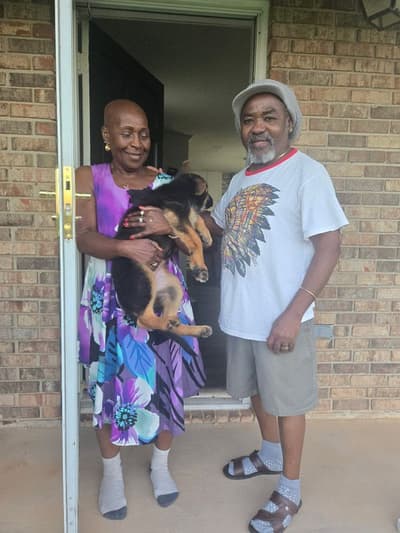
“Everything went nice and smooth.i just love my dog like thanks a million”
Vincent E. · Newnan, GAVerified

German Shepherd Puppies for Sale

Talk to a puppy concierge about your family — it's free. Daily, 9AM–11PM EST.
Popular searches
Need help finding a puppy?Call us at (888) 729-8812

Frequently asked questions about German Shepherd health

Frequently asked questions

The conditions that run in the breed are hip and elbow dysplasia, degenerative myelopathy, exocrine pancreatic insufficiency (EPI), anal furunculosis, pannus and fibrotic myopathy. A lean weight, a yearly exam that covers the eyes and heart, and knowing the signs of bloat help you stay ahead of them.

Hip dysplasia is one of the conditions the breed is known to be prone to, and it is not fixed at birth. Growth rate, body weight and diet affect how severe it becomes, so a large-breed puppy food and a lean puppy help.

Large, deep-chested breeds such as the German Shepherd have a higher risk of bloat (gastric dilatation-volvulus), and the risk rises with age. Restless pacing, retching that brings nothing up or a swollen belly is an emergency. Your vet can discuss a preventive stomach surgery (gastropexy).

Pannus is an immune condition of the cornea, the clear front of the eye, that strong sunlight and high altitude make worse. It usually appears in adulthood, so a yearly eye exam and less strong sun are the practical steps.

Degenerative myelopathy is a slowly worsening spinal cord disease of older dogs. A cheek-swab DNA test can be done at any age. An at-risk result does not mean the dog will develop it, and a carrier is healthy.

Cheek-swab DNA panels test for degenerative myelopathy, drug sensitivity, bleeding disorders such as hemophilia A, pituitary dwarfism and several other conditions. A carrier is healthy, and an at-risk result is a higher chance, not a diagnosis.

Some are, because some German Shepherds carry a gene change that makes certain drugs riskier. A cheek-swab or blood test shows whether a dog has it. Approved heartworm-preventive doses tested safe.

German Shepherds typically live 10–12 years. From about 8 years, senior wellness visits with bloodwork every 6–12 months help catch problems early.

Book senior wellness visits with bloodwork and a urine test, and ask for walking and balance checks. Keep gentle daily exercise, such as walks and swimming, and have hind-leg scuffing, sudden weakness or collapse checked promptly.

Keep your German Shepherd lean, book a yearly exam that covers the eyes and heart, and limit strong sun. Learn the signs of bloat, and avoid big meals and hard exercise around mealtimes.

German Shepherds are not a flat-faced breed, but the thick double coat copes only moderately well with heat. Exercise in the cooler hours on hot days, and never shave the coat, because it insulates the dog.

Sources56 references · 25 groups
AKC
  • 2026 · Puppy Growth Chart: When Does My Puppy Finish Growing?
  • Accessed 2026 · Official Standard of the German Shepherd Dog
  • 2021 · Puppy Training Timeline for Your German Shepherd Dog: From 8 Weeks to 2 Years
  • 2026 · How to Groom a German Shepherd Dog
German Shepherd Dog Club of America
  • 2026 · CHIC Program & Certificate - German Shepherd Dog Club of America
  • 2026 · Health & Genetics - German Shepherd Dog Club of America
  • 2026 · The Status & Predictability of Current Degenerative Myelopathy (DM) Testing - German Shepherd Dog Club of America
  • 2026 · Genetics of fibrotic myopathy in the German Shepherd Dog - German Shepherd Dog Club of America
Golden Retriever Club of America
  • 2015 · Elbow Dysplasia FAQs - Golden Retriever Club of America
OFA
  • 2021 · Browse By Breed | OFA
  • 2021 · Hip Dysplasia | OFA
  • 2021 · Elbow Dysplasia | OFA
  • 2021 · Degenerative Myelopathy | OFA
  • 2021 · Eye Certification | OFA
  • 2021 · Thyroid | OFA
  • ACVO Genetics Committee · Accessed 2026 · Ocular disorders presumed to be inherited in purebred dogs
  • 2021 · Cardiac Disease | OFA
  • 2021 · Disease Statistics by Breed | OFA
  • 2025 · Multiple Drug Sensitivity (MDR1) - OFA
Journal of Veterinary Internal Medicine
  • Zeng et al. · 2014 · Breed Distribution of SOD1 Alleles Previously Associated with Canine Degenerative Myelopathy · Journal of Veterinary Internal Medicine · PMID 24524809
  • Saunders et al. · 2013 · Long‐Term Outcome in Dogs with Patent Ductus Arteriosus: 520 Cases (1994–2009) · Journal of Veterinary Internal Medicine · PMID 24372855
Journal of veterinary internal medicine
  • Westermarck et al. · 2010 · Heritability of exocrine pancreatic insufficiency in German Shepherd dogs. · Journal of veterinary internal medicine · PMID 20102502
  • Batchelor et al. · 2007 · Breed associations for canine exocrine pancreatic insufficiency. · Journal of veterinary internal medicine · PMID 17427378
American journal of veterinary research
  • Moeller et al. · 2002 · Inheritance of pancreatic acinar atrophy in German Shepherd Dogs. · American journal of veterinary research · PMID 12371772
  • Killingsworth et al. · 1988 · Bacterial population and histologic changes in dogs with perianal fistula. · American journal of veterinary research · PMID 3189990
Tissue antigens
  • Kennedy et al. · 2008 · Risk of anal furunculosis in German shepherd dogs is associated with the major histocompatibility complex. · Tissue antigens · PMID 17999655
Journal of the American Animal Hospital Association
  • Harkin et al. · 1996 · Association of perianal fistula and colitis in the German shepherd dog: response to high-dose prednisone and dietary therapy. · Journal of the American Animal Hospital Association · PMID 8906729
PLoS ONE
  • Brambilla et al. · 2020 · Epidemiological study of congenital heart diseases in dogs: Prevalence, popularity, and volatility throughout twenty years of clinical practice · PLoS ONE · PMID 32716943
  • Oberbauer et al. · 2017 · Long-term genetic selection reduced prevalence of hip and elbow dysplasia in 60 dog breeds · PLoS ONE · PMID 28234985
Prev Vet Med
  • Ward et al. · 2003 · Benefits of prophylactic gastropexy for dogs at risk of gastric dilatation-volvulus. · Prev Vet Med · PMID 12941556
Veterinary surgery : VS
  • Danielsson and Sjöström · 1999 · Surgical treatment of degenerative lumbosacral stenosis in dogs. · Veterinary surgery : VS · PMID 10100762
Veterinary and comparative orthopaedics and traumatology : V.C.O.T
  • Suwankong et al. · 2008 · Review and retrospective analysis of degenerative lumbosacral stenosis in 156 dogs treated by dorsal laminectomy. · Veterinary and comparative orthopaedics and traumatology : V.C.O.T · PMID 18536857
Journal of the American Veterinary Medical Association
  • Morgan et al. · 1993 · Lumbosacral transitional vertebrae as a predisposing cause of cauda equina syndrome in German shepherd dogs: 161 cases (1987-1990). · Journal of the American Veterinary Medical Association · PMID 8320160
Scientific Reports
  • Hall et al. · 2020 · Incidence and risk factors for heat-related illness (heatstroke) in UK dogs under primary veterinary care in 2016 · Scientific Reports · PMID 32555323
VCA Animal Hospitals
  • Accessed 2026 · German Shepherd | VCA Animal Hospitals
  • 2023 · Panosteitis in Dogs | VCA Animal Hospitals
  • Accessed 2026 · Puppy Growth and Maturity| VCA Animal Hospitals
  • 2023 · Hip Dysplasia in Dogs | VCA Animal Hospitals
  • 2024 · Atrioventricular Valve Dysplasia in Dogs | VCA Animal Hospitals
OMIA (University of Sydney)
  • 2026 · OMIA:000263-9615: Degenerative myelopathy in Canis lupus familiaris (dog) - OMIA - Online Mendelian Inheritance in Animals
  • 2026 · OMIA:001402-9615: Multidrug resistance 1, ABCB1-related in Canis lupus familiaris (dog) - OMIA - Online Mendelian Inheritance in Animals
  • 2026 · OMIA:002314-9615: Pituitary hormone deficiency, LHX3-related in Canis lupus familiaris (dog) - OMIA - Online Mendelian Inheritance in Animals
  • 2026 · OMIA:000437-9615: Haemophilia A in Canis lupus familiaris (dog) - OMIA - Online Mendelian Inheritance in Animals
  • 2026 · OMIA:001353-9615: Scott syndrome in Canis lupus familiaris (dog) - OMIA - Online Mendelian Inheritance in Animals
  • 2026 · OMIA:001481-9615: Achromatopsia-2, CNGA3-related in Canis lupus familiaris (dog) - OMIA - Online Mendelian Inheritance in Animals
Merck Veterinary Manual
  • 2025 · Gastric Dilation and Volvulus in Small Animals - Digestive System - Merck Veterinary Manual
  • 2024 · Juvenile-Onset Panhypopituitarism in Dogs - Endocrine System - Merck Veterinary Manual
  • 2025 · Dysplasia and Stenosis of Atrioventricular Valves in Animals - Circulatory System - Merck Veterinary Manual
Washington State University (Program in Individualized Medicine / WADDL)
  • Accessed 2026 · Dog breeds commonly affected by MDR1 mutation | Program in Individualized Medicine | Washington State University
AAHA
  • 2019 · Behavior
  • 2024 · White feet don’t treat: Considerations for dogs with MDR1 mutations
The Kennel Club (UK)
  • Accessed 2026 · German Shepherd Dog | Breeds A to Z | The Kennel Club
Wisdom Panel / Mars Petcare
  • 2020 · German Shepherd Dog Facts - Wisdom Panel™ Dog Breeds
Embark Veterinary
  • Accessed 2026 · German Shepherd Dog
Orivet Genetic Pet Care
  • Accessed 2026 · German Shepherd Dog - Full Breed Profile
AVSAB
  • Accessed 2026 · AVSAB Position Statement
See German Shepherd puppies