Home / Puppies for Sale / Great Dane Puppies / Great Dane Health

Great Dane Health

Great Dane health: a guide for new owners

Typical lifespan7–10 years
Available Great Dane puppies →

Puppy First, Health First

†NH, NY, RI, SC and TN residents excluded.

Great Dane health overview

The big picture

Lifespan and outlook

7–10years

Great Danes typically live 7–10 years.

Most Danes whose hearts are checked for defects present from birth get normal results. Several of the breed's health problems can be screened for, and others have simple everyday steps that lower the risk.

Everyday habits

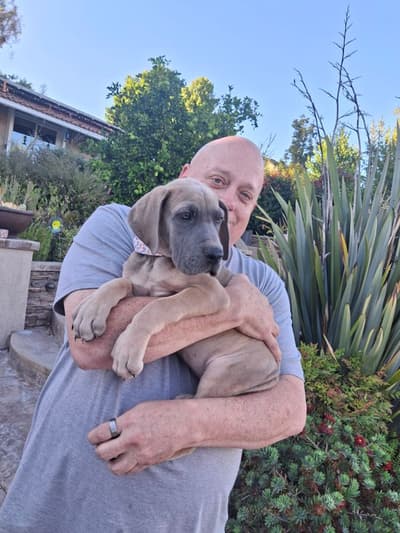
A few everyday habits do a lot of the work.

  • Feed smaller meals with rest before and after them, so bloat is less likely.
  • Keep your puppy lean on a large-breed puppy food.
  • Once grown, a Dane needs regular heart checks.

This page brings together what the research shows about Great Dane health.

It covers the conditions the breed is known to be prone to, screening and DNA results, what to watch for and a care plan for each life stage.

Common Great Dane health conditions

Worth knowing

Each entry below is a condition Great Danes are known to be prone to, with what you might notice and what helps.

This list is not exhaustive or official. Keep asking your veterinarian as your puppy grows.

01

Bloat (GDV)

Bloat, or gastric dilatation-volvulus (GDV), is when the stomach fills with gas and can twist.

What you might notice

It is a true emergency, so a Dane that might have bloat needs a vet right away.

What you can do

Feed two or more smaller meals a day at set times, and slow down a fast eater. Let your Dane rest before and after meals. Ask your vet about a gastropexy, a preventive surgery that tacks the stomach in place and can be done at spay or neuter.

02

Heart

Dilated cardiomyopathy (DCM) is a disease of the heart muscle that runs in the breed.

What you might notice

It usually starts in adulthood, and many dogs show no signs for years.

What you can do

Once your Dane is an adult, your vet can arrange a heart ultrasound (echocardiogram) with a heart specialist. A normal result does not rule out DCM later, so the check is repeated over the dog's life.

03

Neck and spine

In Wobbler syndrome, malformed bones in the neck press on the spinal cord.

What you might notice

The first sign is often a wobbly, unsteady walk in a young Dane.

What you can do

There is no screening test, so see your vet if your Dane's walk looks unsteady. A scan of the neck shows what is going on.

04

Hips

In hip dysplasia, the hip joint forms poorly as a puppy grows.

What you might notice

Limping in a growing Dane is always worth a vet check, and X-rays show how the hips formed.

What you can do

Keep your puppy lean on a large-breed puppy food, with no calcium supplements. Hold off hard exercise and regular running until your Dane is fully grown.

05

Bone cancer

Great Danes are more likely than most dogs to get bone cancer of the legs, called osteosarcoma.

What you might notice

It usually shows up in older dogs as leg pain or lameness.

What you can do

Have any lameness or leg pain in an older Dane checked promptly. Book vet checks more often as your Dane gets older.

06

Eyes

Danes can get cataracts, a clouding of the lens, and entropion, where the eyelid rolls inward and the lashes rub the eye.

What you might notice

Watch for squinting, a watery eye or a cloudy look to the lens.

What you can do

Your vet checks the eyelids at routine visits. Once your Dane is grown, book a yearly exam with a veterinary eye specialist.

Questions about a Great Dane puppy?
Talk to a puppy concierge about your family — it's free. Daily, 9AM–11PM EST.

Less common conditions in the Great Dane

Less common

Some young Danes get growing pains (panosteitis), which cause limping and usually settle on their own.

Hypertrophic osteodystrophy (HOD) is a more serious bone problem of fast growth that causes painful, swollen legs.

An underactive thyroid (hypothyroidism) is often caused by the immune system attacking the gland, and a blood test finds it.

Ectropion, a lower eyelid that droops outward, is also seen in the breed.

Eyes

Cherry eye, where a gland in the third eyelid slips out of place, is seen in Great Danes.

The merle gene, which harlequins also carry, is linked to deafness, and a hearing test (BAER) gives a clear answer.

Inherited myopathy of Great Danes (IMGD) is a muscle disease that causes weakness, and a DNA test can find it.

Skin

Great Dane-type ichthyosis is an inherited skin disease that leaves the skin dry and scaly, and a DNA test can find it.

Great Dane DNA tests

DNA tests

How it works

A cheek swab can test for a few inherited conditions in Great Danes, such as the muscle disease IMGD and Great Dane-type ichthyosis.

Possible results

Each result comes back as clear, carrier or at risk. Clear means the test found no copy of the gene change. A carrier has one copy and stays healthy. At risk means a higher chance of the condition, not a diagnosis, and an at-risk dog may never develop it or may develop it late. Color tests can also show which coat color genes a dog carries.

Great Dane vet checkups

Checkups your dog will get

Puppy visits
  • At the first visit, your vet listens to the heart and checks the eyelids.
  • For a merle or harlequin puppy, ask about a hearing test.
  • Your own vet completes the vaccine series that the breeder started.
Growing up
  • Your vet keeps an eye on growth, weight and the way your puppy walks.
  • This is a good time to talk about spaying or neutering, and about a gastropexy at the same time.
Adult
  • Book a yearly eye exam with a veterinary eye specialist.
  • Ask your vet about regular heart ultrasounds and thyroid checks.
  • Keep feeding at least two meals a day, with no hard exercise around them.
Senior
  • Older Danes need more frequent vet checks of the heart, legs and mobility.
  • Have any new lameness or leg pain checked promptly.

Great Dane life stages

Care plan by life stage

Stage 1

8 weeks to 6 months

  • Feed a large-breed puppy food for lean growth, in three or four meals a day.
  • Keep up the vaccine series, join a puppy class, and use a crate.
  • No forced exercise and no stairs.
  • Watch for limping, which can mean panosteitis or hypertrophic osteodystrophy, and for a wobbly gait.
  • Talk to your vet about gastropexy timing alongside spay or neuter.
Questions at any stage? Talk to a puppy concierge.(888) 729-8812
Stage 2

6 to 18 months

  • Move to two meals a day, and keep the dog lean on large-breed food until it is full grown at 12–18 months.
  • Build exercise up gradually, and continue basic obedience.
  • Preliminary hip X-rays (PennHIP or OFA) are optional at this age.
  • Plan spay or neuter timing with a vet experienced with giant breeds.
Questions at any stage? Talk to a puppy concierge.(888) 729-8812
Stage 3

Adult (about 2 to 6 years)

  • Feed twice a day, avoid hard exercise around meals, and learn the signs of bloat.
  • Book baseline hip X-rays, then a heart ultrasound and a thyroid test every 1–3 years, and an eye exam every year.
Questions at any stage? Talk to a puppy concierge.(888) 729-8812
Stage 4

Senior (from about 6 to 7 years)

  • Book more frequent vet checks for the heart, limb pain or lameness, and mobility.
  • Bloat risk rises with age, so keep the meal routine going.
Questions at any stage? Talk to a puppy concierge.(888) 729-8812
1

8 weeks to 6 months

  • Feed a large-breed puppy food for lean growth, in three or four meals a day.
  • Keep up the vaccine series, join a puppy class, and use a crate.
  • No forced exercise and no stairs.
  • Watch for limping, which can mean panosteitis or hypertrophic osteodystrophy, and for a wobbly gait.
  • Talk to your vet about gastropexy timing alongside spay or neuter.
2

6 to 18 months

  • Move to two meals a day, and keep the dog lean on large-breed food until it is full grown at 12–18 months.
  • Build exercise up gradually, and continue basic obedience.
  • Preliminary hip X-rays (PennHIP or OFA) are optional at this age.
  • Plan spay or neuter timing with a vet experienced with giant breeds.
3

Adult (about 2 to 6 years)

  • Feed twice a day, avoid hard exercise around meals, and learn the signs of bloat.
  • Book baseline hip X-rays, then a heart ultrasound and a thyroid test every 1–3 years, and an eye exam every year.
4

Senior (from about 6 to 7 years)

  • Book more frequent vet checks for the heart, limb pain or lameness, and mobility.
  • Bloat risk rises with age, so keep the meal routine going.

Great Dane vet costs

Planning for Great Dane vet costs

These are typical published costs for treating what a Great Dane vet exam looks at and the conditions the breed is known to be prone to. Each range shows where it comes from and when, and your own vet's estimate will differ.

On the exam Eyes
Eyes: typical published costs
ItemTypical costPerSourceYear
Specialist's first exam (consultation fee only)$198–$350per visitat US veterinary teaching hospitals (Michigan, Missouri, Tennessee)2023–2026
Eye tests before cataract surgery (ERG and eye ultrasound)$500–$1,300per workupat US veterinary teaching hospitals (Missouri, Tennessee)2025–2026
Cataract surgery, one eye$3,800–$5,500per eyeat one US veterinary teaching hospital (Missouri)2023–2025
Cataract surgery, both eyes under one anesthetic$5,600–$6,700at one US veterinary teaching hospital (Missouri)2025
See it in the exam →
Pet insurance is highly recommended.Insurance options ↓

Great Dane pet insurance

Planning for pet insurance

When you are ready to compare plans, here is one option for Pawrade buyers.

MetLife Pet Insurance

MetLife Pet Insurance · 1 month included with every puppy†

Only with Pawrade, you receive a pet insurance policy with no waiting period included for immediate accident or illness coverage, 1 month, with every puppy.† You activate it by calling MetLife; instructions arrive with your travel details. Continuing MetLife coverage after the first month is strongly recommended.

View the MetLife 30-day offer →

†NH, NY, RI, SC and TN residents excluded. Activated by calling MetLife; coverage begins immediately following policy activation. See the offer for full terms.

Whichever plan you look at, read the policy before you buy. Check the waiting periods, how it defines a pre-existing condition, and its deductible, reimbursement percentage and annual limit.

Waiting periods, compared

A waiting period is how long after you buy a pet insurance policy before a claim counts.

Waiting periods, compared
Policy Accidents Illness Joints
MetLife policy included with your Pawrade puppy† None None None
MetLife, bought directly None 14 days Not listed
Industry standard 0–14 days 14–30 days 6–12 months
Nationwide 14 days 14 days Not listed
Trupanion 5 days 30 days 30 days
Embrace 2 days 14 days 6 months
Figo 1 day 14 days Not listed
Waiting periods vary by state; your policy governs. NerdWallet, "Pet Insurance Waiting Periods", 2025 Trupanion, "When does my coverage begin?", as posted 2026 MetLife Pet Insurance, "30-day offer", 2025

Great Dane Veterinary Health Report

What the Veterinary Health Report checks

What the exam covers →

The breeder's licensed vet checks your puppy before it goes home. The vet follows PetPay's exam standards, and the results go in your puppy's Veterinary Health Report.

  1. 1Puppies must be at least 8 weeks old and weigh at least 2 lb before they travel.
  2. 2If the vet finds something that could put your puppy at risk during travel, your puppy stays with the breeder until it's resolved.
  3. 3Problems that can be treated before travel are treated by the breeder's licensed vet first.
  4. 4Anything else the vet notes is shared with you.
PetPay Veterinary Health Report form

16 areas checked on the exam

Closer look for Great DanesOn every puppy's report
Closer look for Great Danes
On every puppy's report
Heart Breathing Temperature, pulse and breathing rate Eyes Ears and hearing Mouth and bite Skin and coat Kneecaps Hips Hernias Soft spot on the skull Body condition and weight Reproductive organs History of vomiting or diarrhea Stool test for parasites Past surgery and notes
Closer look for Great Danes
Focus

Heart

What the vet checks

The vet listens to the heart for a murmur or an irregular rhythm.

Great Dane note

Heart muscle disease (dilated cardiomyopathy) in Great Danes usually appears in adulthood, so this first listen is a starting point for later heart checks.

Focus

Eyes

What the vet checks

The vet checks both eyes, including for cherry eye, where a gland at the inner corner of the eye slips out of place.

Great Dane note

Entropion, an eyelid that rolls inward, runs in the breed, so eyelids that roll in or droop outward are something to watch for as your puppy grows.

Focus

Hearing

What the vet checks

In harlequin and merle puppies, the vet checks how the puppy responds to sound.

Great Dane note

The merle gene seen in harlequins is linked to deafness, and a BAER hearing test gives a definite answer.

Focus

Body condition and weight

What the vet checks

The vet weighs the puppy and scores its body condition, because lean growth is the aim.

Great Dane note

A lean puppy on a large-breed puppy food, with no extra calcium or other supplements, gives growing joints the best start. Take any limping to your vet. Wobbler syndrome has no screening test, so keep an eye on your young Dane's walk as it grows.

FocusHeart
What the vet checks

The vet listens to the heart for a murmur or an irregular rhythm.

Great Dane note

Heart muscle disease (dilated cardiomyopathy) in Great Danes usually appears in adulthood, so this first listen is a starting point for later heart checks.

FocusEyes
What the vet checks

The vet checks both eyes, including for cherry eye, where a gland at the inner corner of the eye slips out of place.

Great Dane note

Entropion, an eyelid that rolls inward, runs in the breed, so eyelids that roll in or droop outward are something to watch for as your puppy grows.

FocusHearing
What the vet checks

In harlequin and merle puppies, the vet checks how the puppy responds to sound.

Great Dane note

The merle gene seen in harlequins is linked to deafness, and a BAER hearing test gives a definite answer.

FocusBody condition and weight
What the vet checks

The vet weighs the puppy and scores its body condition, because lean growth is the aim.

Great Dane note

A lean puppy on a large-breed puppy food, with no extra calcium or other supplements, gives growing joints the best start. Take any limping to your vet. Wobbler syndrome has no screening test, so keep an eye on your young Dane's walk as it grows.

Honest limits

Puppies grow and change quickly, and their immune systems are still developing, so no exam can find everything. The Veterinary Health Report is a strong early look at your puppy and a written starting point that your own vet builds on.

Once your puppy is home
  • Your puppy's vaccination and deworming records are separate documents that travel with your puppy.
  • Bring them, with the Veterinary Health Report, to your first visit so your vet starts from the same record.
  • Before travel, every puppy follows PetPay's vaccination and deworming schedule as far as its age allows.
  • Bordetella and corona are given at the vet's discretion, and no vaccine is given within 3 days of travel.
  • Rabies is given by a licensed vet on the schedule your state requires.
  • Your own vet completes the series.
  • Join a puppy class as your vet advises, and hold off forced exercise and stairs while your Dane grows.
  • Heart ultrasounds by a veterinary cardiologist start in adulthood and are repeated regularly.
  • As an adult, a yearly eye exam and regular heart and thyroid checks keep your Great Dane's care on track.

Great Dane puppy health guarantee

Health guarantee

Every Pawrade puppy comes with a health guarantee administered by PetPay, independent of the seller. The terms are on the health guarantee page.

Health guarantee terms →

Customers Love Us!

Venus, a Great Dane puppy from PawradeVenus · Great Dane
★★★★★
“Couldn't have been better! Tracking via the app was amazing, great communications throughout the drive. The team nailed the arrival time, and the puppy was super excited and full of energy to get out of the van! Thanks so much!”
Mathew B. · Mission Viejo, CAVerified

Great Dane Puppies for Sale

Talk to a puppy concierge about your family — it's free. Daily, 9AM–11PM EST.
Popular searches
Need help finding a puppy?Call us at (888) 729-8812

Frequently asked questions about Great Dane health

Frequently asked questions

The conditions the breed is known to be prone to are bloat (gastric dilatation-volvulus), a heart muscle disease called dilated cardiomyopathy, Wobbler syndrome, hip dysplasia, bone cancer (osteosarcoma), cataract and entropion. Sensible feeding, lean growth and regular heart and eye checks help you stay ahead of them.

Great Danes are known to be prone to bloat (gastric dilatation-volvulus), an emergency in which the stomach fills with gas and can twist. In a US study that followed 11 large and giant breeds at high risk, Great Danes among them, about 6 in 100 dogs developed bloat. Several smaller meals a day, rest around mealtimes and slowing down a fast eater all help. Your vet can discuss a preventive gastropexy, which is often done at the same time as spay or neuter.

Dilated cardiomyopathy (DCM), a disease of the heart muscle, is one of the conditions the breed is known to be prone to. In a UK study that screened 107 Great Danes, about 1 in 3 had DCM. It usually starts in adulthood, so a heart ultrasound (echocardiogram) by a cardiologist is repeated over the dog's life. Heart defects present from birth are uncommon in Danes checked by the Orthopedic Foundation for Animals (OFA).

Wobbler syndrome is a malformation of the neck bones that presses on the spinal cord and makes the walk unsteady. There is no screening test, so watch your young Dane's gait and see your vet if it looks wobbly.

Some do, because entropion, an eyelid that rolls inward, is one of the conditions the breed is known to be prone to. Ectropion, a drooping lower eyelid, is also seen in the breed, and your vet can check the eyelids at routine visits.

They can, because the merle gene, which harlequins also carry, is linked to deafness. A hearing test called BAER gives a definite result for a merle or harlequin puppy.

Cheek-swab tests cover a muscle disease called inherited myopathy of Great Danes (IMGD), a skin disease called Great Dane-type ichthyosis, degenerative myelopathy and leukoencephalomyelopathy, plus coat color genes. No DNA test covers Wobbler syndrome, which has no screening test at all.

A carrier has one copy of the gene change and is healthy. An at-risk result means a higher chance, not a diagnosis, and an at-risk dog may never develop the condition, or may develop it late.

Great Danes typically live 7–10 years. Regular vet checks of the heart, legs and mobility become more important as a Dane gets older.

Have any limb pain or lameness checked promptly, because bone cancer (osteosarcoma) is more common in older Danes. Bloat risk also rises with age, so keep the routine of smaller meals with rest around them.

It is worth asking, because a gastropexy, a surgery that tacks the stomach in place, should prevent the life-threatening twist in bloat. Most forms can be done with keyhole surgery, and it can be done at the same time as spay or neuter.

That is a decision to make with your own vet, because it depends on things like your dog's sex and expected adult size. Ask about a gastropexy at the same time.

Keep your puppy lean on a large-breed puppy food, with no calcium or vitamin supplements. Limit stairs, jumping and rough play, and wait until your Dane is fully grown before regular running.

Sources33 references · 20 groups
AKC
  • 2026 · Great Dane Facts You May Not Know
  • 2017 · Great Dane
Great Dane Club of America
  • Accessed 2026 · Health And Research
  • Accessed 2026 · Great Dane Puppy Information
Great Dane Breed Council (UK)
  • Accessed 2026 · Dilated Cardiomyopathy in Great Danes – Great Dane Breed Council
  • Accessed 2026 · WOBBLERS – Great Dane Breed Council
OFA
  • 2021 · Cardiac Disease | OFA
  • 2021 · Browse By Breed | OFA
  • 2021 · Disease Statistics by Breed | OFA
  • 2021 · Hip Dysplasia | OFA
  • ACVO Genetics Committee · Accessed 2026 · Ocular disorders presumed to be inherited in purebred dogs
  • 2021 · Congenital Deafness | OFA
  • 2021 · Thyroid | OFA
Acta Veterinaria Scandinavica
  • Bonnett et al. · 2005 · Mortality in over 350,000 Insured Swedish dogs from 1995–2000: I. Breed-, Gender-, Age- and Cause-specific Rates · Acta Veterinaria Scandinavica · PMID 16261924
Journal of veterinary internal medicine
  • Stephenson et al. · 2012 · Screening for dilated cardiomyopathy in Great Danes in the United Kingdom. · Journal of veterinary internal medicine · PMID 22882627
J Am Vet Med Assoc
  • Glickman et al. · 2000 · Incidence of and breed-related risk factors for gastric dilatation-volvulus in dogs. · J Am Vet Med Assoc · PMID 10638316
  • Glickman et al. · 2000 · Non-dietary risk factors for gastric dilatation-volvulus in large and giant breed dogs. · J Am Vet Med Assoc · PMID 11128539
J Am Anim Hosp Assoc
  • Raghavan et al. · 2004 · Diet-related risk factors for gastric dilatation-volvulus in dogs of high-risk breeds. · J Am Anim Hosp Assoc · PMID 15131099
Merck Veterinary Manual
  • 2025 · Gastric Dilation and Volvulus in Small Animals - Digestive System - Merck Veterinary Manual
PDSA
  • Accessed 2026 · Great Dane
VCA Animal Hospitals
  • 2023 · Panosteitis in Dogs | VCA Animal Hospitals
  • 2026 · Osteosarcoma in Dogs | VCA Animal Hospitals
  • 2026 · Cherry Eye in Dogs | VCA Animal Hospitals
  • 2024 · Spaying in Dogs | VCA Animal Hospitals
AAHA
  • 2019 · Canine Life Stage - Puppy
FCI
  • Accessed 2026 · FCI-Standard N° 235
The Kennel Club (UK)
  • Accessed 2026 · Great Dane | Breeds A to Z | The Kennel Club
Canine Medicine and Genetics
  • O’Neill et al. · 2023 · Dog breeds and conformations predisposed to osteosarcoma in the UK: a VetCompass study · Canine Medicine and Genetics · PMID 37365662
ISRN Veterinary Science
  • Dobson · 2013 · Breed-Predispositions to Cancer in Pedigree Dogs · ISRN Veterinary Science · PMID 23738139
PLOS One
  • O’Neill et al. · 2025 · Conformational eyelid disorders in dogs under primary veterinary care in the UK - Epidemiology and clinical management · PLOS One · PMID 40587483
Wisdom Panel / Mars Petcare
  • 2020 · Great Dane Facts - Wisdom Panel™ Dog Breeds
Embark Veterinary
  • Accessed 2026 · Great Dane
Orivet Genetic Pet Care
  • Accessed 2026 · Great Dane - Full Breed Profile
See Great Dane puppies