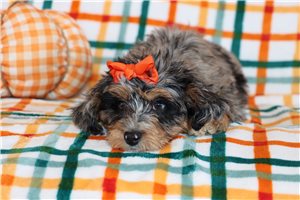
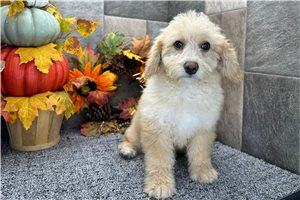
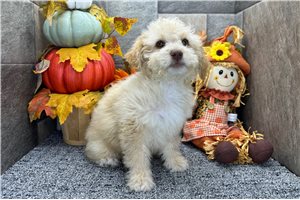
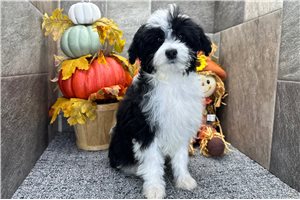
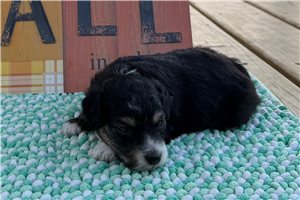
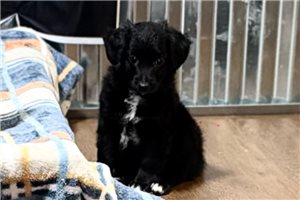
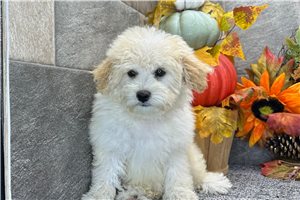
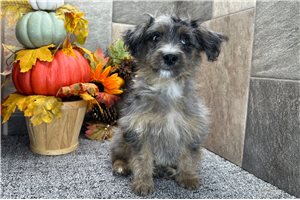
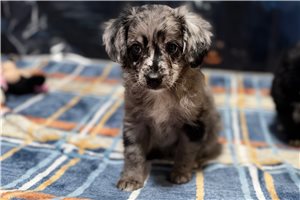
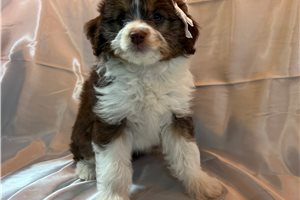
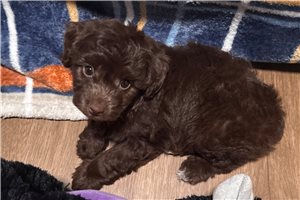
Also called Mini Aussie and Miniature American Shepherd
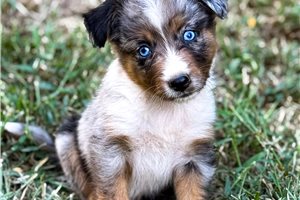
A Mini Aussie packs a herding dog's brains and drive into a compact body, small enough that riders once carried them along to horse shows. People fall for the merle coats, the eyes that can be blue, brown or one of each, and a dog that is devoted and loyal to its family.
A Mini Aussie packs a herding dog's brains and drive into a compact body, small enough that riders once carried them along to horse shows. People fall for the...A Mini Aussie packs a herding dog's brains and drive into a compact body, small enough that riders once carried them along to horse shows. People fall for the merle coats, the eyes that can be blue, brown or one of each, and a dog that is devoted and loyal to its family.
Only with Pawrade, you receive a pet insurance policy with no waiting period included for immediate accident or illness coverage. *NH, NY, RI, SC and TN residents excluded
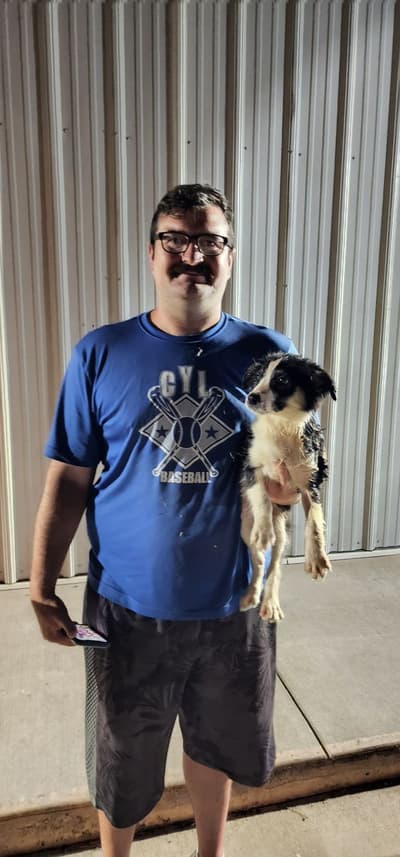
Finally got our new puppy … it was a nice process the people were all very helpful always there with answers to lots of my questions. Totally wworth the wait was able to stock up and be prepared. Great choice would do it again
“Finally got our new puppy … it was a nice process the people were all very helpful always there with answers to lots of my questions. Totally wworth the wait was able to stock up and be prepared. Great choice would do it again”
Ophelia · Miniature Australian Shepherd
Feb 27, 2026
“Very thorough and professional application process which we appreciate. No direct contact with the breeder which is understandable to us. We were walked through the entire process, questions answered and anticipated. We would definitely purchase another high quality pet using Pawrade”
Baron · Miniature Australian Shepherd
Nov 26, 2023
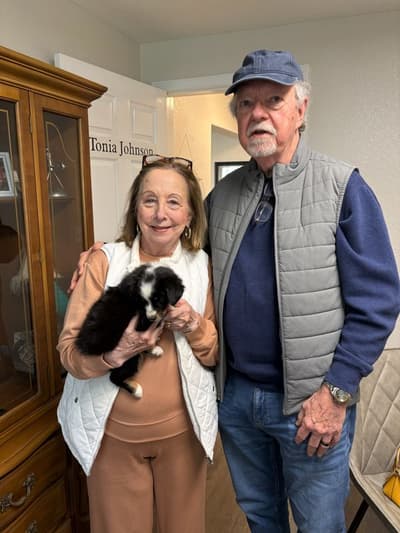
“Communication was great at all times. They made adopting a puppy half ways across the states easy. They handled everything and all I had to worry about is picking up my boy from the airport. Thanks for everything.”
Gracie · Miniature Australian Shepherd
Sep 14, 2026
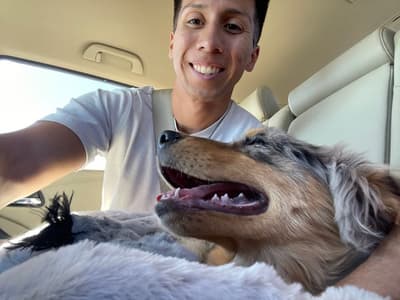
“Very happy with the whole experience and I love my new puppy!!”
Puppy scams cost U.S. families millions every year. Here's how you know Pawrade isn't one: we're a named, audited business with a public track record you can check anywhere.
Pawrade data: parents of puppies placed through Pawrade (breeder-reported)
Height
13–18 in
Lifespan
12–13 years
Energy
High
Shedding
Moderate
Group
Herding
AKC
Miniature Australian Shepherd Characteristics
Full-Grown Size
2 of 7SmallLarge
Grooming Needs
2 of 7SeldomRegularly
Good with Dogs
3 of 7Not ReallyYes!
Watchdog Ability
5 of 7LowHigh
Exercise Needs
4 of 7Couch PotatoHigh Needs
Your new best friend.
Miniature Australian Shepherd temperament
Personality and daily life
At home
A Mini Aussie is a smart little working dog with strong herding and guarding instincts. At home Mini Aussies are affectionate, sometimes cuddly, and content to settle indoors once they have been active. Strangers get a more reserved, watchful welcome. They should not be shy, though.
Training and play
Mini Aussies are generally good with children when socialized and trained, but many try to herd them. Supervise play with young children, and redirect heel nipping early. They are friendly with a family's other pets, though they may herd those too.
Most bark a moderate amount, mainly to tell you a stranger is coming. A bored Mini Aussie tends to invent its own jobs, and that is where unwanted behavior starts.
Miniature Australian Shepherd breeders & placements
Mini Aussies on Pawrade
Happier pups. Brighter tomorrows.
734
Miniature Australian Shepherds placed through Pawrade
23 / 20lb
typical weight of fathers / mothers
Mar 2020 – Sep 2026 · 914 records
76%
of litters socialized with older children
Feb 2022 – Sep 2026 · 725 records
86%
of litters socialized with small dogs
Feb 2022 – Sep 2026 · 725 records
Pawrade data: parents of puppies placed through Pawrade (breeder-reported). Placements and reviews come from Pawrade's records.
A healthier start for a happier tomorrow.
Miniature Australian Shepherd care & grooming
Care and training
The routine
Exercise needs
High
Energy is high, and the breed needs more exercise than the average dog: walks, hikes, games or dog sports every day, plus something to think about.
Coat and shedding
Moderate
The coat is a weather-resistant double coat of medium length, straight to wavy, with a mane and frill that is usually fuller in males. It sheds a fair amount, with heavier seasonal sheds once or twice a year.
Weekly
Coat and grooming care
Brush weekly for most of the year, and daily in shedding season, with an undercoat rake or slicker brush and a metal comb.
Book a yearly exam with a veterinary eye specialist, because hereditary cataract and progressive retinal atrophy (PRA) can show up after puppyhood.
Joints and movementKeep them lean and cool
Keep your Mini Aussie lean, and keep its exercise controlled while its joints are still growing.
Teeth and gumsRoutine vet checks
Have the bite and the adult teeth looked at during routine vet checks, because missing teeth and bite problems run in the breed.
Every milestone, together.
Miniature Australian Shepherd puppy milestones
Growing up: your Mini Aussie's first years
Before 8 weeks
Before your puppy comes home
Your puppy is still with its mother and littermates, and most Mini Aussie breeders on Pawrade are getting their litters used to other dogs and to children.
Set up the crate or puppy pen in a room where the family spends time, or in your bedroom at night.
Buy a slicker brush and a metal comb, so grooming can start in the first week.
Have a few puzzle toys ready, because this breed needs to use its brain as well as its legs.
Ask what food your puppy is eating now, and plan to measure every meal.
Why it matters
A crate close to people helps a new puppy settle in, and puzzle toys give a busy young mind something to do.
Miniature Australian Shepherd note
If your puppy has a result for MDR1 (a gene change that makes some drugs risky), ask for a copy for your vet.
8–10 weeks
The first week home
Everything is new, and your puppy is meeting the people, places and sounds of its new home. A puppy can usually hold its bladder for about as many hours as its age in months, so trips outside come often.
Take your puppy out first thing in the morning, after every nap and last thing at night.
Keep the crate close enough at night to hear a whimper when your puppy needs to go out.
Book the first vet visit, and give the vet your puppy's MDR1 result or ask about a cheek-swab test.
Start short, gentle brushing sessions, so your puppy gets used to the brush and comb.
Why it matters
Frequent trips outside give your puppy plenty of chances to get it right, and your vet needs the MDR1 result before choosing some medicines.
Miniature Australian Shepherd note
Expect some nipping at heels, which is the herding instinct showing, and redirect it from the start.
10–12 weeks
Weeks 2 to 4
Puppies are most open to new experiences in their first 3 months, so these weeks shape the adult your Mini Aussie becomes.
Introduce friendly people, calm dogs, new places and everyday sounds, a little at a time.
Join a puppy class, which can start as early as 7–8 weeks with healthy classmates, as your vet advises.
Keep training sessions short, fast-paced and varied, because repetition bores this breed.
Why it matters
Mini Aussies are naturally reserved with strangers, so good early meetings with new people build a confident adult.
Miniature Australian Shepherd note
Supervise play with young children, and gently redirect any herding or nipping.
3–4 months
3 to 4 months
Most puppies finish their core vaccine series at about 16 weeks, as your vet advises. Baby teeth start to fall out from about 12 weeks, so expect a busy, mouthy puppy.
Once your vet says the vaccines are complete, widen your puppy's world with new places, surfaces and sounds.
Offer safe chew toys, supervise chewing, and keep shoes and other valued things out of reach.
Get your puppy used to weekly nail trims along with its brushing sessions.
Why it matters
Chewing eases sore gums, and a safe outlet protects the things you value.
Miniature Australian Shepherd note
A bright Mini Aussie puppy learns fast, so add puzzle toys and short training games to every day.
4–6 months
4 to 6 months
Teething is in full swing, and by about 6 months the adult teeth are in. Your puppy is growing fast, and the growth plates in its legs are still soft.
Keep only a few chew toys out at a time, and rotate them to keep them interesting.
Ask your vet to look at the adult teeth and the bite once they are all in.
Agree an exercise plan with your vet, and skip strenuous exercise while your puppy is still growing.
Why it matters
Controlled exercise and a lean body help protect the hips while the joints are still forming.
Miniature Australian Shepherd note
Mini Aussies have high energy throughout life, so mental games matter as much as walks.
6–12 months
6 to 12 months
Adolescence often starts at about 6 to 8 months, and teenage dogs test boundaries and may seem to forget their training. Growth slows, and many Mini Aussies reach adult size by about their first birthday.
Keep training consistent and patient, with plenty of exercise for body and mind.
Talk with your vet about when to spay or neuter, because the right choice depends on things like sex and adult size.
Start the foundations for a dog sport such as agility, rally or herding, with short and fun sessions.
Why it matters
This phase is normal and it passes, and consistent, patient training carries your dog through it.
Miniature Australian Shepherd note
Keep up socialization too, because the breed stays naturally reserved with strangers.
1–2 years
1 to 2 years
Most dogs are fully grown and settled into adulthood at around 2 years. The chewing phase usually eases around 18 months.
Book a wellness exam with your vet at least once a year, the normal routine for an adult dog.
Keep the yearly eye exam with a veterinary eye specialist as part of that routine.
Keep your Mini Aussie lean by measuring meals and keeping treats to a small part of what it eats each day.
Why it matters
A lean weight protects the hips, and regular checkups catch eye changes early.
Miniature Australian Shepherd note
Mini Aussies stay high-energy as adults, so daily exercise plus a job to do keeps them content.
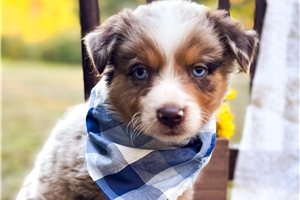
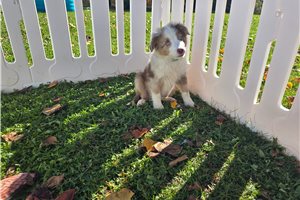
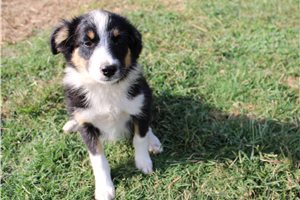
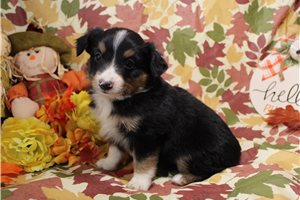
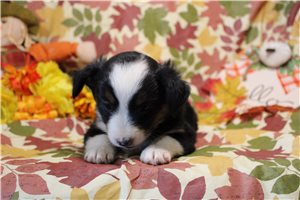
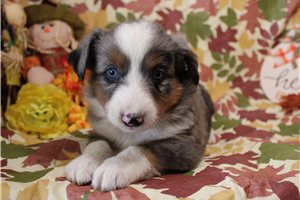
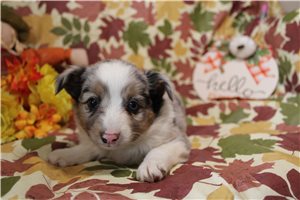
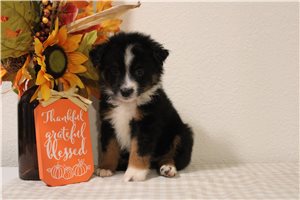
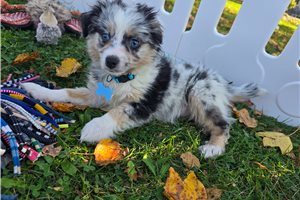
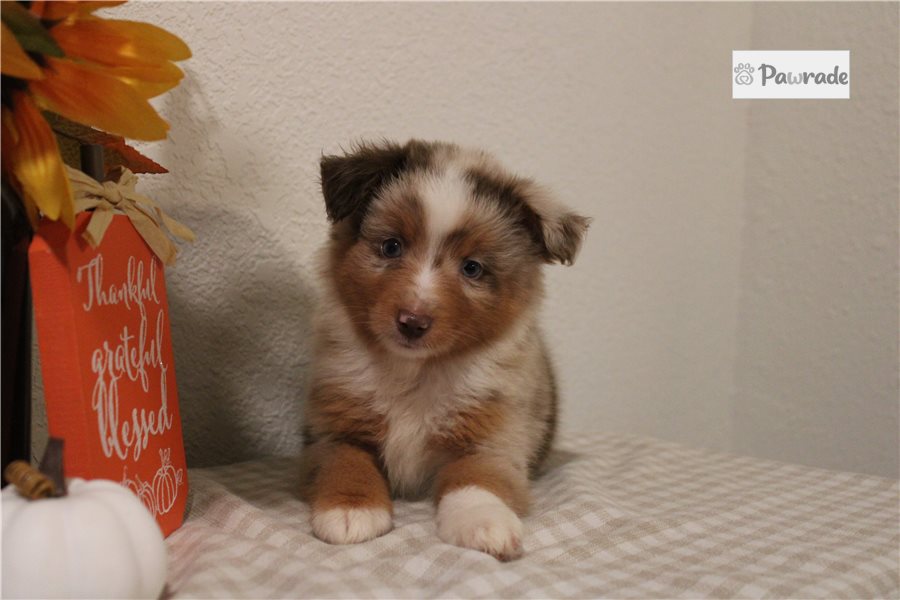
The Mini Aussie is a small herding dog, slightly longer than tall, with moderate bone and a solid build without bulk. Its ears are triangular and set high, and its teeth meet in a scissor bite. A docked tail or a natural bobtail is the preferred look. Eyes can be brown, blue, hazel, amber or any mix, including two different colors or flecks, and every eye color is accepted with every coat color.
Colors and coat
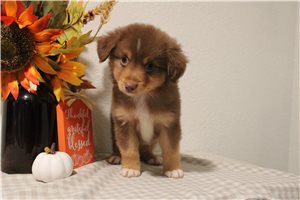
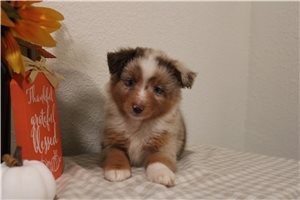
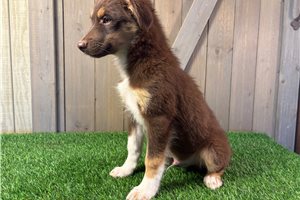
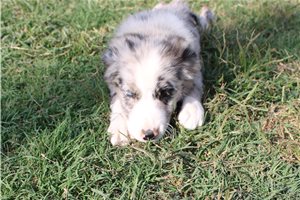
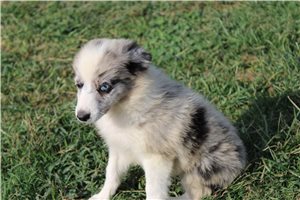
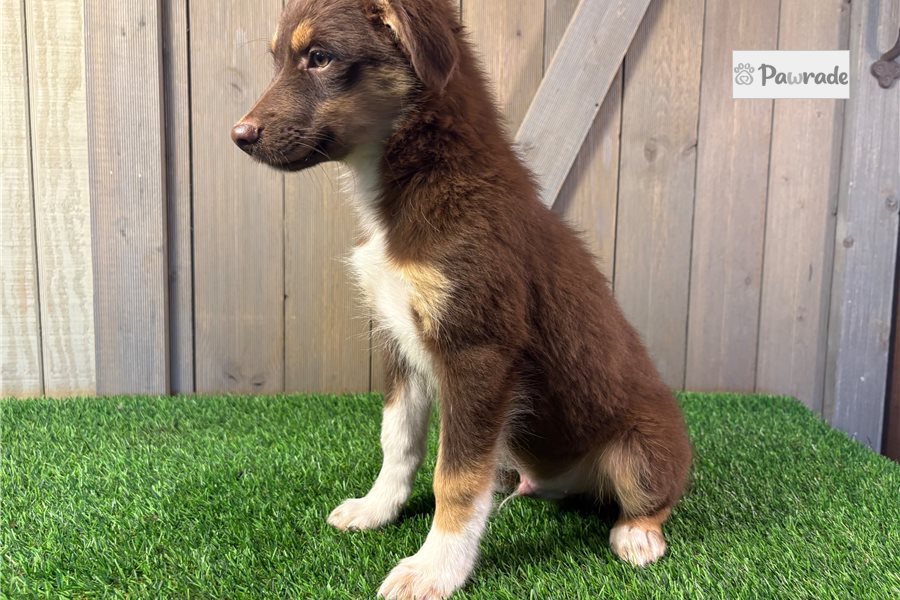
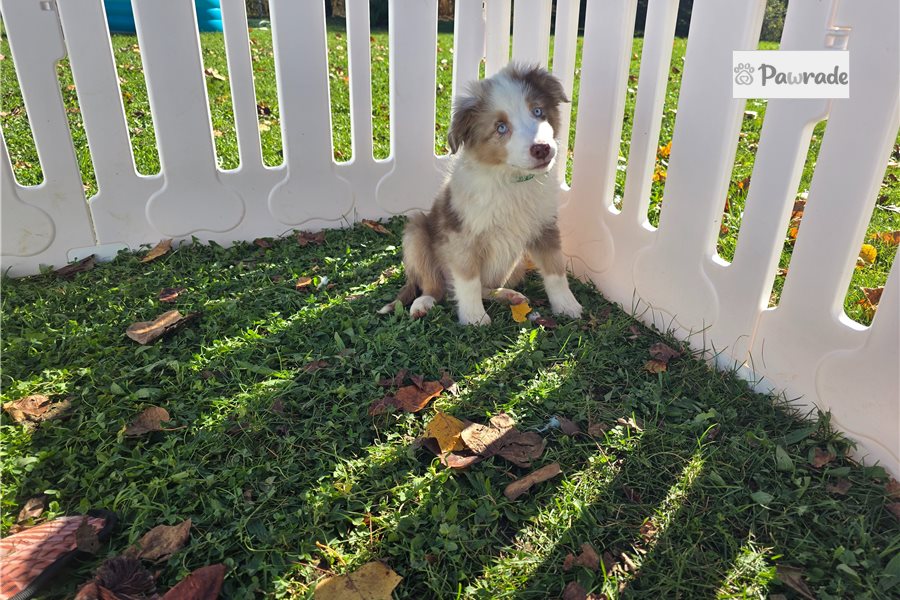
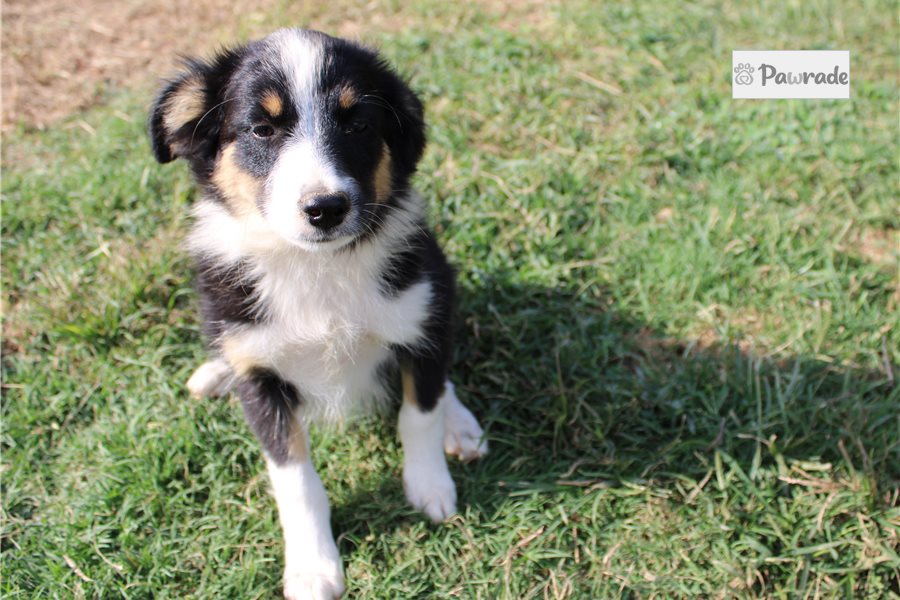
The AKC standard colors are black, blue merle, red (liver) and red merle, each with or without white and/or tan (copper) markings. A "tri", such as a black tri or red tri, has both white and tan markings. Other colors, and white body splashes on the back or sides, are outside the AKC breed standard. Breeding two merles (double merle) raises the risk of deafness and eye defects.
Colors listed by Pawrade breeders
Black
Blue Merle
Red
Red Merle
Red Tri
Sable
White
Yellow
Keeping your Mini Aussie healthy
The Mini Aussie is known to be prone to a handful of inherited conditions of the eyes, hips, teeth and nerves, plus a sensitivity to some common drugs. Several of them can be found early with a cheek-swab DNA test or an eye exam.
The drug sensitivity, called MDR1, is the one to know about from day one. In dogs that carry the gene change, some sedatives, an anti-diarrhea medicine and high doses of certain parasite drugs can cause serious reactions. Share your puppy's MDR1 result with every vet, and if it has none, ask about a cheek-swab test.
A little history, a lot of heart.
Miniature Australian Shepherd history
History and fun facts
1960s
The breed's story starts in late-1960s California, where breeders selected small Australian Shepherds for compact size, intelligence and an active character.
The dogs herded smaller stock such as sheep and goats, and their small, easy-to-carry size made them favorites of riders traveling to horse shows.
1980
In 1980 the National Stock Dog Registry began registering them as Miniature Australian Shepherds.
The first was Cordova's Spike, a 13-inch male.
1990
The Miniature American Shepherd Club of the USA formed in 1990, was incorporated in 1993 and became the AKC parent club in 2011.
That year the breed entered the AKC Foundation Stock Service as the Miniature American Shepherd, a name club members chose to reflect its American heritage.
2015
The AKC and the UKC both recognized the breed in 2015, and the FCI (Fédération Cynologique Internationale) has since published a standard for it.
1996
The Miniature Australian Shepherd Club of America, founded in 1996, still registers the dogs under the original name.
As herders, Mini Aussies move small flocks of sheep, goats and even ducks by nipping at heels, and they will take on cattle too.
2020
In 2020 a Miniature American Shepherd named Lexi received the parent club's medallion for the breed at her first AKC Rally National Championship.
Checked with care before travel.
Miniature Australian Shepherd Veterinary Health Report
Your puppy's Veterinary Health Report
Before your Mini Aussie puppy comes home, the breeder's licensed vet gives it a full hands-on exam to PetPay's exam standards, and the results go into its Veterinary Health Report.
The exam, a health certificate and a stool test for parasites all happen 3 to 5 days before your puppy leaves.
1It is a check of your own puppy, not paperwork about its family, so you start with a clear record of how your puppy is doing.
2If the vet finds something that could put your puppy at risk during travel, your puppy stays with the breeder until it's resolved.
3Problems that can be treated before travel are treated by the breeder's licensed vet first.
4Anything else the vet notes is shared with you.
5A hard copy of the report travels with your puppy for your records, and a digital copy is in your PetPay account.
PetPay Veterinary Health Report form
16 areas checked on the exam
Closer look for Miniature Australian ShepherdsOn every puppy's report
Miniature Australian Shepherd puppy health guarantee
Going home and the health guarantee
Puppies travel only once they are at least 8 weeks old and weigh at least 2 lb. Every puppy also comes with a health guarantee administered by PetPay, independent of the seller. The terms are on the health guarantee page.
A Miniature Australian Shepherd puppy's price reflects what goes into it: its pedigree and registration, its coat and color, and the breeder's program. Every Pawrade puppy's price also includes the pre-travel exam by the breeder's licensed vet, the Veterinary Health Report and a health guarantee administered by PetPay. See today's price range for Miniature Australian Shepherd puppies on Pawrade's Miniature Australian Shepherd listings.
Typical asking price
$2,420
Based on 457 Miniature Australian Shepherd listings in the last 12 months
Frequently asked questions about Miniature Australian Shepherd puppies
Frequently asked questions
Adult Mini Aussies weigh 20–40 lb and stand 13–18 in at the shoulder. Males stand 14–18 in and females 13–17 in. Most reach adult size between about 6 and 12 months.
Parents of Pawrade Mini Aussies typically weigh 12–35 lb (fathers) and 12–35 lb (mothers). Even so, many dogs sold as minis grow larger than expected, so treat the parents' size as a guide rather than a promise.
The Miniature American Shepherd is the same breed under its newer name. Miniature Australian Shepherd was the original name, and the breed became the Miniature American Shepherd when it entered the AKC Foundation Stock Service in 2011. The AKC, the UKC and the FCI register it only under the newer name, and the AKC and the UKC both recognized it in 2015.
It began as one, but the AKC now registers the Miniature American Shepherd and the Australian Shepherd as separate breeds. The Miniature Australian Shepherd Club of America (MASCA), a separate registry, still treats the Mini Aussie as a size variety of the Australian Shepherd with its own standard.
The difference is mostly size and which standard applies. The Australian Shepherd is the larger breed, and a Mini Aussie is judged against the Miniature American Shepherd standard or the MASCA standard. Both of those standards set a minimum height, so toy- or teacup-sized dogs fall outside them.
The AKC standard colors are black, blue merle, red (liver) and red merle, each with or without white and/or tan (copper) markings. A tri has both white and tan markings, and other colors are outside the AKC breed standard.
Mini Aussies can have brown, blue, hazel or amber eyes, or a mix, including two different colored eyes or flecks. Every eye color is accepted with every coat color.
Many Mini Aussies have a docked tail or a natural bobtail, which is the look the UKC and FCI standards prefer.
A Mini Aussie has a double coat of medium length, straight to wavy, with a mane and frill. Feathering grows on the backs of the front legs and on the breeches.
Males stand a little taller, 14–18 in against 13–17 in for females, and usually carry a fuller mane and frill. Pawrade Mini Aussie placements are split almost evenly between males and females.
Mini Aussies are intelligent, devoted and protective working dogs with strong herding and guarding instincts. The quirks to plan for are herding, a reserved manner with strangers and a real need for a job.
Mini Aussies have high energy throughout life, and a small size does not mean low energy. Most settle calmly indoors once they have had their daily exercise and something to think about.
Many do, because the herding instinct shows as nipping at heels and herding children and other pets. Redirect it early with training, and supervise play with young children.
Mini Aussies bark a moderate amount, mainly to alert you to strangers or something unusual. Early obedience training and socialization keep it from becoming excessive.
Mini Aussies are reserved and watchful with strangers at first, but they should not be shy. Early socialization builds their confidence around new people.
Mini Aussies are usually friendly with a family's other pets, though they may try to herd them. Most Mini Aussie breeders on Pawrade socialize their litters with other dogs before the puppies go home. More than a third of Pawrade Mini Aussie buyers already have a dog at home.
Mini Aussies are generally good with children when socialized and trained, and they do best with kids who understand dogs. Many try to herd children, so redirect nipping early and supervise play with young kids. Most Mini Aussie breeders on Pawrade socialize their litters with children before the puppies go home.
Many do with supervision, since Mini Aussies are friendly with the family's other pets but may try to herd them. Some breeders on Pawrade socialize their litters with cats before the puppies go home.
For an active family, a Mini Aussie is an affectionate, loyal companion that settles indoors after its exercise. Among Pawrade Mini Aussie buyers, most have a yard, about a third have children at home and more than a third already have a dog.
A Mini Aussie needs about as much activity as a standard Australian Shepherd, because both breeds have top energy. Plan daily walks, hikes, games or sports, plus training or puzzle toys for the mind.
Mini Aussies can live happily in an apartment as long as they get enough exercise and mental work every day. Alert barking is typical, and early training keeps it in check.
Mini Aussies make keen partners for hiking and for fetch and disc games. They compete in AKC agility, herding, obedience, rally, tracking, scent work and more. Keep exercise controlled while a puppy is still growing, and agree a plan with your vet.
Mini Aussies have a long history as travel companions, because their small, easy-to-carry size made them favorites of riders going to horse shows.
Mini Aussies shed a fair amount all year, with heavier seasonal sheds once or twice a year. They are not a low-shedding breed, so plan on regular brushing.
Brush weekly for most of the year and daily in shedding season, and add a bath about once a month and regular nail and ear care. The coat is left natural, and show dogs are trimmed only on the ears, feet, hocks, pasterns and tail.
Mini Aussies are bright, eager to please and easy to train with positive reinforcement. Harsh methods and repetitive drilling backfire, so keep sessions short and varied.
A common rule of thumb is that a puppy can hold its bladder for about as many hours as its age in months. A 3-month-old, for example, can usually wait about 3 hours. The rule works up to about 9 months to 1 year, and every puppy is different. Take your puppy out first thing in the morning, after naps and last thing at night.
Set up the crate in a room where the family spends time, or in your bedroom at night, so your puppy settles near you. Breeders on Pawrade report whether they have started crate training, so ask how far your puppy has got.
Your Mini Aussie is most likely in adolescence, a normal phase when dogs test boundaries and may seem to forget their training. Adolescence runs from about 6–8 months to about 2 years. Keep training consistent and patient, with plenty of exercise for body and mind.
Fetch and disc games, puzzle toys, hiking and herding instinct tests all suit their instincts. Many also enjoy real herding work with sheep, goats or ducks.
Puppies travel only once they are at least 8 weeks old and weigh at least 2 lb. Most Mini Aussie puppies go home at about 11 weeks, usually between 9 and 17 weeks.
Mini Aussie breeders on Pawrade report a typical litter of 5 puppies, usually between 3 and 8.
Most Mini Aussie litters on Pawrade meet other dogs and children before the puppies go home. Breeders report socializing 86% of litters with small-breed dogs and 76% with older children. They also report getting litters used to loud music or TV (85%), the vacuum cleaner (81%) and car rides (75%). These figures come from what breeders reported for 370 litters.
Have a crate set up in a room where the family spends time, a slicker brush and metal comb, and a few puzzle toys. Ask what your puppy is eating now, and if it has an MDR1 result, bring it to the first vet visit.
Start right away, because the first 3 months are the most important time for socialization. That matters even more in a breed that is naturally reserved with strangers. Puppy classes can begin as early as 7–8 weeks, with healthy classmates, as your vet advises.
Most puppies finish teething by about 6 months, when the adult teeth are in. Baby teeth start to fall out from about 12 weeks, and in Mini Aussies the chewing phase usually eases around 18 months. Offer a few safe chew toys at a time and rotate them, and keep valued things out of reach.
Most puppies finish their core vaccine series at about 16 weeks, as your vet advises. A puppy class with healthy classmates is fine before then, if your vet agrees. Tell your vet your puppy's MDR1 result before it gets any parasite drug.
Many Mini Aussies reach adult size by about a year old. Most dogs are fully grown and settled into adulthood at around 2 years.
The Veterinary Health Report is the record of your Mini Aussie puppy's exam before it goes home. The breeder's licensed vet gives the puppy itself a full hands-on exam to PetPay's exam standards and writes down what they find. It gives you and your own vet a clear starting point for your puppy's care.
The breeder's licensed veterinarian examines every puppy before it goes home, to PetPay's exam standards. The results are recorded in the puppy's Veterinary Health Report, and a copy travels with your puppy for your records.
The breeder's vet examines the whole puppy and pays close attention to a few things that matter in Mini Aussies. The vet checks the eyes, the bite and, in males, the testicles, and listens to the heart for a murmur. In merle or mostly white puppies, the vet also checks how the puppy responds to sound.
Before travel, every puppy follows PetPay's vaccination and deworming schedule as far as its age allows: deworming at 2, 4, 6, 8, 10 and 12 weeks, and the distemper, parvo, adenovirus and parainfluenza combination shot at 6–8, 9–11 and 12–14 weeks. Bordetella and corona are given at the vet's discretion, and no vaccine is given within 3 days of travel. Rabies is given by a licensed vet on the schedule your state requires. Your own vet completes the series. Your puppy's vaccination and deworming records are separate documents that travel with your puppy. Bring them, with the Veterinary Health Report, to your first visit so your vet starts from the same record.
If the vet finds something that could put your puppy at risk during travel, your puppy stays with the breeder until it's resolved. Problems that can be treated before travel are treated by the breeder's licensed vet first. Anything else the vet notes is shared with you.
Puppies grow and change quickly, and their immune systems are still developing, so no single exam can find everything. Hips, for example, are checked later with X-rays. The report is a strong early look at your puppy, and your own vet builds on it at every checkup.
Every puppy comes with a health guarantee administered by PetPay, independent of the seller. The terms are on the health guarantee page.
Mini Aussie buyers rate their Pawrade experience 4.7 out of 5 on average, from 305 reviews, and about 79% of those reviews give 5 stars.
Right now, most Miniature Australian Shepherd puppies on Pawrade are listed within the typical range shown on Pawrade's Miniature Australian Shepherd listings. Each breeder on Pawrade sets their own price, and each puppy's listing shows it. A Miniature Australian Shepherd puppy's price reflects what goes into it: its pedigree and registration, its coat and color, and the breeder's program. Every Pawrade puppy's price also includes the pre-travel exam by the breeder's licensed vet, the Veterinary Health Report and a health guarantee administered by PetPay.




 Miniature Australian Shepherd note