Only with Pawrade, you receive a pet insurance policy with no waiting period included for immediate accident or illness coverage. *NH, NY, RI, SC and TN residents excluded
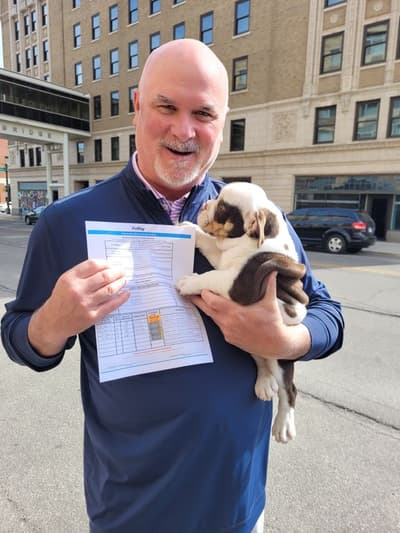
“Thank you very much for our wonderful beabull puppy, Gene! It has been a great experience, and Gene is adjusting well to his new home! ”
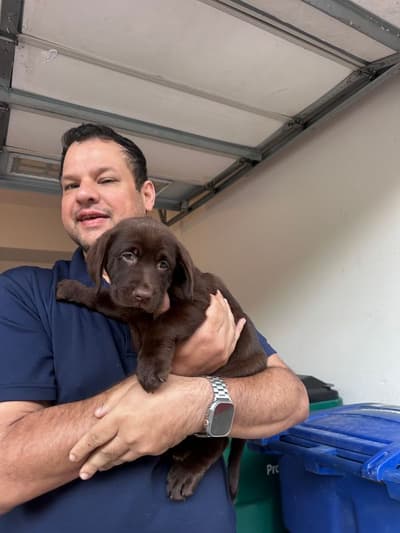
Bingo · Labrador Retriever
Aug 7, 2026
“We love our new puppy! The process at Pawrade.com was great! Everyone was very helpful.”
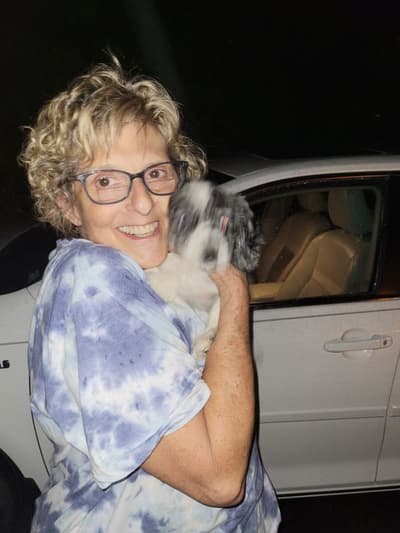
Marigold · Cocker Spaniel
Jul 20, 2023
“With Marigold/Paisley it was love at first site. One look at her picture and I knew that was my girl. It was sooo nice to have someone be the middleman and make ALL of the arrangements. Thanks Pam and Denise, Paisley has help fill a huge hole in my heart. ”
Puppy scams cost U.S. families millions every year. Here's how you know Pawrade isn't one: we're a named, audited business with a public track record you can check anywhere.
Yorkiepoos are friendly, playful, affectionate and bold, with a sassy streak, and they want to be with their people. Temperament, like size and looks, varies from dog to dog.
Kids and other pets
A Yorkiepoo can do well with children, but young children need supervision around such a small dog, and it is best suited to adults or older children. With proper introductions and socialization it can live with other dogs and cats, though it may take on dogs much larger than itself.
Energy and play
Energy is moderate: short walks and indoor play sessions cover most of a Yorkiepoo's exercise. A Yorkiepoo suits apartments and small homes and must live indoors.
Barking and noise
Yorkiepoos are prone to barking and do not like long periods alone, which can lead to separation anxiety and nuisance barking. Train quiet behavior early and consistently, and keep your dog mentally busy.
Training
Training works best with treats, praise, consistency and patience, because some Yorkiepoos are stubborn. Start on the first day home. Many enjoy learning tricks, and through AKC Canine Partners a Yorkiepoo can compete in AKC agility, obedience and rally.
Placements and reviews come from Pawrade's records.
A healthier start for a happier tomorrow.
Yorkiepoo care & grooming
Care and grooming
The routine
Coat and shedding
Low
The soft coat ranges from silky and straight, like a Yorkie's, to wavy or curly, like a Poodle's, and it sheds little.
Daily
Coat and grooming care
Brush daily, and book a professional clip every 4–8 weeks, or every 4–6 weeks for curlier coats. An ungroomed coat mats quickly, and mats can cause painful skin infections.
Teeth and gums
Brush the teeth every day, because a small mouth crowds the teeth.
Monthly / as needed
Bath time
Bathe about monthly.
Nail trims
Keep the nails trimmed.
Ear checks
Keep the ears clean.
Keeping them safe
Heat safety
Avoid heat extremes.
Cold weather
A Yorkiepoo's small body chills easily, so keep cold outings short.
Leash and fencing
Use a harness rather than a collar, because collar pressure on the throat makes a weak windpipe worse.
Ask your vet to check the eyes at every yearly exam, since cataracts run on both sides of the family.
Breathing and airwayKnow when to call
See your vet about a honking cough, which can be a sign of a weak airway (tracheal collapse).
Joints and movementKnow when to call
See your vet if your Yorkiepoo starts skipping or holding up a back leg, which can mean a slipping kneecap.
Teeth and gumsRoutine vet checks
Book dental cleanings at the yearly exam when your vet recommends them.
Body weightKeep them lean and cool
Keep your Yorkiepoo lean, one of the easiest ways to help it live longer.
Heart checksRoutine vet checks
Have your vet listen to the heart at each yearly exam.
Every milestone, together.
Yorkiepoo puppy milestones
Your Yorkiepoo's first 2 years
Before 8 weeks
Before your puppy comes home
Your puppy is still with its mother and littermates, and its most important weeks for meeting the world have already started. Its adult size is still a best guess, because a Yorkiepoo's size depends on its parents and varies by generation.
Set up a crate in a room where the family spends its day, or in your bedroom at night.
Buy a small harness rather than a collar, so walks never press on the windpipe.
Have a soft brush, a comb and a dog ear cleaner ready before your puppy arrives.
Book a visit with your own vet for soon after your puppy comes home.
Why it matters
A crate near people helps a new puppy settle, and you will hear it at night when it needs to go out.
Yorkiepoo note
Yorkiepoos want to be with their people, so a crate within sight and sound of the family suits them from the first night.
8–10 weeks
The first week home
Everything is new, and your puppy needs a bathroom trip first thing in the morning, last thing at night and after every nap. Small, frequent meals suit a young puppy, about four a day for now.
Start training on the first day home, using a steady routine, treats and praise.
Begin short daily brushing and gentle handling of the face, ears and teeth this week.
Take your puppy to your own vet, and bring its Veterinary Health Report along.
Why it matters
A puppy that learns to enjoy brushing early is much easier to groom for the rest of its life.
Yorkiepoo note
Some Yorkiepoos have a stubborn streak, so patience and consistency from day one pay off.
10–12 weeks
Weeks 2 to 4
Your puppy is in the middle of its most important weeks for socialization, which run through about the first 3 months. Calm, happy meetings now shape how it feels about people, children and other pets later on.
Plan a few short, gentle meetings each day with new people, friendly healthy dogs and everyday sounds.
Sign up for a reward-based puppy class, which can start at 7–8 weeks once your vet is happy.
Until the vaccine series is done, keep your puppy away from sick or unknown dogs, as your vet advises.
Why it matters
Early socialization helps a Yorkiepoo get along with other dogs and cats later on.
Yorkiepoo note
A bold Yorkiepoo may take on a much larger dog, so keep it on a leash around big dogs and watch play with young children.
3–4 months
3 to 4 months
Around 12 weeks, the baby teeth start falling out as the adult teeth come in, and chewing picks up. The puppy vaccine series usually finishes at about 16 weeks, as your vet advises.
Keep only a few safe chew toys out at a time, and rotate them so they stay interesting.
Stretch the time between bathroom trips slowly, since a puppy can usually hold its bladder about as many hours as it is months old.
Ask your vet to check for baby teeth that stay in, because toy dogs often keep them.
Why it matters
Chewing is strongest while the teeth change, so safe toys protect both your home and your puppy.
Yorkiepoo note
A small mouth crowds easily, and gum disease can start young on both sides of the family, so make tooth brushing part of the routine now.
4–6 months
4 to 6 months
By about 6 months, the adult teeth are in and teething winds down. Your puppy is still growing, and the growth plates in its legs stay soft until growth is done.
Let your puppy play at its own pace, and save long, hard exercise for when it is grown.
Agree on an exercise plan with your vet while your puppy is still growing.
Book regular visits with a professional groomer, and keep brushing at home every day in between.
Why it matters
Too much strenuous exercise can hurt a puppy's soft growth plates and lead to injury.
Yorkiepoo note
Curlier Yorkiepoo coats need clipping more often than silky ones, and an ungroomed coat mats quickly. A hip problem called Legg-Calvé-Perthes disease runs on the Toy Poodle side, and it is seen mostly in young dogs up to about a year old.
6–12 months
6 to 12 months
From about 8 months, many young dogs test limits and seem to forget cues they already knew. This teenage stretch is normal, and patience carries you through it.
Keep training sessions short and upbeat, with treats, praise and plenty of consistency.
Keep working on quiet behavior, and give your dog's mind plenty to do each day.
Talk with your vet about spaying or neutering, since the right time depends on things like sex and expected adult size.
Why it matters
Consistent training, patience and plenty of play for body and mind help a young dog through this stage.
Yorkiepoo note
A Yorkiepoo left alone too long can turn noisy, so keep alone time short and the days busy.
1–2 years
1 to 2 years
Your Yorkiepoo looks grown up, and most dogs are fully grown and settled into adulthood at around 2 years. Small dogs finish growing sooner than large ones.
Settle into an adult routine of two meals a day, daily brushing, and short walks with indoor play.
Book a wellness exam with your vet at least once a year, and ask for the eyes, teeth and heart to be checked.
Keep your Yorkiepoo lean, which eases knee and windpipe problems and helps it live longer.
Why it matters
Yearly checkups let your vet catch eye, tooth and heart changes early.
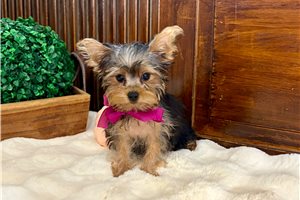
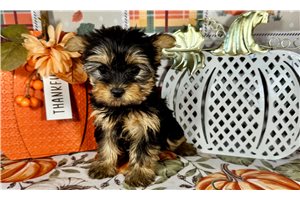
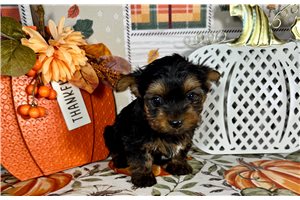
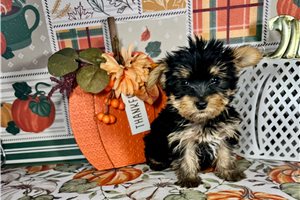
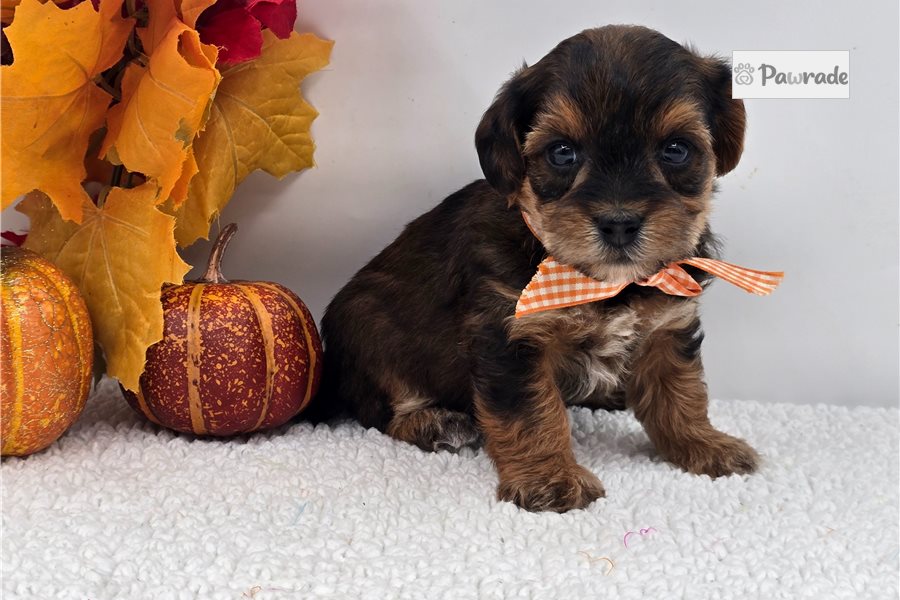
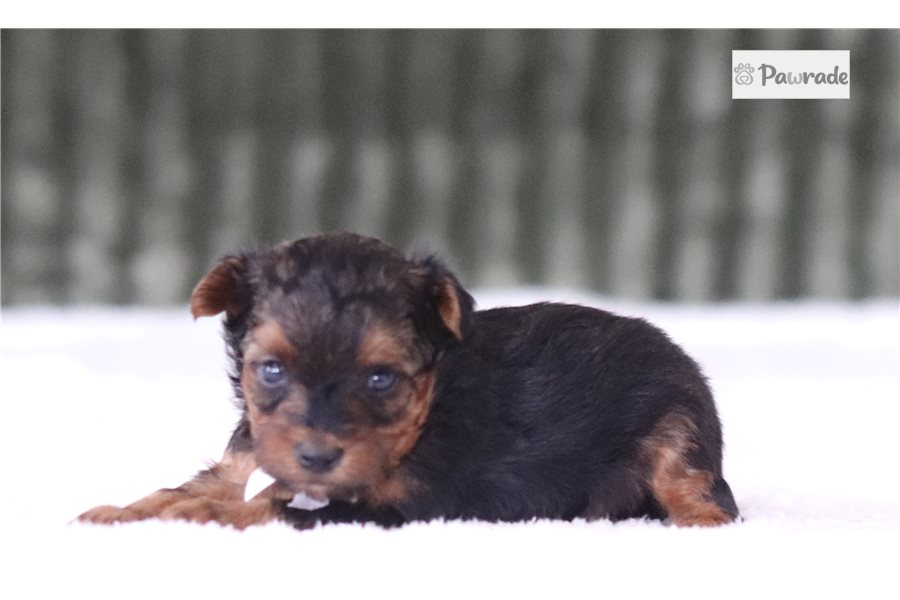
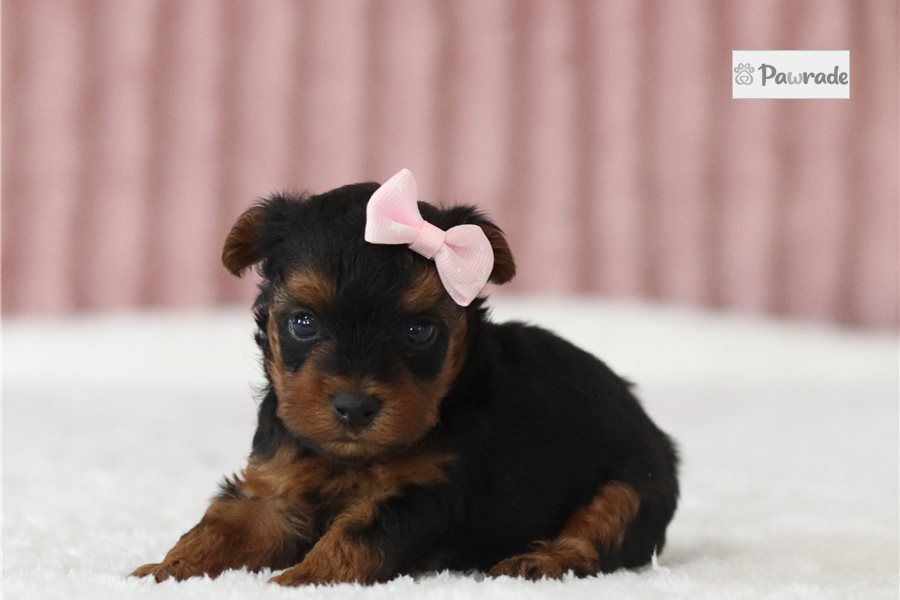
A Yorkiepoo has no breed standard and no single look. Some resemble the Yorkie and some the Poodle, and the muzzle, tail and build vary from dog to dog.
Size
Size depends mostly on which Poodle variety was used and on the lines behind the puppy. A Yorkiepoo's adult size depends on its parents and varies from one generation to the next, so each Pawrade listing shows the parents' weights.
Generations
A first-cross Yorkiepoo (F1) has a Yorkshire Terrier parent and a Poodle parent. A multigenerational Yorkiepoo (multigen) has two Yorkiepoo parents, which is less common. In any generation, traits sort randomly, so a puppy will not necessarily get the best of each parent.
Colors and markings
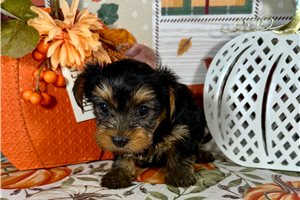
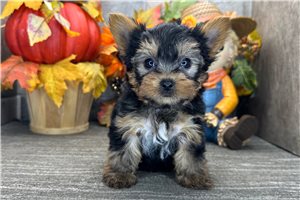
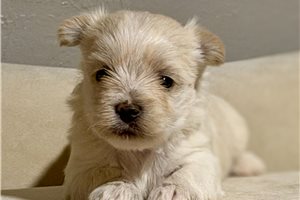
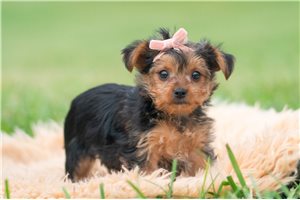
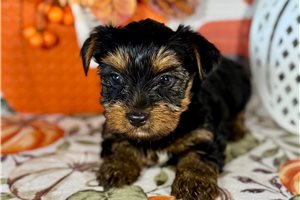
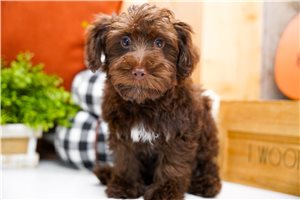
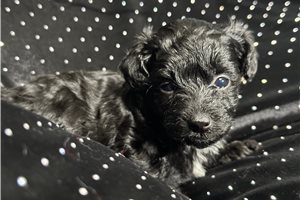
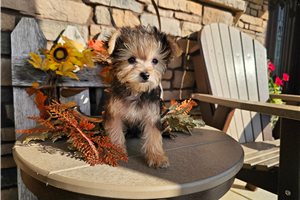
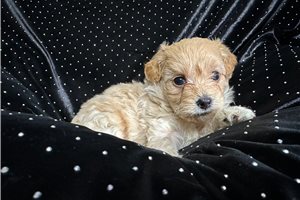
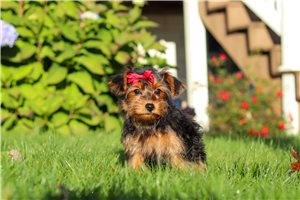
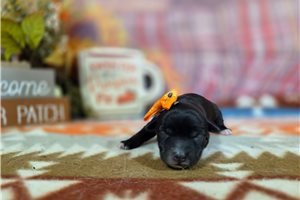
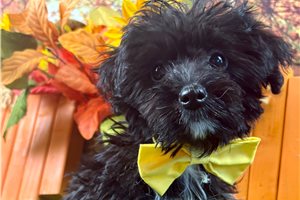
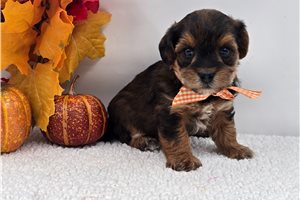
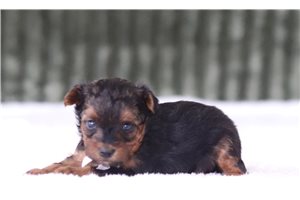
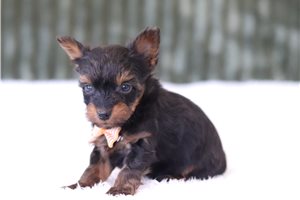
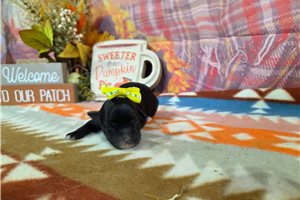
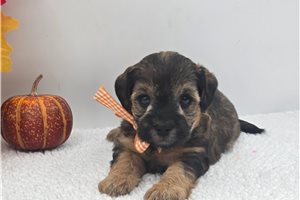
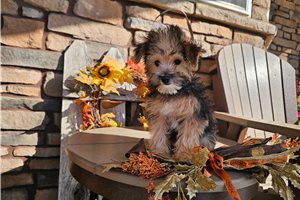
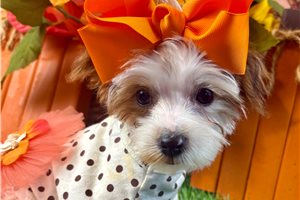
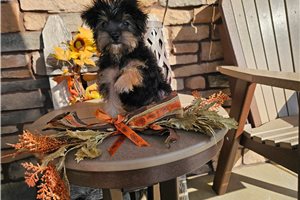
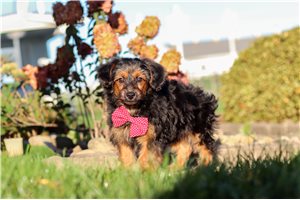
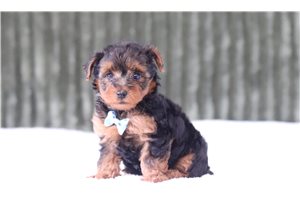
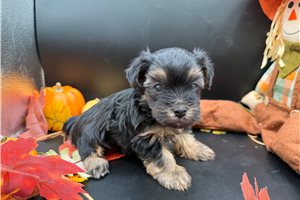
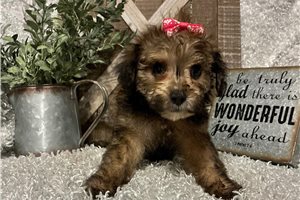
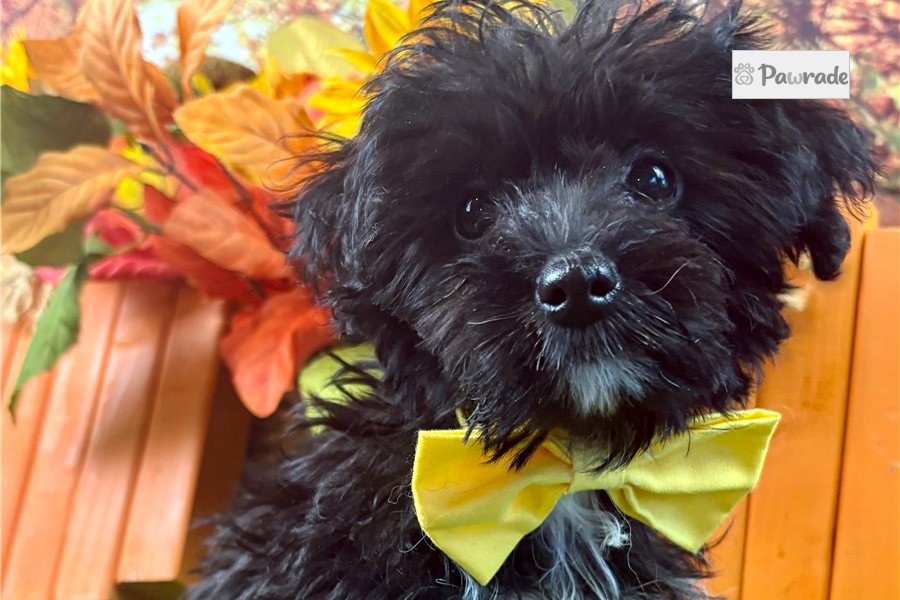
Reported colors include black, white, cream, gold, red, the Yorkie's blue and tan or blue and gold, parti (a color plus white), bicolor and tricolor. With no breed standard, no color is standard for the cross itself; parti and tricolor fall outside both parent breeds' AKC standards. Coat color often changes as a puppy grows.
Colors listed by Pawrade breeders
Black
Brown
Cream
White
A little history, a lot of heart.
Yorkiepoo history
History
The Yorkiepoo's exact origin is undocumented; it became widely popular in the US over roughly the last 10–20 years, alongside other Poodle crosses.
It also goes by Yorkipoo, Yorkie-poo and Yorkie Poo.
Neither the AKC nor the UKC recognizes the Yorkiepoo, and no breed club or breed standard exists for it.
It is on the Designer Kennel Club's breed list.
The parent breeds have their own clubs, the Yorkshire Terrier Club of America and the Poodle Club of America.
Second World War
No famous Yorkiepoo is on record, but the Yorkshire Terrier side has Smoky, a 4-lb Second World War dog who pulled telephone wire through a pipe under an airstrip.
Checked with care before travel.
Yorkiepoo Veterinary Health Report
Your puppy's Veterinary Health Report
Before your Yorkiepoo puppy goes home, the breeder's licensed veterinarian gives it a full hands-on exam to PetPay's exam standards, and the results go into its own Veterinary Health Report.
The exam, a health certificate and a stool test for parasites all happen 3 to 5 days before your puppy leaves.
1The exam looks at your puppy itself, not its parents, so the record you get is about your own dog.
2If the vet finds something that could put your puppy at risk during travel, your puppy stays with the breeder until it's resolved.
3Problems that can be treated before travel are treated by the breeder's licensed vet first.
4Anything else the vet notes is shared with you.
5A hard copy of the report travels with your puppy for your records, and a digital copy is in your PetPay account.
Puppies must be at least 8 weeks old and 2 lb before they travel. Every puppy also comes with a health guarantee administered by PetPay, independent of the seller. The terms are on the health guarantee page.
Frequently asked questions about Yorkiepoo puppies
Frequently asked questions
A grown Yorkiepoo weighs 4–15 lb and stands 7–15 in tall. Where a puppy lands in that range depends mostly on whether its Poodle parent is a Toy or a Miniature, and on the lines behind it. Each puppy's listing shows its parents' weights, because a Yorkiepoo's adult size depends on its parents and varies by generation.
There is no teacup size, because neither parent breed has a teacup variety. Registries recognize one size of Yorkshire Terrier, and a Yorkiepoo's Poodle parent is a Toy or a Miniature. A grown Yorkiepoo weighs 4–15 lb, depending mostly on its parents.
Only roughly, because the Yorkiepoo is not a fixed breed and size varies from puppy to puppy. The Poodle parent's variety and the lines behind the puppy matter most. Each listing shows the puppy's own parents' weights, because a Yorkiepoo's adult size depends on its parents and varies by generation.
A Yorkiepoo is a cross between a Yorkshire Terrier and a Toy or Miniature Poodle, not a breed with its own standard. Compared with a Yorkie, it can be larger, its coat ranges from straight to curly, and it comes in many more colors.
These labels describe a puppy's generation. An F1 Yorkiepoo has a Yorkshire Terrier parent and a Poodle parent, and a multigenerational (multigen) Yorkiepoo has two Yorkiepoo parents. Multigen litters are less common, and in any generation traits sort randomly.
Yorkiepoos come in many colors, including black, white, cream, gold, red, the Yorkie's blue and tan, parti, bicolor and tricolor. The cross has no breed standard of its own, so no color is standard for it.
Many do, because Yorkie-pattern puppies are born black and tan and lighten to blue and tan. Poodle lines in blue, silver, café-au-lait or silver beige are also born darker and clear gradually.
Yorkiepoos are friendly, playful, affectionate and bold, and they want to be with their people. Many have a sassy streak, and because the cross is not fixed, temperament varies from dog to dog.
Trick training is a favorite, and many enjoy agility and obedience. As a mixed breed, a Yorkiepoo can take part in AKC events through AKC Canine Partners.
They can be, with supervision, because a Yorkiepoo is small and young children need watching around it. It is best suited to homes with adults or older children. Yorkiepoo breeders on Pawrade report socializing 84% of their litters with younger children and 83% with older children.
Usually, with proper introductions and socialization, although a Yorkiepoo may challenge a much larger dog. Keep it on a leash around big dogs. Yorkiepoo breeders on Pawrade report socializing 92% of their litters with small-breed dogs.
They can live with cats when introduced properly and socialized early. Some breeders on Pawrade socialize their litters with cats before the puppies go home.
Yorkiepoos suit apartments and small homes, as long as they live indoors. Early, consistent training against barking helps in shared buildings. Most Yorkiepoo buyers on Pawrade live in a single-family home, and some live in apartments.
Not for long stretches, because Yorkiepoos do not like long periods alone and can develop separation anxiety and nuisance barking. They do best when someone is home for much of the day.
It can be, because a Yorkiepoo is small, needs only moderate exercise and does best with adults or older children. Plan for daily brushing, regular grooming visits and company for much of the day.
Yorkiepoos are low-shedding, but no dog is truly hypoallergenic. The coat may suit some people with allergies, so spend time with a Yorkiepoo before you commit.
A Yorkiepoo needs daily brushing and a professional clip every 4–8 weeks, or every 4–6 weeks for curlier coats. An ungroomed coat mats quickly, and mats can cause painful skin infections.
A Yorkiepoo has a soft hair coat, often a little scruffy. It can be silky and straight like a Yorkie's or wavy to curly like a Poodle's. Curlier coats need clipping more often than silky ones.
Start short daily brushing and gentle handling of the face, ears and teeth in the first week. A puppy that starts early can learn to enjoy it, which makes the daily brushing ahead much easier.
Brush the teeth every day and book professional cleanings as your vet advises, because a small mouth crowds the teeth. Toy dogs often keep baby teeth after the adult teeth arrive, so have your vet check the mouth while the adult teeth come in, at about 3–7 months.
Most learn well with a steady routine and rewards, starting on the first day home. Take a young puppy out first thing in the morning, last thing at night and after naps. Keep the crate in a room where the family spends time, or in your bedroom at night, so you hear when your puppy needs to go out.
Usually, with patience, because Yorkiepoos learn well with treats, praise and consistency, though some are stubborn. Start on the first day home, and socialize widely in the first 3 months.
A puppy can usually hold its bladder for about as many hours as it is months old, so a 3-month-old can wait about 3 hours. Very young puppies need to go out first thing in the morning, last thing at night and after naps.
Your Yorkiepoo has probably reached its teenage phase, which can start around 8 months and last until about 2 years. Young dogs test limits and seem to forget cues they knew, and the phase passes. Keep training short and upbeat, with treats, praise and plenty of consistency.
Puppies travel only once they are at least 8 weeks old and weigh at least 2 lb. Most Yorkiepoo puppies go home at about 11 weeks, usually between 9 and 16 weeks.
Most puppies finish teething by about 6 months, when all the adult teeth are in. The baby teeth start falling out at around 12 weeks, so expect extra chewing from then on. Offer safe chew toys, and rotate a few at a time so they stay interesting.
Most puppies finish their core vaccine series at about 16 weeks, as your vet advises. The shots are given as a series over several weeks, and your vet sets the exact schedule. Until then, keep your puppy away from sick or unknown dogs.
Start right away, because the first 3 months are the main socialization window. Puppy classes can begin at 7–8 weeks once your vet is happy, as long as your puppy stays away from sick dogs.
Get a harness rather than a collar, food for small, frequent meals, a soft brush and comb, and a dog ear cleaner. Set up a crate where the family spends time, and book a vet visit for soon after arrival.
Most Yorkiepoo litters on Pawrade meet children, other small dogs and everyday household sounds before the puppies go home. Breeders report socializing 92% of litters with small-breed dogs and 84% with younger children. They also report getting litters used to loud music or TV (72%), the vacuum cleaner (59%) and pots and pans (52%). These figures come from what breeders reported for 212 litters. Keep it going once your puppy is home, because the first 3 months are the main socialization window.
The Veterinary Health Report is the written record of your Yorkiepoo puppy's exam before it goes home. The breeder's licensed vet gives the puppy itself a full hands-on exam to PetPay's exam standards and writes down what they find. It gives you and your own vet a clear starting point for your puppy's care.
The breeder's licensed veterinarian examines every puppy before it goes home, to PetPay's exam standards. The results are recorded in the puppy's Veterinary Health Report, and a copy travels with your puppy for your records.
The breeder's licensed vet gives your Yorkiepoo puppy a full hands-on exam and records it in the Veterinary Health Report. The vet feels both knees, checks the eyes for vision and eyelash problems, looks at the bite, and records the puppy's weight and body condition.
Before travel, every puppy follows PetPay's vaccination and deworming schedule as far as its age allows: deworming at 2, 4, 6, 8, 10 and 12 weeks, and the distemper, parvo, adenovirus and parainfluenza combination shot at 6–8, 9–11 and 12–14 weeks. Bordetella and corona are given at the vet's discretion, and no vaccine is given within 3 days of travel. Rabies is given by a licensed vet on the schedule your state requires. Your own vet completes the series. Your puppy's vaccination and deworming records are separate documents that travel with your puppy. Bring them, with the Veterinary Health Report, to your first visit so your vet starts from the same record.
If the vet finds something that could put your puppy at risk during travel, your puppy stays with the breeder until it's resolved. Problems that can be treated before travel are treated by the breeder's licensed vet first. Anything else the vet notes is shared with you.
Puppies grow and change quickly, and their immune systems are still developing, so no single exam can find everything. Inherited eye conditions such as cataract, for example, often appear later in life. The report is a strong early look at your puppy, and your own vet builds on it at every checkup.
Right now, most Yorkiepoo puppies on Pawrade are listed within the typical range shown on Pawrade's Yorkiepoo listings. Each breeder on Pawrade sets their own price, and each puppy's listing shows it. A Yorkiepoo puppy's price reflects what goes into it: its pedigree and registration, its coat and color, and the breeder's program. Every Pawrade puppy's price also includes the pre-travel exam by the breeder's licensed vet, the Veterinary Health Report and a health guarantee administered by PetPay.






 Yorkiepoo note