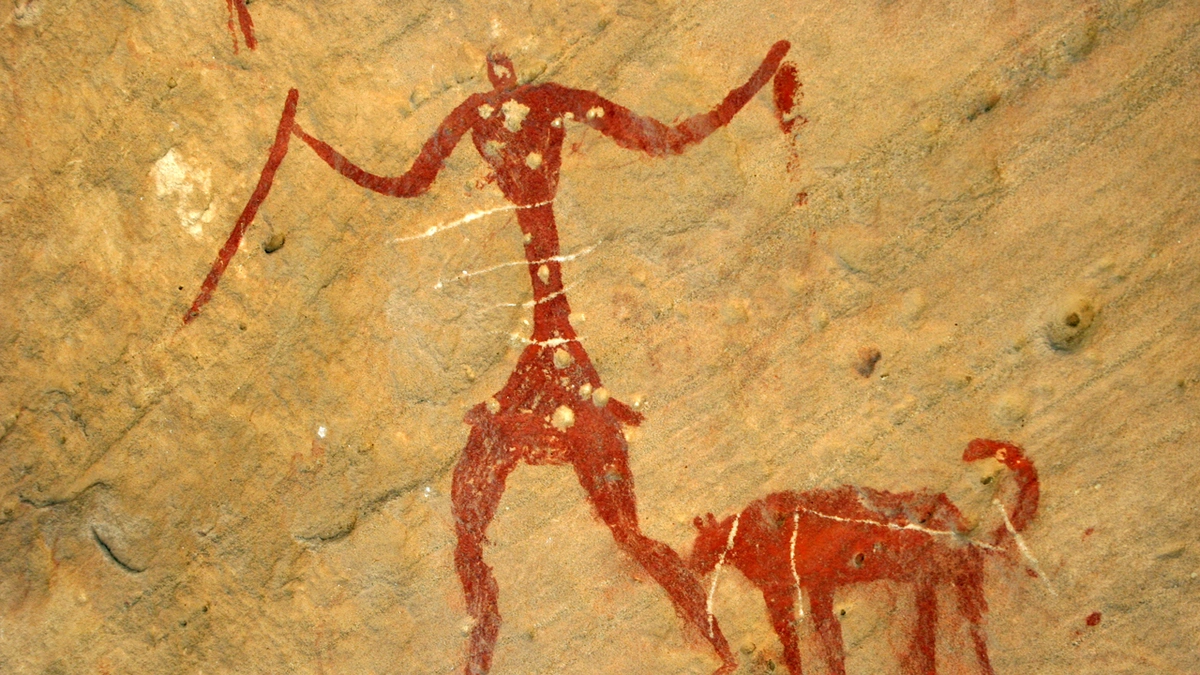
It's commonly known that domesticated dogs are descended from gray wolves. But did you know that the dog was the first species to be domesticated by humans? Or that the dog has the most breeds out of any animal, at 450? Or that the earliest known remains of a domesticated dog date back over 14,000 years?! Break out your textbooks and don't sweat the test at the end. Get ready for a crash course on the history of man's best friend, because this is Dog History 101!
In the beginning...
Originally, dogs were predators and scavengers, enjoying a commensal relationship with humans (dog gains, human doesn't gain or lose). They would have learned complex behaviors, such as bite inhibition, from their wolf ancestors. Sophisticated social cognitions such as these may have contributed to the dog's trainability and playfulness. Ever wonder how dogs are able to fit into human households and social situations? There's your answer!
When? Remains to be seen
There is considerable debate about when exactly dogs were domesticated by humans. A 2008 study concluded that dogs were domesticated in Europe between 18,800 and 32,000 years ago, with the oldest dog remains in the world, so far discovered, dating back 31,700 years. This Paleolithic dog bears a striking resemblance to a Siberian Husky. These findings are challenged by the discovery of dog remains in Belgium dating back 36,500 years. Additionally, remains of a domesticated dog were found in Bonn-Oberkassel, Germany, and were dated to 14,223 years ago! In other words, before Ancient Egypt, agriculture, or writing, we had dog buddies. There has also been evidence found dating back to 12,000 BCE in the ancient temple Gobekli-Tepe in Turkey of domesticated dogs, corresponding to further evidence found in Israel dating back to the same time, in which an old man was found buried with a puppy.

Our oldest folk tales and mythologies feature dogs. In the Sumerian Epic of Gilgamesh, dogs appear as companions to the goddess Ishtar, who travels with seven prized hunting dogs. An even older story, Descent of Innana, in which Ishtar goes down into the Underworld, her husband, Dumuzi, keeps domesticated dogs as part of his royal retinue. In Mesopotamian art, dogs are depicted both as hunters and companions. Inscriptions and plaques depict dogs waiting for their masters and even listening to their masters play music.

Dogs in Europe
Dogs have been integral to European civilizations since ancient times, with their domestication paralleling the rise of agriculture and the establishment of settled communities. From guarding homesteads to aiding in hunting expeditions, European dogs evolved alongside humans, becoming indispensable companions and workers.
Vikings

More dog remains have been found in Scandinavian burial sites than in those of any other culture. Scholar Anne-Sofie Graslund notes that they obviously played an important role in funerary rites, but also that they are often depicted in carvings that show scenes of hunting and ritual ceremonies. Hardly surprising, considering dogs were among the sacrifices dedicated to Odin, Thor, and Freyr (Odin's brother-in-law). Pets were an integral part of Norse culture, with both dogs and cats being kept as companions and featuring in mythology, folklore, and art (Spoilers: this is a trend). It might seem strange to imagine a tough, grizzled Viking chief bringing along his favorite furbaby on raids, but recent studies have shown that this is exactly what happened. It would be more believable for the chief to bring his pet bear on raids...which also happened.
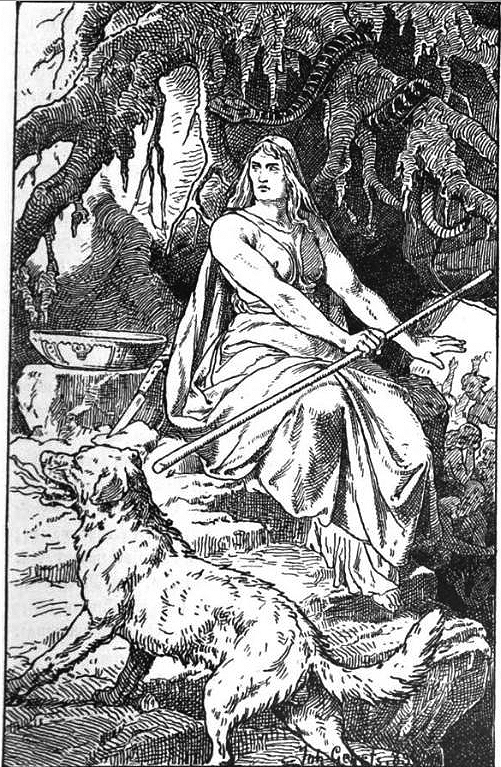
The best-known dog from Norse mythology is Garm, who guarded the gates of the afterlife realm, Hel. He kept the souls of the dead safely within the walls of Hel while keeping the living out, preventing them from returning dead souls to the land of the living. He is even called "best of hounds" by Odin himself! There is some dispute among scholars, however, noting that the dog who guards the gates to Hel is never actually given a name, and that Garm is nearly identical to the great wolf, Fenris, both of whom are released during the Viking apocalypse, Ragnarok. In any event, dogs were closely associated with the gods and the afterlife. Some sagas mention dogs accompanying their masters to Valhalla after death.

In everyday life, dogs were companions as well as working dogs, used for both hunting and herding. Dogs were highly valued and expensive to keep and train, and so became status symbols among the Norse. Among the breeds kept by the Vikings were the Norwegian Elkhound, the Swedish Elkhound, the Karelian Bear Dog, and the Finnish Spitz Dog. Additionally, Huskies were specifically bred to be sled dogs across Europe and Asia during the Iron Age. Today, the Halden Hound (pictured above) is the national dog of Norway and is still used for hunting.
Rome/Greece

It's commonly known that Cerberus guarded the gates to the Underworld. However, dogs were also seen as companions, hunters, and protectors. Like in Sumer, they were associated with female goddesses, such as Artemis and Hecate (known as Trivia by the Romans). Most notably, Argos, Odysseus's loyal companion, is the only one to recognize his friend after he has been away for 20 years, rising from the place where he had waited faithfully all that time.
Additionally, the ancient Greek philosophy school of Cynicism takes its name from the Greek word for dog, and their followers were called Kynikos, "dog-like," likely because of their unswerving devotion and loyalty to a singular path. In Plato's Republic, Socrates claims that the dog is the true philosopher because they, "distinguish the face of a friend and of an enemy only by the criterion of knowing and not knowing."
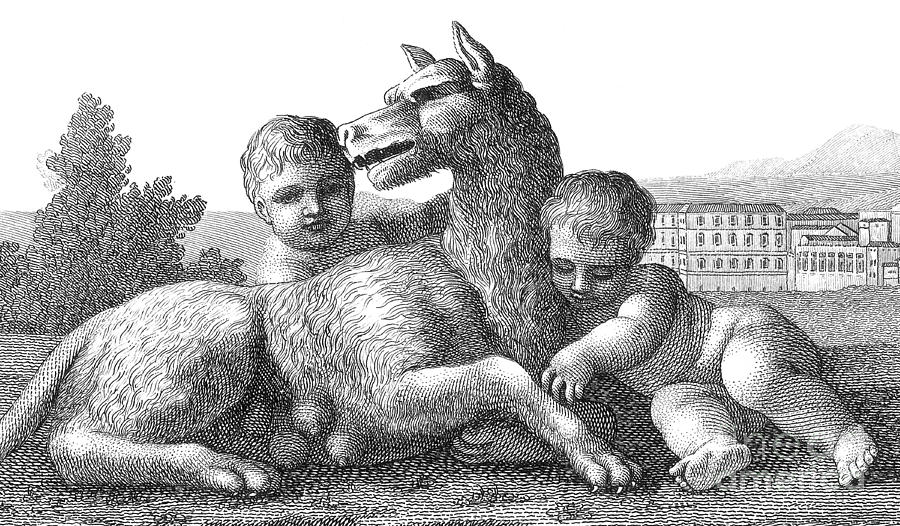
Dogs in Ancient Roman culture were seen much the same way, though, distinctively, dogs weren't featured in the Roman afterlife. That said, they were still prominent figures in Roman mythology, including the founding of the city by twin brothers Romulus and Remus, who were said to have been raised by wolves.
The Romans had a wide range of pets, from cats to apes, but they favored dogs above all others. The dog is featured in mosaics, paintings, poetry, and prose. The Latin poet Virgil wrote, "Never, with dogs on guard, need you fear for your stalls a midnight thief." Similarly, the writer Varro said that every family should have two types of dogs: a hunting dog and a watchdog. Other writers offer advice on the best use of dogs, the best breeding practices, and how to tell which puppies are worthy of attention (we at Pawrade contend that all of them are worthy of attention).

The Romans distinguish themselves from most other cultures by being one of the few in history to leverage dogs as a business. Dog breeding was a serious pursuit, and "high-quality" dogs were much sought after. Popular breeds included the Vertragus (ancestor to the modern Greyhound), the Maltese (the OG lapdog), and the Molossian (ancestor of the Neapolitan Mastiff). The speed of the Vertragus encouraged the development of dog racing. The Molossian often accompanied Roman legionnaires in war and was the preferred breed in dog fighting, alongside the Cane Corso, known as cane pugnaces in those days. An owner's reputation and even livelihood depended on the dog's performance, so racing and fighting dogs were highly regarded and well-taken care of, receiving better attention and care than many Roman slaves and even some family members.
Dogs in Asia
Across the vast expanses of Asia, the story of dog domestication unfolds against a backdrop of diverse cultures and landscapes. Initially tamed for their hunting prowess and later revered as loyal guardians and spiritual symbols, Asian dogs have woven themselves deeply into the tapestry of Asian societies.
China/Japan

The Neolithic site of Banpo Village in Shaanxi Province is one of the many that offers evidence of the dog's early domestication. Dog bones have been found in abundance, and it is likely that, even at this early time period, they were associated with the spirit world. Sometimes, they were killed to release their spirits for protection and buried in front of homes. Like with most ancient cultures, the Chinese had a deep-seated fear of ghosts. There were many different types of ghosts, as well as a variety of reasons why a ghost might appear. Since dogs were recognized as natural protectors, it only made sense that they would be effective against evil spirits as spirits themselves.
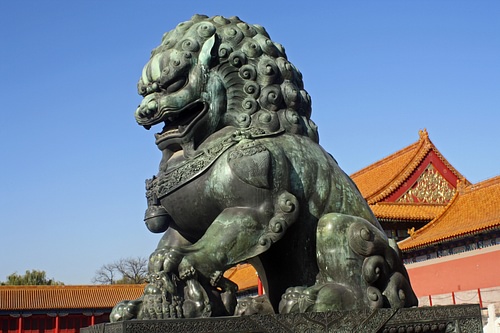
Spirits and the harm they could cause were of great concern to the ancient Chinese, a belief that persists even today. This belief is so prevalent that it even affects the way roads are designed in the country. It is believed that ghosts can only walk in a straight line, so roads are specifically designed to curve and swerve so that spirits can't follow anyone home. It also affected the making of dog collars. Often, small bells were attached to scare off evil spirits. In time, mothers would fasten these same collars on their kids to protect them; a ghost would hear the bells, think the child was a dog, and run away.

In Japan, dogs have long been cherished companions, though they weren't often considered members of the family. Most pets were considered community residents and didn't typically reside within one home. Upon the death of a community animal, folk tradition required that special care be taken of its remains to protect against vengeful spirits.

Unique to Japan are the Nihon-ken ('Japanese dogs'), which comprise six breeds: Akita, Kai, Kishu, Shiba, Shikoku, and Hokkaido. In fact, so unique and admired are the Nihon-ken that they have been declared a Natural Monument. They are said to be brave, honest, and loyal to the person they consider their master, capable of forming strong bonds.
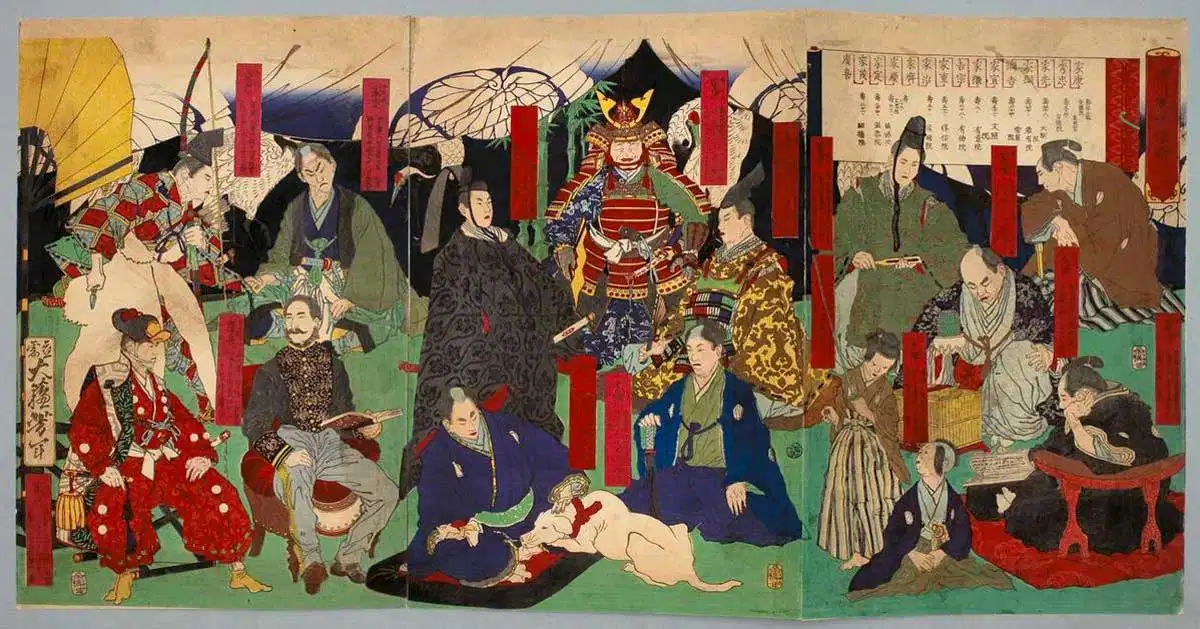
Japan has always been a deeply spiritual culture, and dogs played a large role. Notably, this religious ideology influenced Shogun Tokugawa Tsunayoshi, who was born in the Year of the Dog. He sought protection for all living beings and believed he should take measures concerning dogs. At the time, Edo (the capital city until it was renamed Tokyo) had many stray and diseased dogs walking freely in the streets. A collection of edicts, known as Edicts on Compassion for Living Things, instructed the populace, among other things, to protect dogs. In 1695, the Nakano Kennel was constructed, capable of housing tens of thousands of dogs. Paradoxically, this kennel, born of the notion of the sanctity of life, came at the expense of many of Japan's citizens, including the forced relocation of Nakano's residents. Critics of Tsunayoshi dubbed him Inu-Kubō, the Dog Shogun. The kennel was dismantled and the dogs dispersed after his death in 1709.
Today, dogs continue to play a prominent role in pop culture and folk stories. Most well-known would be Hachikō, who was renowned for his intense faithfulness, as well as Kabosu, better known as Doge meme. Organizations such as the Tokyo-based International Therapy Dog Association train dogs with no owners into therapy dogs and send them to various nursing homes and hospitals throughout Japan.
India
The Indian Pariah Dog, which still exists today, is considered by some to be the first truly domesticated dog in history. One of their great epics tells the tale of King Yudisthira, who, while on pilgrimage, is accompanied by his family and his dog. One by one, his family members perish along the path, but the dog remains. When he finally reaches the gates of paradise, the dog is refused entry. Yudisthira is so shocked that he remains with his faithful dog. This, of course, proves to be one final test of his virtue, and the pair are welcomed into paradise.

This story may serve as the inspiration beyond the second day of the Hindu festival, Kukur, known as Tihar. Kukur Tihar is dedicated to the worship of dogs, in order to please Yama, as they are considered his messengers. Dogs are decorated with tilaka and flower garlands, and are offered various foods, including meat, eggs, milk, and dog food. It's considered a sin if someone acts disrespectfully toward a dog on this day.
Dogs in Africa
In Africa—especially ancient Egypt—dogs were more than companions; they were symbols of loyalty, guardianship, and even the afterlife. Revered for their keen senses and protective nature, dogs in Egyptian society served as hunters, guards, and sacred animals closely tied to spiritual and royal traditions.
Egypt
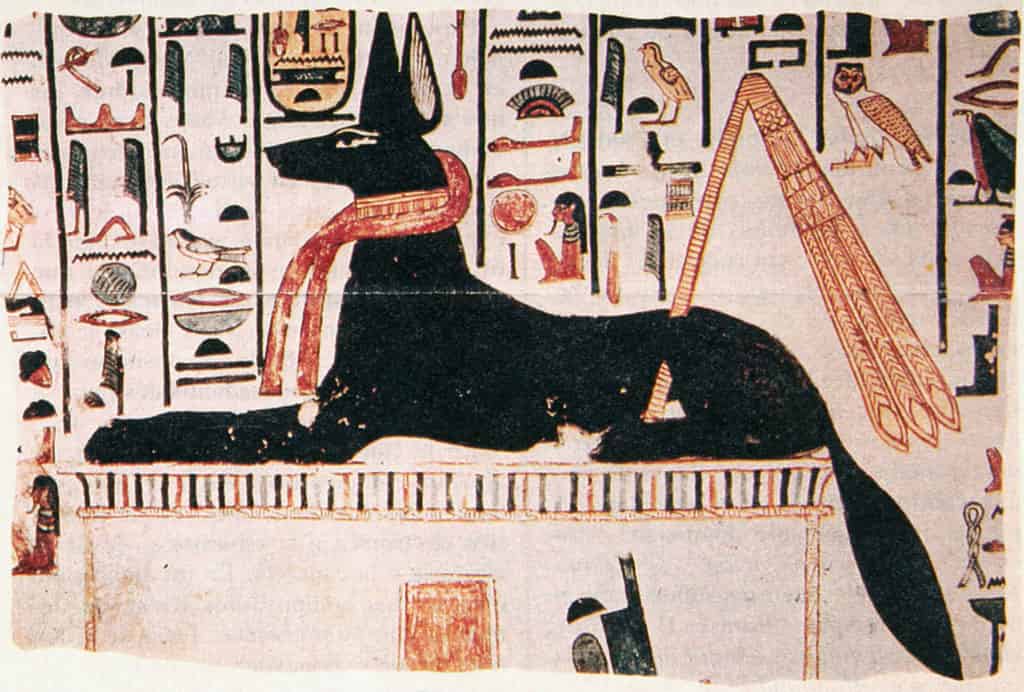
In ancient Egypt, the dog was linked with the god, Anubis, who guided the souls of the dead to the Hall of Truth to be judged by Osiris. Domesticated dogs were buried in the temple of Anubis at Saqqara, likely so that they could pass on to paradise, known as the Field of Reeds. One such dog, which belonged to a servant of the King, was found with a limestone slab. On it was inscribed, "His Majesty ordered that [the dog] be buried ceremonially, that he be given a coffin from the royal treasury, fine linen in great quantity, and incense." Although this is an especially high honor, dogs were commonly mummified alongside their family members.
Some of the earliest evidence of dog collars has also been found in Egypt. A wall painting dating back to 3500 BCE depicts a man walking his dog on a leash, which would have been a simple rope tied to a single ring of leather over the dog's head. These collars grew more elaborate over the centuries, becoming ornamented with copper and bronze studs, as well as intricate etching and artwork.
Dogs in the Americas
The relationship between dogs and indigenous peoples of the Americas spans millennia, beginning with their domestication among early hunter-gatherer societies. Serving as both hunting partners and esteemed companions, dogs in the Americas played multifaceted roles that reflected the rich diversity of indigenous cultures.
Aztecs/Maya

To the ancient peoples of the Aztec and Mayan empires, man's best friend was a hairless, ugly-cute companion known as the Xoloitzcuintli (pronounced show-low-itz-QUEENT-ly). The xolo was a healer, an occasional food source, and, most importantly, a guide to the Underworld. It got its name from two words: "Xolotl," who is the god of lightning and death, and "itzcuitli," meaning dog. The Aztecs believed that the Dog of Xolotl was created to guard the living and guide the souls of the dead through the dangers of the Underworld.
Researchers believe that the Xolo's ancestors accompanied early migrants from Asia and, by roughly 1,500 BCE, developed into the breed we see today. They appear in ancient Mesoamerican art, most frequently in the form of small ceramic vessels, similar to Egypt's canopic jars, known as Colima Dogs. These likely served as symbolic dog guides to assist the dead.
By the time the Xolo was officially recognized in Mexico in 1956, the breed was nearly extinct, having suffered when the conquistadors developed the Aztecs' taste for the canine protein source and nearly ate them into oblivion. Thankfully, the ancient breed is undergoing a revival, especially among people with allergies. But they're not for everyone. Kay Lawson, former president of the Xoloitzcuintl Club of America, warns, "You really have to be thinking [with Xolos] all the time. They open doors, they open crates. This is a primitive dog. They're extremely intelligent."
Pawrade's Pawprint in History
From Garm to Cerberus, from demigods, pharaohs, war chiefs, to farmers and everything in between, "man's best friend" has stood the test of time, becoming a loyal companion to every culture in human history. Like the great empires and cultures of old, Pawrade recognizes the inherent worth of man's best friend. We believe every dog deserves a life of dignity, care, and unconditional love—and that starts with ethical breeding practices, transparency, and lifelong support. At Pawrade, our mission is simple: to connect loving families with healthy, happy puppies raised with compassion, not cruelty. When you choose Pawrade, you're not just getting a pet. You're continuing a legacy of loyalty, love, and respect that has endured through the ages.