Stop, dog. Stop!
The light is red now.
Go, dogs. Go!
The light is green now.
The beloved children’s book, Go, Dog. Go! by P.D. Eastman has been read in classrooms and households for decades, delighting children with silly dogs and their funny antics. Other classic books featuring dogs in children’s literature include Nana from Peter Pan, the early reader series Biscuit, the novel Because of Winn Dixie, and the tearjerkers Where the Red Fern Grows and Old Yeller. The presence of a dog provides comfort in trying times and serves as a best buddy to characters exploring their way through life’s lessons.
Children’s literacy capabilities are severely behind in the United States. According to the National Literacy Institute, 54% of adults demonstrate literacy skills below a 6th-grade level, and 21% of adults in the US were illiterate in 2024. Effective, comprehensive literacy programs are sorely needed across the nation to ensure the next generation of children improves their ability to read and write proficiently. The ability to read is a building block to how children learn about the world around them, and unique measures should be taken into consideration to ensure children have a variety of learning opportunities.
One unique way organizations promote reading comprehension is through kids reading to dogs to improve literacy skills. Let’s learn about innovative programs that utilize dogs as a way to increase children’s literacy skills.

Benefits of Reading to Dogs For Children
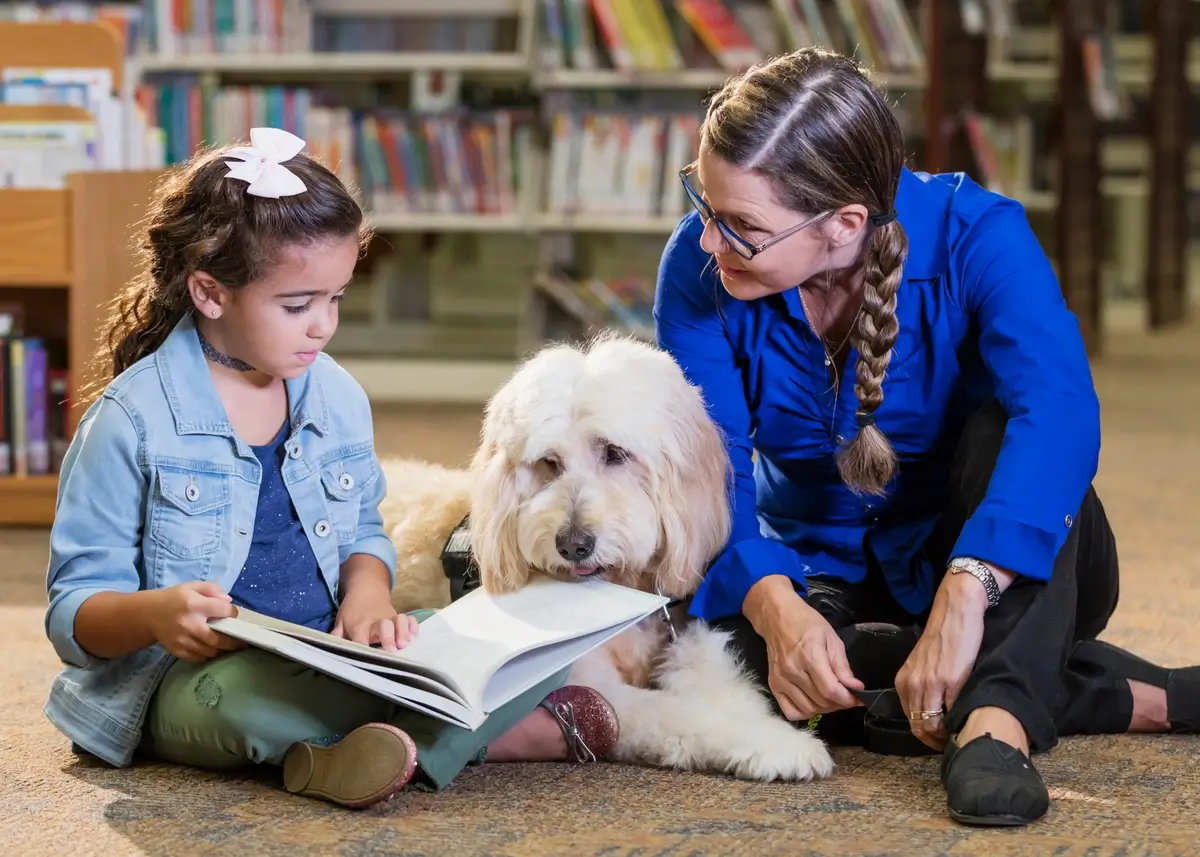
Reading to children is one of the best ways to help them form and practice literacy skills, especially at an early age. Several organizations pair trained dogs with children’s schools and programs where children read aloud to dogs to practice reading in a new way. Reading to dogs helps children learn that reading can be fun and rewarding while learning new words and gaining confidence in a relaxed, stress-free environment. The benefits of reading to dogs go beyond learning reading fundamentals. Children also learn emotional, social, and character traits reflected in stories to practice in their own lives.
Dogs listen and they don’t judge
Reading out loud in front of a classroom of peers and teachers can be a daunting task, even for the most proficient reader. A child may become so nervous they trip up over the words, even if they usually demonstrate fluency. Struggling readers may clam up completely, feeling defeated before they even begin. Children also don’t want to get made fun of or teased. According to Psychology Today regarding how reading to a dog improves literacy skills, “the first casualty is self-esteem, and the second, and perhaps more important, is their motivation to read.” Not having confidence when reading aloud can affect children’s love of reading since they associate it with a stressful event.
However, when students read to dogs, they can build self-esteem and confidence in their reading skills. There’s no fear of criticism from the encouraging face and patient demeanor of a well-behaved canine reading buddy. The child will feel less embarrassed when sounding out difficult words and decoding sentences. A dog will not judge a child who is struggling to read, unlike the risk in a classroom.
Emotional regulation and connections
Because of their newfound confidence, children will be more willing to share their thoughts and feelings about the story with their dog friends, things children might have withheld from a class discussion. Engaging more with the story helps children connect with what they are reading rather than merely sounding out a string of words, missing key points and life lessons reflected through literature.
In addition to relating to the world around them through connection to the story, a connection made when reading to dogs can help regulate children’s emotions and teach values like empathy, persistence, and courage. Exposure to pets helps children increase their love of animals and empathy toward other living creatures.
Behavioral improvements
Some children have difficulty in school with behaviors that can be challenging in a classroom setting. Reading to dogs helps children regulate their behaviors by reinforcing a calm setting, improving focus, and reinforcing positive behaviors and expectations. A recent study exploring how reading aloud to children affects aggression, hyperactivity, and other behaviors notes that “When parents read with their children more…they learn to use words to describe feelings that are otherwise difficult, and this enables them to better control their behavior when they have challenging feelings like anger or sadness.”
Paws and Pages: 6 Canine Reading Programs
Several organizations aim to improve literacy by young readers reading to dogs in various settings, whether it’s a classroom, a library, or an animal shelter. A break from the norm in a different setting when practicing reading can spark a different approach and give the kid a variety of settings to flex their reading skills with a dog attentively listening. See how a few of these organizations where students read to dogs make a difference in budding readers’ literacy journeys.
Canines For Literacy
The Canines For Literacy program brings the magic of reading to school children in two North Carolina areas. Each dog-handler team completes a comprehensive training program to ensure calm behavior with the public and an understanding of the goals of the program. Their mission is to help improve communication and reading skills in a judgment-free environment utilizing the quiet presence of a canine listener. Adult participants love seeing their students acquire a love of learning, maintaining focus, and practicing their reading skills in a relaxed setting with certified dogs.
K9 Reading Buddies of the North Shore
K9 Reading Buddies of the North Shore near Chicago motivates kids to read by using registered therapy dogs and qualified handlers to supplement local literacy programs. They focus on the pre-kindergarten age where a person with a canine buddy reads aloud to the class. Elementary and middle school-aged kids who are struggling benefit from teaching and reading to the dog rather than a teacher teaching a student the material to gain mastery and reduce embarrassment. Afterschool programs offer children the opportunity to read in English or Spanish to reach a wider population. Visits to libraries and community programs also fill the dogs’ days of literacy services.
Read to Dogs at Cleve J. Fredricksen Library in PA
For nearly a decade, the Read to Dogs program at the Cleve J. Fredricksen Library in the greater Harrisburg, PA area. Read to Dogs provides certified therapy dogs for children through age 12 to overcome anxieties about reading aloud and hone their literacy skills at the same time. Student Frannie has noticed a huge improvement in her confidence and reading skills. She notes, “I wasn’t very confident because I knew I didn’t have the skills the other kids have. But once I kept growing and reading, I just kinda felt more confident.”
Reading Education Assistance Dogs (R.E.A.D.)
An international program called Reading Education Assistance Dogs (R.E.A.D.) aims to “improve the literacy skills of children through the assistance of registered therapy teams as literacy mentors.” The R.E.A.D. program offers specific training for handlers and dogs to become certified “literacy coaches.” With chapters all over the world, R.E.A.D. has helped thousands of children foster a love of reading since 1999. Teacher feedback has included such successful comments as, “Students enjoyed reading again rather than seeing as a chore,” and “The dogs brought excitement back to reading out loud in my classroom when the dogs were no longer there.” One of the most telling comments as to a testament to the importance of the R.E.A.D. program is when a participant noted, “The students who work 1:1 with the dogs have definitely shown an increase in a desire to read, and a less hesitant nature when opportunities arise to read aloud in class.”
BARK Reading Therapy Dogs
Teams across California are spreading a love of reading with the BARK Reading Therapy Dogs program. Reading to a dog in the BARK program encourages students to read words aloud they do not know by trying them out without the anxiety of making mistakes. The program has schools select a small group of students needing additional reading support. For 8-10 weeks, students read to dogs for about 20 minutes once a week. Teachers have found an increase in reading words per minute, improved classroom participation, and self-confidence in reading skills.
“Reading to Dogs” Progam at Prince William Public Libraries (VA)
The “Reading to Dogs” Program at Prince William Public Libraries in Virginia has helped transform the library into a community hub. Specially trained dogs sit with children who read aloud to them as they patiently listen. Adult participants have noticed “heartwarming moments of connection and growth” as children form bonds with the dogs, form ideas about the world around them, and make new friendships. The area libraries publish an online calendar so community members know when the programs are held.
Tell a “Tail” To A Pawrade Puppy
At Pawrade, we believe every person deserves a puppy to write a new chapter in life, your story unfolding with each adventure. We offer plenty of cuddly couch buddies that would love to curl up with you for a family bedtime story, your puppy and your children snuggled up together sleeping peacefully. Perhaps you want a companion to warm your lap as you finish the latest page-turner. Maybe you want to train your own canine reading therapy buddy to listen to local children practice their literacy skills. Your story begins as you browse our puppies for sale. We can’t wait to help you fill in that first blank page of a beautiful “tail” together.