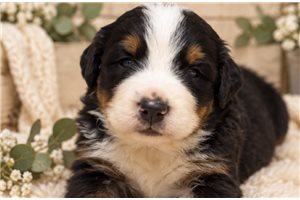
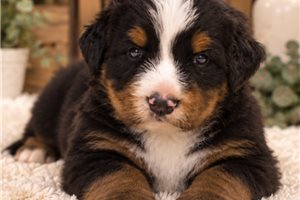
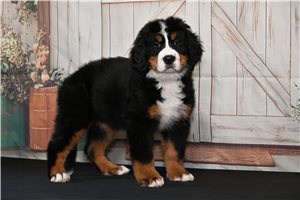
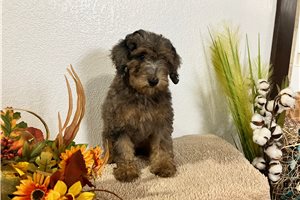
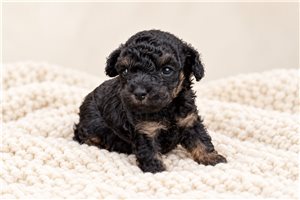
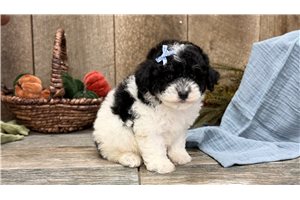
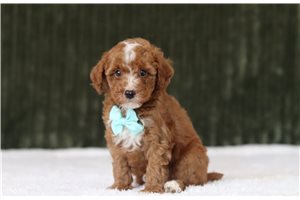
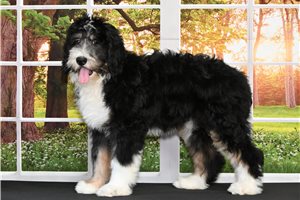
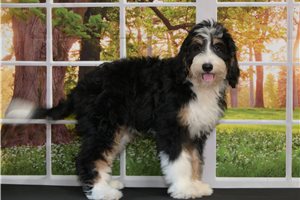
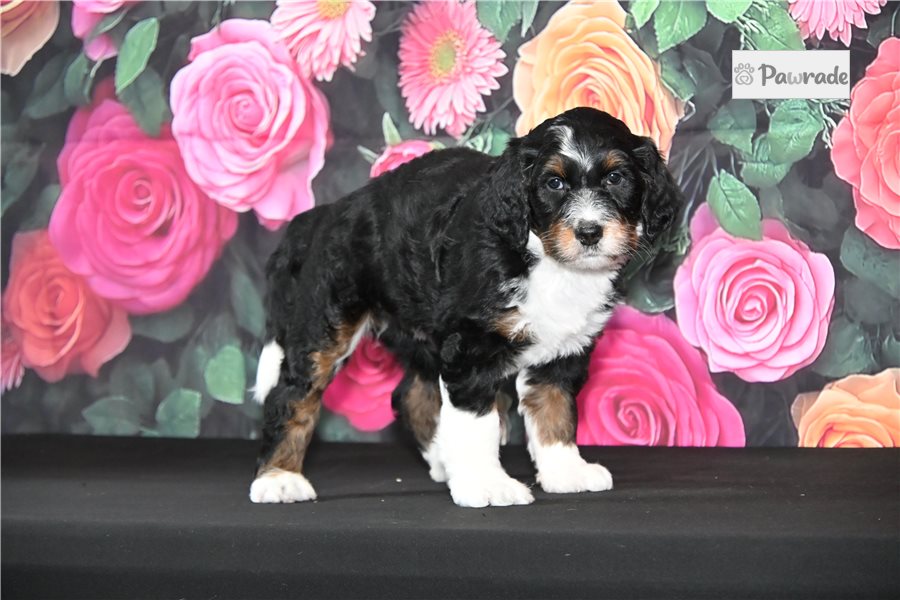
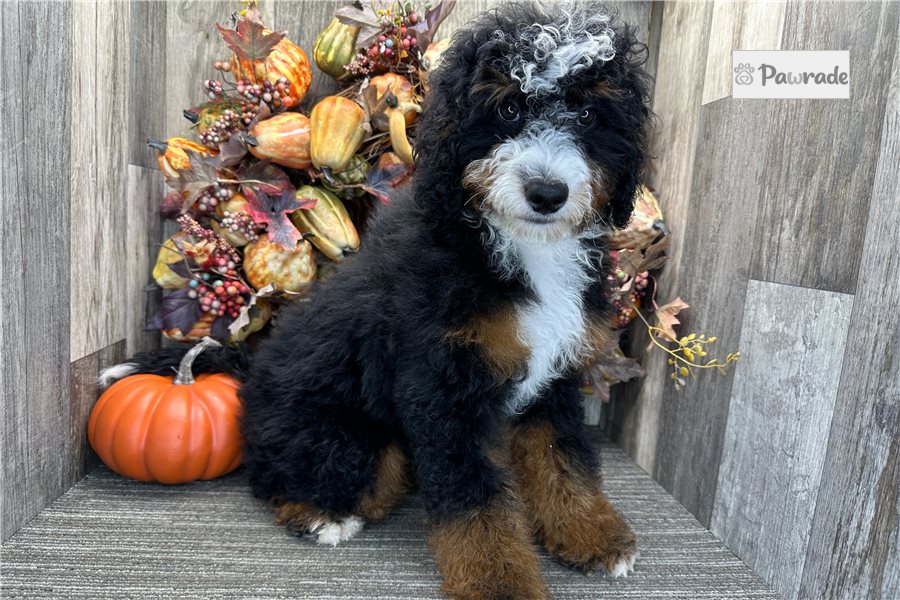
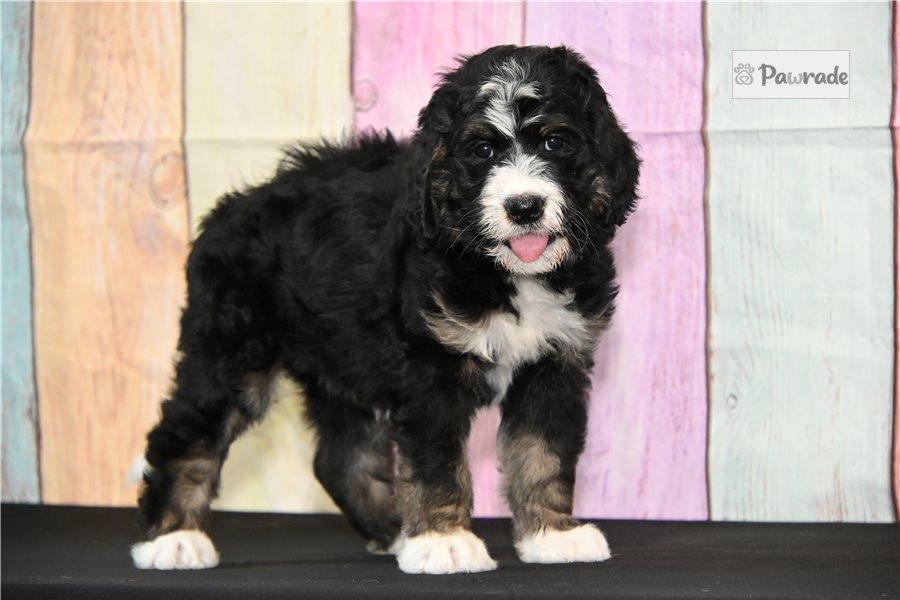
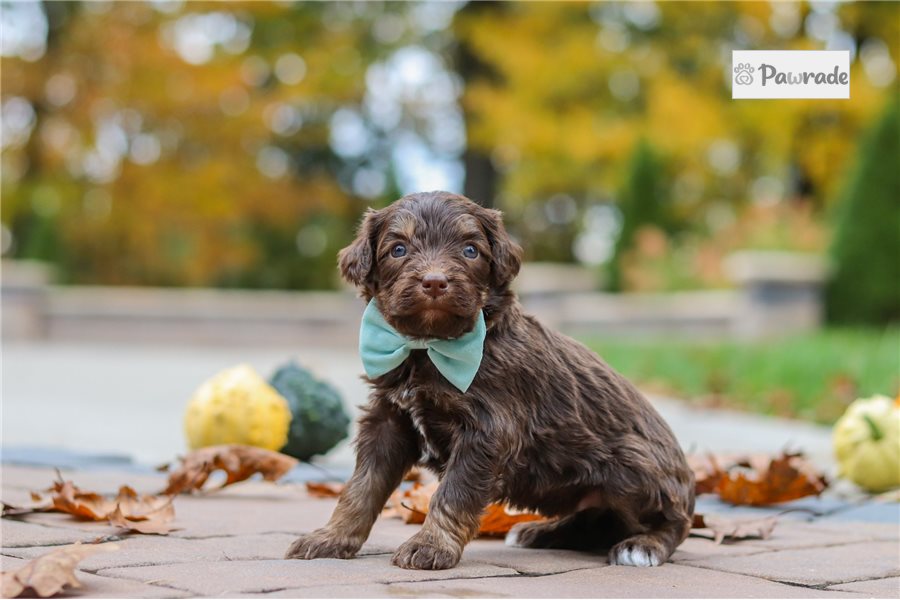
People fall for the Bernese look in a doodle coat: the black, white and rust markings on soft waves or curls. Underneath is a goofy, affectionate dog that wants to be wherever its people are.
People fall for the Bernese look in a doodle coat: the black, white and rust markings on soft waves or curls. Underneath is a goofy, affectionate dog that wants...People fall for the Bernese look in a doodle coat: the black, white and rust markings on soft waves or curls. Underneath is a goofy, affectionate dog that wants to be wherever its people are.
Only with Pawrade, you receive a pet insurance policy with no waiting period included for immediate accident or illness coverage. *NH, NY, RI, SC and TN residents excluded
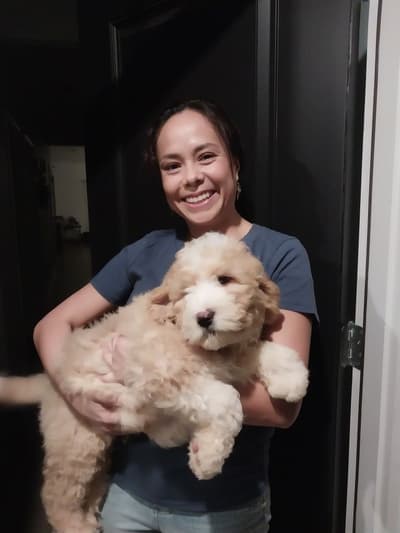
“Maui is a beautiful pup. My family is so happy to have him. Everything went smooth with the process to get him. Thank you.”
Alison · Bernedoodle
May 23, 2023
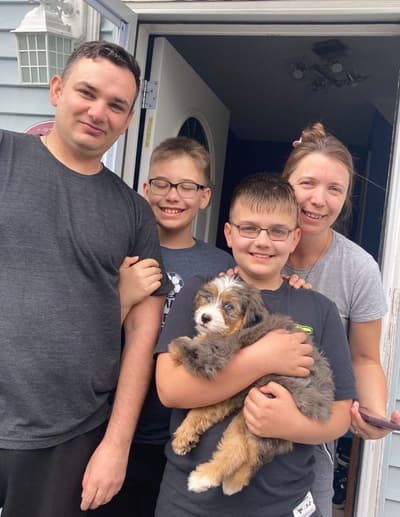
“Puppy is perfect!!! Playful and full off energy!! The service was great, fast respond for all my questions...”
Paisley · Bernedoodle
Aug 19, 2026
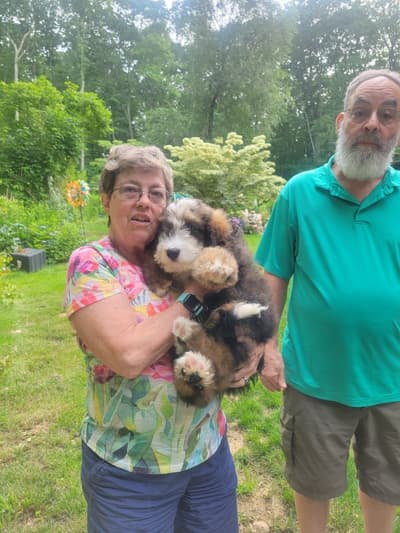
“You made it so easy for me. Everyone was so nice and helpful.”
Tucker · Bernedoodle
Jul 8, 2023
“The advisors were very helpful and answered every question. They did some digging to find a good match since I had some restrictions. When I had trouble with a link they worked with me to resolve the issue. The delivery folks were great and took great care of the puppy.”
Puppy scams cost U.S. families millions every year. Here's how you know Pawrade isn't one: we're a named, audited business with a public track record you can check anywhere.
Pawrade data: parents of puppies placed through Pawrade (breeder-reported)
Height
10–29 in
Mini Bernedoodles have their own CatID (mini-bernedoodle); the Tiny/Toy size is listed by variety only.
Lifespan
12–15 years
Shedding
Moderate
Bernedoodle Characteristics
Full-Grown Size
5 of 7SmallLarge
Grooming Needs
6 of 7SeldomRegularly
Good with Dogs
4 of 7Not ReallyYes!
Watchdog Ability
5 of 7LowHigh
Exercise Needs
5 of 7Couch PotatoHigh Needs
Your new best friend.
Bernedoodle temperament
Personality and daily life
Temperament
A Bernedoodle is a family dog first. Most are goofy, affectionate, clever and eager to please. Well-socialized Bernedoodles are generally good with children and other pets, cats included. Early, broad socialization matters, because it keeps a Bernedoodle from becoming shy or aloof with strangers as it grows up.
Energy and play
Puppies are busy and can be destructive without play, while adults usually settle well indoors. Hikes, swims and trick training suit most Bernedoodles, and grown dogs make good running partners. That love of the outdoors comes from both sides: the Poodle was a water retriever, and the Bernese a farm dog that pulled carts.
Training
They learn quickly. Training goes best with positive reinforcement and a calm voice, and harsh methods backfire. Some Bernedoodles turn stubborn in adolescence, so start early and stay consistent. Through AKC Canine Partners, Bernedoodles can compete in AKC sports such as agility, obedience, rally and scent work.
Company and time alone
The one thing to plan around is time alone. Many Bernese Mountain Dogs, one of the two parent breeds, dislike being left alone and some can develop separation anxiety, so a Bernedoodle may as well. Practice short absences from the start, with a crate, a chew toy and a little music, and build the time up slowly.
Pawrade data: parents of puppies placed through Pawrade (breeder-reported). Placements and reviews come from Pawrade's records.
A healthier start for a happier tomorrow.
Bernedoodle care & grooming
Care and grooming
The routine
Exercise needs
A Bernedoodle needs about 60 minutes of walks and play a day, plus brain games such as puzzle toys. Many enjoy fetch, water games and even pulling a cart.
Coat and shedding
Moderate
The coat can be straight, wavy or curly, and most Bernedoodles are wavy. Straighter, Bernese-like coats shed more than curly ones.
Daily
Teeth and gums
Brush the teeth every day with a dog toothpaste.
Weekly
Coat and grooming care
The coat tangles into mats without regular care, so brush at least weekly, ideally two or three times. Book professional grooming every 2–3 months.
Monthly / as needed
Bath time
Bathe only when needed, because frequent baths dry the skin.
Ear checks
Clean the ears after every swim with a gentle ear cleaner.
Keeping them safe
Heat safety
Like the Bernese, Bernedoodles are sensitive to heat.
Book a yearly checkup, and have a cloudy or changing eye looked at promptly.
Skin changesMention skin changes
Mention itching, hot spots or other skin changes at checkups.
Back and spineKnow when to call
See your vet promptly about weakness in the back legs of an older dog.
Joints and movementKeep them lean and cool
Keep your Bernedoodle lean, especially while it is growing, to protect the hips and elbows.
Stomach and digestionKnow when to call
Learn the signs of bloat in a standard Bernedoodle, and treat them as an emergency.
Heart checksRoutine vet checks
Ask your vet to listen for a heart murmur at each visit while your puppy is young.
Every milestone, together.
Bernedoodle puppy milestones
Your Bernedoodle's first 2 years
Before 8 weeks
Before your puppy comes home
Your puppy is still with its litter, and its most open weeks for meeting new people, places and sounds have already begun. Nobody can promise its exact adult size, because a Bernedoodle's size depends on its parents and varies by generation.
Set up a crate in a room where the family spends time, or in your bedroom at night, with safe chew toys ready.
Buy a floor-level slow-feeder bowl and a puppy food suited to your puppy's adult size.
Pick up a gentle, pH-balanced ear cleaner for after baths and swims.
Book a first visit with your own vet, and ask about steady growth and preventing bloat.
Why it matters
A crate near people helps a new puppy settle, and you will hear it if it needs to go out at night.
Bernedoodle note
Standard Bernedoodles grow into large, deep-chested dogs, so the floor-level bowl and smaller meals help prevent bloat from the start.
8–10 weeks
Week 1 at home
Everything is new, and Bernedoodle puppies tend to pick up crate and potty training quickly when the routine stays the same. A young puppy needs to go out often, especially first thing in the morning, last thing at night and after naps.
Take your puppy out at those times every day, and keep meals and bedtime on the same schedule.
Start leash training right away, with short, happy walks around your home and yard.
Leave your puppy in its crate for a few minutes with a chew toy while you are home.
Take your puppy for its first vet visit, a full check of the eyes, ears, heart, lungs and joints.
Why it matters
Releasing your puppy only once it is quiet teaches it that quiet, not crying, gets rewarded.
Bernedoodle note
A Bernedoodle may take after the many Bernese Mountain Dogs that dislike being alone, so start alone-time practice in week one.
10–12 weeks
Weeks 2 to 4
Your puppy is in the middle of its main socialization window, which runs through about the first 3 months. What it meets now shapes how it feels about strangers, other dogs and new places later on.
Plan a few short, calm introductions each day to new people, new places and friendly, healthy dogs.
Sign up for puppy classes, which can start at 7–8 weeks, once your vet is happy with the first vaccines.
Until the vaccines are finished, keep your puppy away from sick dogs, as your vet advises.
Keep training sessions short and upbeat, and reward the behavior you want with treats and praise.
Why it matters
Positive, structured experiences in these weeks give a puppy skills it will use for the rest of its life.
Bernedoodle note
A Bernedoodle is a sensitive dog that responds to a calm voice, so harsh corrections tend to backfire.
3–4 months
3 to 4 months
Around 12 weeks, the baby teeth start falling out as the adult teeth push through, and chewing picks up. The puppy vaccine series usually ends at about 16 weeks, as your vet advises.
Rotate a few safe chew toys at a time, and put shoes and cords out of reach.
Stretch the gaps between bathroom trips slowly, since a puppy can usually hold its bladder about as many hours as it is months old.
Brush your puppy gently a few times a week, so the brush feels normal long before the first mat.
Why it matters
A Bernedoodle coat mats without regular brushing, and a puppy that learns to enjoy grooming copes far better with a lifetime of it.
Bernedoodle note
Doodle coats are not low-maintenance, so the brushing habit you build now pays off for years.
4–6 months
4 to 6 months
By about 6 months, your puppy's adult teeth are in and teething winds down. A standard Bernedoodle is a large, fast-growing puppy whose hips and elbows are still developing.
Feed measured meals of a large-breed puppy food so a standard grows steadily rather than fast.
Let your puppy run and play at its own pace, and skip forced running and long jogs for now.
Keep your puppy lean rather than round, because fast growth and extra weight are hard on young hips.
Why it matters
A puppy's leg bones grow from soft growth plates, and too much hard exercise can injure them before growth is done. Steady, lean growth also lowers the risk of the hip problems that run in the Bernese side of the family.
Bernedoodle note
Limping in a growing Bernedoodle is worth a vet visit rather than a wait to see if it passes.
6–12 months
6 to 12 months
Around 8 months, many young dogs start testing boundaries and seem to forget cues they already knew. This teenage stage is normal, and some Bernedoodles also turn stubborn for a while.
Keep training sessions short and consistent, and use rewards your dog really wants.
Keep your dog lean and its exercise controlled while it is still growing.
Talk with your vet about spaying or neutering, since the right time depends on things like sex and expected adult size.
For a standard, also ask your vet about a stomach-tacking surgery (gastropexy) that helps prevent bloat.
Why it matters
Patience, consistent training and plenty of exercise for body and mind carry a young dog through these months.
Bernedoodle note
Some Bernedoodles inherit a stubborn streak from the Bernese side, so patience works better than pressure.
1–2 years
1 to 2 years
Your Bernedoodle looks grown up, but most dogs are fully grown and settled only at around 2 years. Most adults settle well indoors once they get their daily exercise.
Ask your vet whether growth is finished before you add jogging, long hikes or agility.
Settle into the adult routine of two meals a day, with no hard exercise right after eating.
Keep brushing through the week, and book professional grooming every few months.
Book a yearly wellness exam with your vet, and keep brushing your dog's teeth every day.
Why it matters
An adult Bernedoodle that gets its walks, play and brain games is a relaxed, happy companion at home.
Bernedoodle note
Hikes, swims and games of fetch suit most adult Bernedoodles, so this is the time to find the activities you both enjoy.
No registry or club publishes a Bernedoodle standard, so size, coat and color vary with the parents and the generation.
Size
Size follows the Poodle parent: a Standard Poodle gives a standard Bernedoodle, a Miniature Poodle a mini, and a Toy Poodle the tiny size. A tiny is often bred from a Mini Bernedoodle and a Toy Poodle. A standard Bernedoodle weighs 61–100 lb and stands up to 29 in. A tiny Bernedoodle weighs up to 20 lb and stands 12–17 in. Medium and mini sizes fall in between, and females are usually smaller than males. A Bernedoodle's adult size depends on its parents and varies by generation, so each puppy's listing shows its parents' weights.
Generations
A first-generation (F1) Bernedoodle has one Bernese Mountain Dog parent and one Poodle parent. An F1B is an F1 bred back to a Poodle, and an F2 is two Bernedoodles bred together. F1B puppies tend to shed less. F2 and straighter-coated dogs may shed more.
Colors and markings
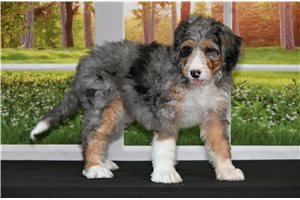
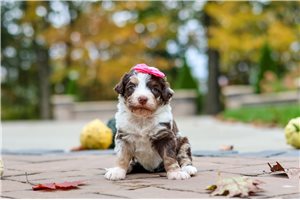
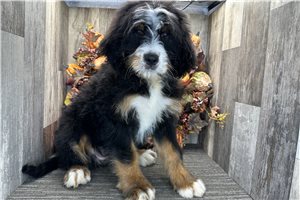
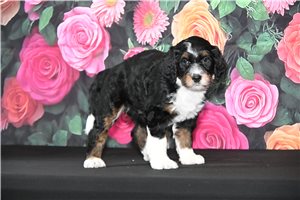
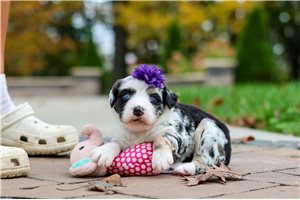
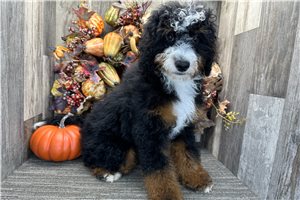
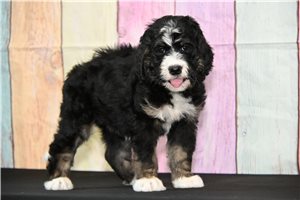
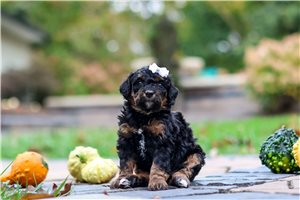
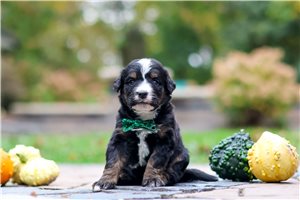
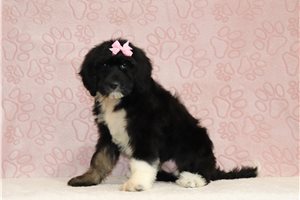
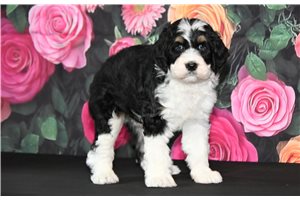
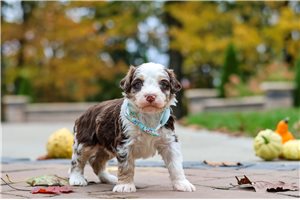
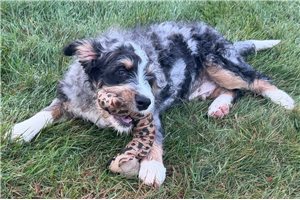
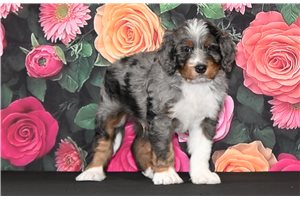
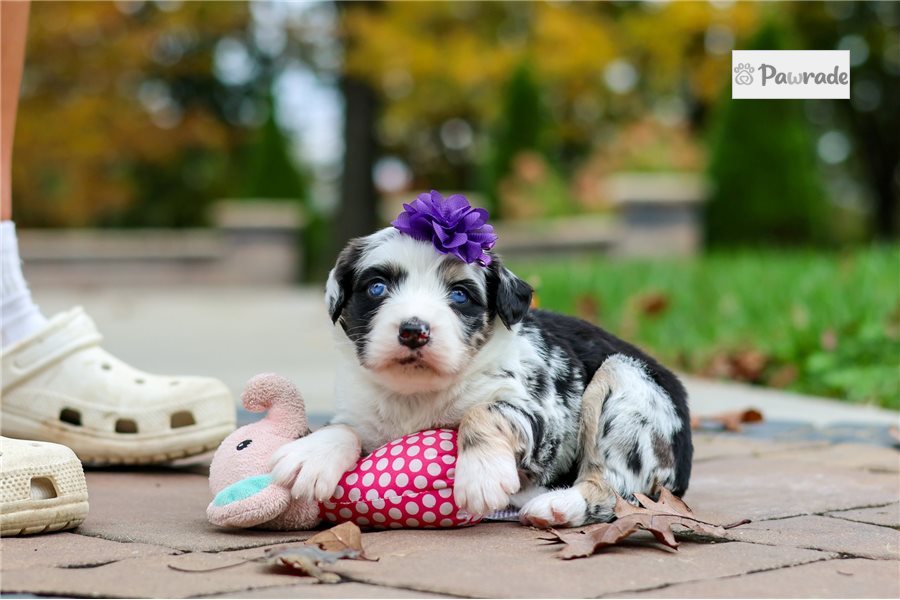
Bernedoodles are most often tricolor (black, white and rust or tan), black and white, black and brown, or solid black. Chocolate, gray or blue bi-colors and merle also occur. The Bernese standard allows only the black, rust and white tricolor, and neither parent breed's standard includes merle. Breeding two merles (double merle) raises the risk of deafness and eye defects.
Colors listed by Pawrade breeders
Black
Blue Merle
Brindle
Chocolate
Cream
Fawn
Merle
Phantom
Sable
Silver
Tri-colored
A little history, a lot of heart.
Bernedoodle history
History
2003
Sherry Rupke of Swissridge Kennels bred the first deliberate Bernedoodles in Canada in 2003.
The aim was a companion with the Bernese temperament, a longer life and a coat that sheds less.
The Poodle, France's national dog, began in Germany as a water retriever, and its name comes from the German word for splashing.
1887
The AKC recognized the Poodle in 1887 and the Bernese in 1937.
The AKC, UKC and the international registry (FCI) do not recognize the Bernedoodle, and no breed club or association sets a standard for it.
The parent breeds' clubs are the Bernese Mountain Dog Club of America and the Poodle Club of America.
Checked with care before travel.
Bernedoodle Veterinary Health Report
Your puppy's Veterinary Health Report
Every Bernedoodle puppy gets a full hands-on exam from the breeder's licensed veterinarian before it goes home, done to PetPay's exam standards and recorded in its own Veterinary Health Report.
The exam, a health certificate and a stool test for parasites all happen 3 to 5 days before your puppy leaves.
1It is a close look at your puppy itself, not a breeder's paperwork on the parents.
2If the vet finds something that could put your puppy at risk during travel, your puppy stays with the breeder until it's resolved.
3Problems that can be treated before travel are treated by the breeder's licensed vet first.
4Anything else the vet notes is shared with you.
5A hard copy of the report travels with your puppy for your records, and a digital copy is in your PetPay account.
PetPay Veterinary Health Report form
16 areas checked on the exam
Closer look for BernedoodlesOn every puppy's report
Puppies must be at least 8 weeks old and 2 lb before they travel. Every puppy also comes with a health guarantee administered by PetPay, independent of the seller. The terms are on the health guarantee page.
Frequently asked questions about Bernedoodle puppies
Frequently asked questions
A standard Bernedoodle weighs 61–100 lb and stands up to 29 in, and a tiny one weighs up to 20 lb and stands 12–17 in. Standards reach their full size at about 2 years, and each puppy's listing shows its parents' weights.
The parents' weights give a rough guide, and each listing shows them, because a Bernedoodle's adult size depends on its parents and varies by generation. Parents of Pawrade Bernedoodles typically weigh 30–90 lb (fathers) and 35–75 lb (mothers).
They name the generation, and an F1 is a Bernese Mountain Dog crossed with a Poodle. An F1B is an F1 bred back to a Poodle, and an F2 comes from two Bernedoodles bred together. F1B puppies tend to shed less, while F2 and straighter-coated dogs may shed more.
Pawrade breeders list Bernedoodles in black, blue merle, brindle, chocolate, cream, fawn, merle, phantom, sable, silver and tri-colored. The AKC, UKC and FCI do not recognize the Bernedoodle, so no breed standard sets its colors. Merle is outside both parent breeds' standards.
Bernedoodles are affectionate, goofy and intelligent, and most are eager to please and love to be with their people. Early, broad socialization keeps them confident rather than shy with strangers.
Most adult Bernedoodles are playful without being hyperactive, though energy varies with size and parentage. Puppies are busier, and adults usually settle well indoors.
Many Bernedoodles thrive as therapy dogs, and therapy work is among the activities the cross is known for. Their people-loving, eager-to-please nature suits the work, and calm, reward-based training brings it out.
It can be, because Bernedoodles are eager to please and pick up crate and potty training quickly. First-time owners should plan for daily exercise, company and a regular grooming routine.
Well-socialized Bernedoodles are generally good with children. Bernedoodle breeders on Pawrade report socializing 87% of their litters with young children.
Well-socialized Bernedoodles are generally good with other dogs and pets. Bernedoodle breeders on Pawrade report socializing 88% of their litters with large dogs before the puppies go home.
Bernedoodles are generally good with cats when they are socialized. Some breeders on Pawrade socialize their litters with cats before the puppies go home.
Plan on about 60 minutes of walks and play a day, plus brain games such as puzzle toys and snuffle mats. Puppies need gentle play rather than forced running, and adults can join you on runs once they are grown.
A tiny or mini Bernedoodle can if it gets daily exercise, while standards do better with more space. Most Bernedoodle buyers on Pawrade live in a single-family home, and some live in apartments.
Long days alone may be hard on a Bernedoodle, because many Bernese Mountain Dogs, one of its parent breeds, dislike being left alone and some can develop separation anxiety. Start crate training and short absences early, with chew toys.
Many do, because swimming and water retrieving suit the Poodle's water-retriever heritage. Clean the ears after swims and baths to help prevent infection.
Feed a puppy food suited to its adult size, such as a large-breed puppy food for a standard, in 3–4 meals a day. Adults do well on two meals a day from a floor-level bowl. Raised bowls, fast eating and one large meal raise the risk of bloat in large dogs.
Hiking, swimming, fetch, puzzle toys and trick training suit most Bernedoodles. Adults can also join you on runs, and mixed breeds can compete in AKC sports through AKC Canine Partners.
Wait until your Bernedoodle has finished growing before you start jogging or long runs, and ask your vet when that is. Standards reach their full size at about 2 years, and until then gentle play is kinder to growing joints than forced running.
Most Bernedoodles shed a moderate amount, and no dog is truly hypoallergenic. Allergens are also carried in saliva and urine, so a Poodle-type coat may suit some people with allergies but not all. Straighter coats shed more than curly ones.
Most Bernedoodles need a professional groomer, because the coat tangles into mats without regular care. Brush at least weekly, ideally two or three times, and book a professional groom every 2–3 months.
Clean the ears after swims and baths with a gentle, pH-balanced ear cleaner to help prevent infection. Brush the teeth every day with a dog toothpaste.
Mostly, because they are intelligent and eager to please, but some turn stubborn, especially in adolescence. Positive reinforcement and a calm voice work best, and harsh methods backfire.
Start on the first day, because Bernedoodles tend to learn crate and potty training quickly. Keep the crate in a room where the family spends time, or in your bedroom at night. Take your puppy out first thing in the morning, last thing at night and after naps, and start leash training right away too. Breeders on Pawrade report whether they have started crate training, so ask how far your puppy has got.
A puppy can usually hold its bladder for about as many hours as it is months old, so a 3-month-old can wait about 3 hours. Very young puppies need to go out first thing in the morning, last thing at night and after naps.
Your Bernedoodle has probably reached adolescence, which may begin around 8 months and last until about 2 years. Testing the rules is a normal stage, and some Bernedoodles turn stubborn for a while. Keep training short, calm and consistent, and use rewards your dog really wants.
Puppies travel only once they are at least 8 weeks old and weigh at least 2 lb. Most Bernedoodle puppies go home at about 12 weeks, usually between 9 and 18 weeks.
Most puppies have all their adult teeth by about 6 months, and teething winds down then. The baby teeth start falling out at around 12 weeks, so expect extra chewing from then on. Offer safe chew toys, rotate a few at a time, and keep shoes and cords out of reach.
Start right away, because the main socialization window is roughly the first 3 months. Puppy classes can start at 7–8 weeks, after a first set of vaccines, as long as your puppy stays away from sick dogs.
Most puppies finish their core vaccine series at about 16 weeks, as your vet advises. Your puppy's own vet sets the exact schedule. Puppy classes can start before the series ends, from 7–8 weeks, as long as your puppy avoids sick dogs.
Get a crate, safe chew toys, a floor-level slow-feeder bowl, puppy food suited to the adult size and an ear cleaner. Book a first vet visit, and ask about steady growth and preventing bloat.
Most Bernedoodle litters on Pawrade meet children, other dogs and everyday household sounds before the puppies go home. Breeders report socializing 87% of litters with young children and 88% with large dogs. They also report getting litters used to the vacuum cleaner (64%) and music or TV (54%). These figures come from what breeders reported for 193 litters. Keep it going once your puppy is home, because the first 3 months are the main socialization window.
The Veterinary Health Report is the record of your Bernedoodle puppy's exam before it goes home. The breeder's licensed vet gives the puppy itself a full hands-on exam, to PetPay's exam standards, and records the results there. It gives you and your own vet a clear starting point for your puppy's care.
The breeder's licensed veterinarian examines every puppy before it goes home, to PetPay's exam standards. The results are recorded in the puppy's Veterinary Health Report, and a copy travels with your puppy for your records.
The breeder's vet examines the whole puppy and pays close attention to a few things that matter in Bernedoodles. The vet listens to the heart for a murmur and checks the eyes for eyelash problems and cloudiness. The vet also looks over the skin, ears and coat.
Before travel, every puppy follows PetPay's vaccination and deworming schedule as far as its age allows: deworming at 2, 4, 6, 8, 10 and 12 weeks, and the distemper, parvo, adenovirus and parainfluenza combination shot at 6–8, 9–11 and 12–14 weeks. Bordetella and corona are given at the vet's discretion, and no vaccine is given within 3 days of travel. Rabies is given by a licensed vet on the schedule your state requires. Your own vet completes the series. Your puppy's vaccination and deworming records are separate documents that travel with your puppy. Bring them, with the Veterinary Health Report, to your first visit so your vet starts from the same record.
If the vet finds something that could put your puppy at risk during travel, your puppy stays with the breeder until it's resolved. Problems that can be treated before travel are treated by the breeder's licensed vet first. Anything else the vet notes is shared with you.
Puppies grow and change quickly, and their immune systems are still developing, so no single exam can find everything. Hip and elbow problems, for example, usually can't be detected at this age, so checks carry on as your dog grows. The report is a strong early look at your puppy, and your own vet builds on it at every checkup.
Not from the AKC, UKC or FCI, which do not recognize the Bernedoodle. No breed club sets a Bernedoodle standard, and enrolling in AKC Canine Partners for AKC sports is not breed recognition.
Right now, most Bernedoodle puppies on Pawrade are listed within the typical range shown on Pawrade's Bernedoodle listings. Each breeder on Pawrade sets their own price, and each puppy's listing shows it. A Bernedoodle puppy's price reflects what goes into it: its pedigree and registration, its coat and color, and the breeder's program. Every Pawrade puppy's price also includes the pre-travel exam by the breeder's licensed vet, the Veterinary Health Report and a health guarantee administered by PetPay.











 Bernedoodle note