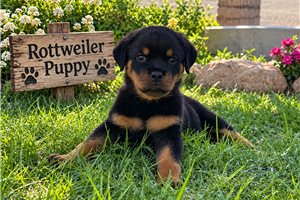
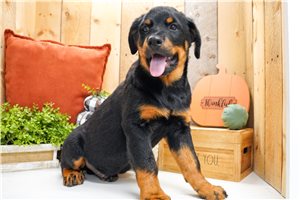
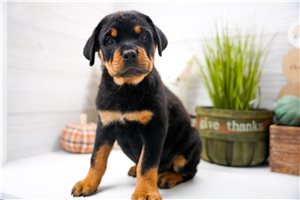
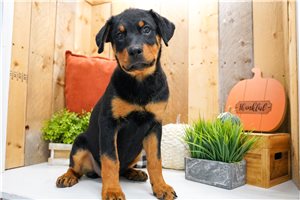
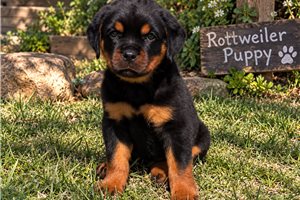
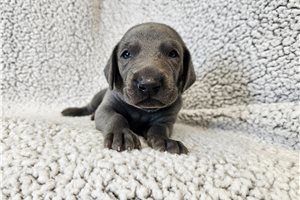
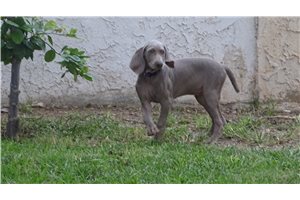
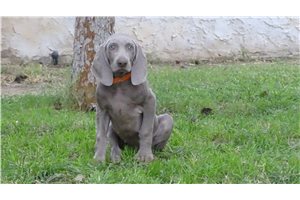
People fall for the Doberman's mix of elegance and devotion: a sleek, powerful dog that wants to be wherever its family is. It is alert and fearless on watch, yet quick to learn and happiest working alongside the people it loves.
People fall for the Doberman's mix of elegance and devotion: a sleek, powerful dog that wants to be wherever its family is. It is alert and fearless on watch,...People fall for the Doberman's mix of elegance and devotion: a sleek, powerful dog that wants to be wherever its family is. It is alert and fearless on watch, yet quick to learn and happiest working alongside the people it loves.
Only with Pawrade, you receive a pet insurance policy with no waiting period included for immediate accident or illness coverage. *NH, NY, RI, SC and TN residents excluded
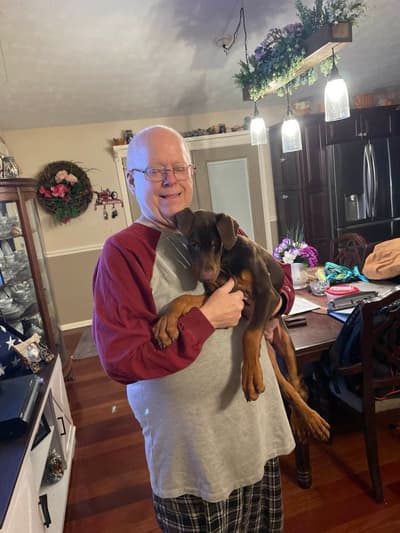
“Excellent customer service and everything from beginning to end was just as promised”
Chelsia · Doberman Pinscher
Jan 6, 2022
“This experience has been amazing from start to finish. Getting Chelsia, now Mila, home was a process due to weather, but everyone involved was patient and kind. Chelsia did have an ear infection when she arrived, but the vet has her on the mend. 10/10 would definitely use Pawrade again.”
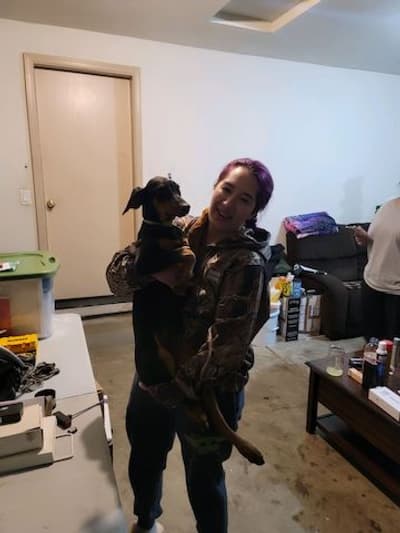
Banx · Doberman Pinscher
Apr 5, 2022
“Thanks pawrade i could have not found this beautiful puppy without you guys”
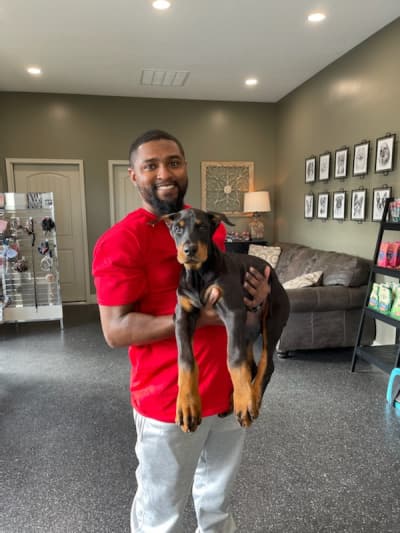
Checkers · Doberman Pinscher
Dec 11, 2021
“The experience was wonderful - from the time I hit the Love button until I had Checkers in my arms.”
Puppy scams cost U.S. families millions every year. Here's how you know Pawrade isn't one: we're a named, audited business with a public track record you can check anywhere.
Pawrade data: parents of puppies placed through Pawrade (breeder-reported)
Height
24–28 in
Lifespan
10–12 years
Energy
High
Shedding
High
Group
Working
AKC
Doberman Pinscher Characteristics
Full-Grown Size
5 of 7SmallLarge
Grooming Needs
1 of 7SeldomRegularly
Good with Dogs
1 of 7Not ReallyYes!
Watchdog Ability
5 of 7LowHigh
Exercise Needs
3 of 7Couch PotatoHigh Needs
Your new best friend.
Doberman Pinscher temperament
Personality and daily life
At home
A Doberman wants to be with its people. A Doberman belongs indoors with its family: it needs company every day and does poorly when left alone for long. At home it is alert, watchful and loyal, fearless when it matters and protective of its family.
At home
The breed is meant to be steady, too, and shy or vicious dogs are dismissed from the show ring. The sharper temper of the first Dobermans has been bred down over a century.
Training and play
Dobermans are high-energy athletes, and young ones are the busiest of all. They need regular exercise and training from the start.
Training and play
Dobermans learn very fast and work hard for rewards, so calm, consistent, reward-based training works best. Keep sessions focused, because a bright Doberman soon starts inventing its own versions of a task. Harsh handling, yelling, isolation and boredom backfire. Puppy classes and ongoing obedience work are strongly recommended, such as AKC S.T.A.R. Puppy and the Canine Good Citizen test.
Training and play
Dobermans compete in obedience, rally, agility, tracking, nosework, barn hunt, dock diving and protection sports. Many also work in search and rescue and as therapy, service and guide dogs.
Pawrade data: parents of puppies placed through Pawrade (breeder-reported). Placements and reviews come from Pawrade's records.
A healthier start for a happier tomorrow.
Doberman Pinscher care & grooming
Caring for a Doberman
The routine
Exercise needs
High
Plan on hard exercise every day, plus some mental work. Ideally, that means at least half an hour of free running in a fenced area morning and evening, or a brisk walk or jog twice a day. An under-exercised, untrained Doberman can become pushy and hard to manage.
Coat and shedding
High
The coat is short, smooth, hard and close-lying. Even so, it sheds a lot. It sheds all year, and the dark hairs show on clothes and furniture.
Weekly
Ear checks
Check and wipe the ears every few days.
Monthly / as needed
Coat and grooming care
A rubber grooming mitt or brush keeps loose hair down.
Bath time
An occasional bath with a mild shampoo is enough.
Nail trims
Trim the nails short to keep the feet tight.
Teeth and gums
Brush the teeth regularly.
Keeping them safe
Cold weather
The short single coat gives little protection from cold.
Keep your Doberman lean and active, and go easy on treats.
Heart checksKnow when to call
Fainting, weakness or tiring quickly can be signs of heart trouble, and they need a vet visit.
Heart checksRoutine vet checks
Book a yearly heart check with a Holter recording and a heart ultrasound once your Doberman is grown.
Every milestone, together.
Doberman Pinscher puppy milestones
Growing up: your Doberman's first two years
Before 8 weeks
Before your puppy comes home
Your puppy is still with its breeder, so use the time to get your home ready for a big, busy young dog.
Choose a crate big enough for an adult Doberman to stand, turn and stretch out in.
Put the crate in a room where the family spends time during the day, or in your bedroom at night.
Walk the yard, close any gaps under the fences and block access to a pool.
Plan to keep the gates secured when workers visit, so your puppy can't slip out.
Why it matters
A young Doberman should never have the run of the house unsupervised, so a safe crate and a secure yard keep it out of trouble from day one.
Doberman Pinscher note
Young Dobermans should sleep in their crate, so set it up before the first night.
8–10 weeks
The first week home
Everything is new, and your puppy needs plenty of rest while it settles in. Training can start the day it comes home, beginning with a light collar and gentle recall.
Take your puppy out first thing in the morning, last thing at night and after every nap.
Go out again after it eats, after it wakes and after short bursts of play.
Keep play with children and other dogs gentle, and introduce a resident dog on neutral ground, on leash.
At the first vet visit, ask the vet to listen to the heart and talk about the von Willebrand DNA test.
Why it matters
Calm first days and a steady routine teach your puppy where to go and that its new home is safe.
Doberman Pinscher note
Doberman puppies have long memories, so make every new experience calm and positive.
10–12 weeks
Weeks 2 to 4
The first 3 months are the most important time for a puppy to learn that new people, places, animals and things are safe. There is also a fear period around now, when a single bad experience can stick.
Introduce your puppy to many kinds of people and friendly animals, and keep each meeting short and happy.
Sign up for a puppy class, which can start as early as 7–8 weeks, and keep away from sick dogs.
Start leash work, and practice sit, down and stay with small food rewards.
Why it matters
A Doberman grows into a strong, protective adult, and good early experiences help it stay steady and confident.
Doberman Pinscher note
Grabbing or yelling teaches a Doberman puppy to avoid you, so calm rewards work far better.
3–4 months
3 to 4 months
The vaccine series usually finishes at about 16 weeks, as your vet advises. Bladder control is growing too: a puppy can usually hold it for about as many hours as its age in months.
Keep every vaccine appointment your vet sets, because your own vet completes the series that began before your puppy came home.
Stretch the time between potty trips slowly, and still go straight out after meals, naps and play.
If your puppy's ears are cropped, keep up the posting or taping, and clean and dry the ears each time.
Why it matters
Cropped ears need posting for an extended period before they stand on their own, while natural ears need none.
Doberman Pinscher note
The crate makes house-training easier, and a Doberman that sleeps in its crate learns to hold on through the night.
4–6 months
4 to 6 months
Teething is in full swing: baby teeth start to fall out from about 12 weeks, and by about 6 months the adult teeth are in. Chewing is strongest while the teeth change.
Keep only a few chew toys out at a time and rotate them, and hand one over whenever your puppy starts on a hand or a chair leg.
Keep valued things out of reach, and supervise chewing until the adult teeth are in.
Limit jumping and forced running, and agree an exercise plan with your vet while your puppy grows.
Why it matters
Growth plates in a puppy's legs stay soft while it grows, and larger dogs finish growing later, so gentle exercise protects young joints.
Doberman Pinscher note
Keep practicing recall in the house and yard every day, with a reward each time your puppy comes.
6–12 months
6 to 12 months
Adolescence usually starts at about 6–8 months. Your Doberman may test boundaries and seem to forget its training, and its protective streak starts to grow.
Keep the house rules the same, and keep training calm, consistent and full of rewards.
Talk with your vet about if and when to spay or neuter, because the right choice depends on your own dog.
Keep high-impact running and jumping gentle until the bones finish growing, when the growth plates close at about 16–18 months.
Why it matters
Steady training through adolescence keeps a strong young Doberman's growing protectiveness manageable.
Doberman Pinscher note
Plenty of physical and mental exercise helps a teenage Doberman settle.
1–2 years
1 to 2 years
Adolescence winds down, and most dogs are fully grown and settled by about 2 years.
Once the joints are grown, try a sport such as dock diving, barn hunt, flyball or lure coursing.
Book a vet exam at least once a year, and ask your vet about starting yearly heart screening.
Keep up the daily exercise, weekly nail trims and regular tooth brushing that suit the breed for life.
Why it matters
Heart disease in Dobermans starts in adulthood, often before any signs show, so regular screening finds it early.
Doberman Pinscher note
A 24-hour Holter recording from about 3 years, repeated every year, is the usual heart check for the breed.
The Doberman is square, compact and muscular with an elegant outline, and it has a scissors bite with 42 teeth. In the US, the ears are usually cropped and the tail docked. The UKC accepts natural or cropped ears and a natural or docked tail equally. The international standard of the Fédération Cynologique Internationale (FCI) keeps both natural.
Colors and coat
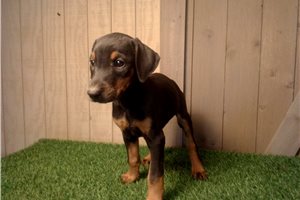
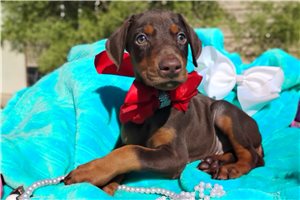
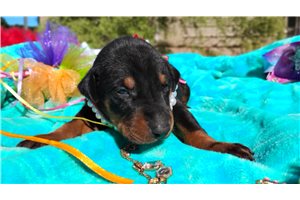
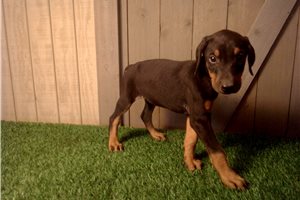
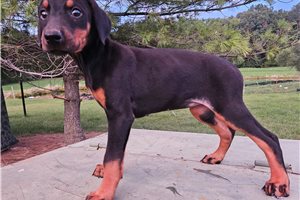
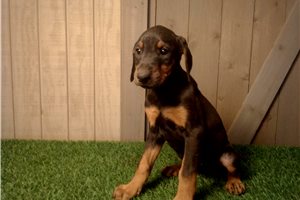
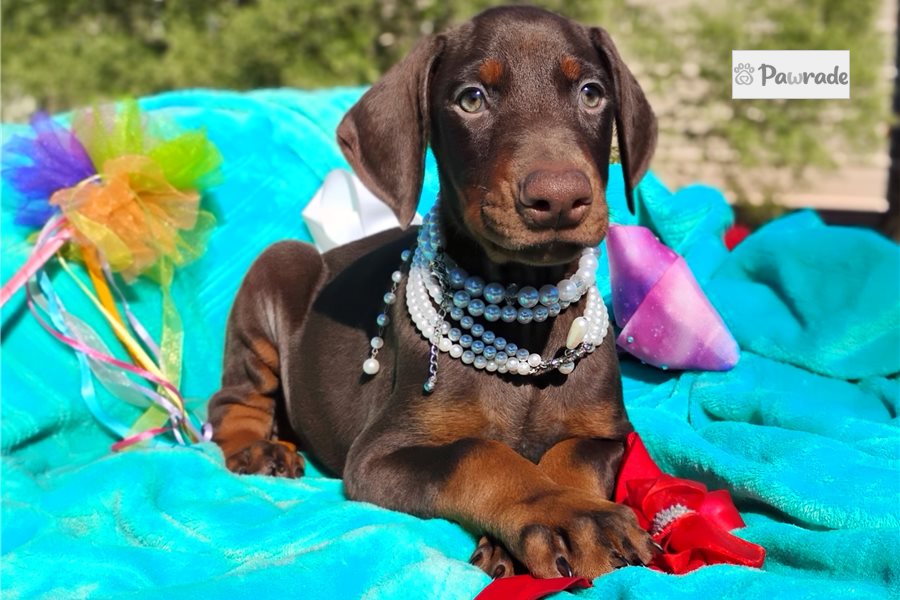
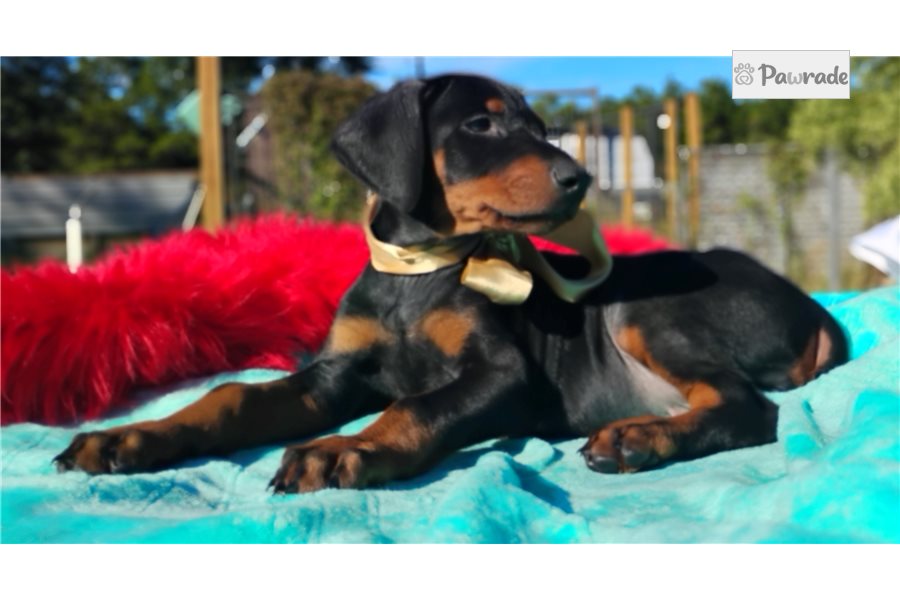
The AKC standard colors are black, red, blue and fawn (Isabella), each with sharply defined rust markings. The markings sit above the eyes and on the muzzle, throat, forechest, legs, feet and below the tail. Blue is a lighter (dilute) form of black, and fawn is a dilute of red, a silvery beige. A small white chest patch, up to half a square inch, is allowed. White Dobermans can be registered with the AKC, but white, like every other color, is outside the AKC breed standard.
Colors listed by Pawrade breeders
Albino
Black
Blue
Dilute Blue
Dilute Fawn
Dilute Red
Fawn
Red
White
Keeping your Doberman healthy
Dobermans are known to be prone to a few conditions, led by a heart-muscle disease of adults, and regular checkups catch most of them early.
A little history, a lot of heart.
Doberman Pinscher history
History and fun facts
late 19th century
Louis Dobermann of Apolda, Germany, bred the first Dobermans as personal protection dogs, and the breed carries his name.
The exact mix of breeds he used was never recorded.
So are the Black and Tan Terrier (forerunner of the Manchester Terrier), the Greyhound and old German shepherd-type dogs.
The Rottweiler-type dogs gave the breed much of its substance and guarding ability, and it went on to serve as a police dog.
Germany dropped "Pinscher", the German word for terrier, from the name about half a century later, and Britain followed, while North America kept "Doberman Pinscher".
The FCI and the UK still spell the name Dobermann, with two n's.
1908
The AKC recognized the breed in 1908, and Dobermans arrived in the US in large numbers after World War I.
World War II
In the Second World War, Marine Corps Dobermans led patrols and guarded troops in the South Pacific.
Those killed are buried in the National War Dog Cemetery at Naval Base Guam.
1952–1953
Dobermans have a proud record at Westminster: Ch. Rancho Dobe's Storm won Best in Show in 1952 and 1953.
2026
Penny won Best in Show at the 150th Westminster show in 2026.
The Doberman Pinscher Club of America is the breed's AKC parent club.
Checked with care before travel.
Doberman Pinscher Veterinary Health Report
Your puppy's Veterinary Health Report
Before your Doberman puppy leaves, the breeder's licensed vet gives it a full hands-on exam to PetPay's exam standards, and the results go into its Veterinary Health Report.
The exam, a health certificate and a stool test for parasites all happen 3 to 5 days before your puppy leaves.
1The exam looks at your puppy itself, not its parents, so the record you get is about your own dog.
2If the vet finds something that could put your puppy at risk during travel, your puppy stays with the breeder until it's resolved.
3Problems that can be treated before travel are treated by the breeder's licensed vet first.
4Anything else the vet notes is shared with you.
5A hard copy of the report travels with your puppy for your records, and a digital copy is in your PetPay account.
PetPay Veterinary Health Report form
16 areas checked on the exam
Closer look for Doberman PinschersOn every puppy's report
Puppies must be at least 8 weeks old and weigh at least 2 lb before they travel. Every Pawrade puppy also comes with a health guarantee administered by PetPay, independent of the seller. The terms are on the health guarantee page.
A Doberman Pinscher puppy's price reflects what goes into it: its pedigree and registration, its coat and color, and the breeder's program. Every Pawrade puppy's price also includes the pre-travel exam by the breeder's licensed vet, the Veterinary Health Report and a health guarantee administered by PetPay. See today's price range for Doberman Pinscher puppies on Pawrade's Doberman Pinscher listings.
Puppy first, every step of the way.
Questions about a Doberman Pinscher puppy?
Talk to a puppy concierge about your family — it's free. Daily, 9AM–11PM EST.
Frequently asked questions about Doberman Pinscher puppies
Frequently asked questions
Adult Dobermans weigh 60–100 lb and stand 24–28 in tall. Males stand 26–28 in and females 24–26 in, and males are usually the heavier of the two. Parents of Pawrade Dobermans typically weigh 78–120 lb (fathers) and 65–98 lb (mothers).
The AKC standard colors are black, red, blue and fawn (Isabella), each with rust markings. Blue is a lighter form of black, and fawn is a lighter form of red. White and any other color are outside the AKC breed standard.
They are one breed, registered as the Doberman Pinscher in the US and as the Dobermann under the FCI standard used across Europe. The standards differ in a few details. The FCI keeps ears and tail natural and does not allow a visible undercoat or white spots. In the US, ears are usually cropped and tails docked, and a small white patch on the chest is allowed.
A Doberman does not need cropped ears or a docked tail. The UKC accepts natural ears and tail equally, and the FCI standard keeps them natural, although cropping and docking are usual in the US. Cropped ears need posting for an extended period so they stand, and natural ears need none. Before any cropping or other surgery, know the puppy's von Willebrand disease result.
The Miniature Pinscher is a separate, older breed, not a scaled-down Doberman. The two share at most distant Pinscher roots, despite the look-alike name and markings.
The breed is named after Louis Dobermann, who developed it, and "Pinscher" is German for terrier. Germany and Britain later dropped "Pinscher", but North America kept it.
Dobermans are alert, watchful, loyal, fearless and intelligent, and protective of their family. They are energetic, especially when young, and need exercise and training from the start.
A well-bred Doberman is protective and fearless but also stable, and shy or vicious dogs are dismissed from the show ring. Early socialization, puppy classes and consistent obedience training keep that protectiveness manageable.
Aggression toward people is not typical of the breed. The first Dobermans were sharper-tempered, but that has been bred down over a century. An under-exercised, untrained Doberman can become pushy, which is why daily exercise and training matter.
Dobermans do this kind of work, serving as service dogs, therapy dogs and guide dogs, as well as in search and rescue. They learn fast and work hard for positive reinforcement.
A careful introduction gives them the best start: meet on neutral ground, on leash, and keep early play gentle. About a third of Doberman buyers on Pawrade already have a dog at home. Breeders on Pawrade report socializing 89% of Doberman litters with large-breed dogs and 60% with small-breed dogs before the puppies go home.
A Doberman is loyal and protective of its family, and early socialization helps it grow up steady around children. Breeders on Pawrade report socializing 78% of Doberman litters with older children and 78% with younger children. Keep play between a new puppy and children gentle and supervised while it settles in.
Early, positive introductions make the biggest difference. The first 3 months are the most important time for a puppy to learn that new animals are safe. Breeders on Pawrade report socializing 60% of Doberman litters with small-breed dogs before they go home.
A Doberman needs vigorous exercise every day, such as free running in a fenced area or brisk walks and jogs, plus mental work. It can become a running or hiking partner once it is fully grown. Until the growth plates close at about 16–18 months, keep high-impact exercise gentle.
A Doberman can suit an active older owner who can give it vigorous exercise every day and patient, consistent training. It is a strong dog, and without early socialization and obedience work it can become pushy or hard to manage.
It can if its exercise needs are met, because a Doberman needs vigorous exercise every day and lives indoors with its family, whatever the home. Almost all Doberman buyers on Pawrade have a yard.
A Doberman should live indoors with the family, not outside. Outdoor or kennel life leads to boredom and problem behavior, and the short coat gives little protection from cold.
Not for long stretches, because Dobermans need daily company and should not be left isolated. Boredom and isolation lead to barking, digging and destruction, and a crate keeps a young dog safe when you are out.
Active adults typically eat about 2–5 cups of a high-quality food a day, depending on metabolism and activity. Go easy on treats to prevent weight gain.
Dobermans shed a lot, all year round, despite the short coat. The dark hairs show on clothes and furniture, and a rubber grooming glove cuts down loose hair.
A Doberman needs very little grooming: no professional grooming, just regular brushing or a rubber mitt and an occasional bath. Nails, teeth and ears need the most attention, with short nails and ears checked and wiped every few days.
Dobermans learn very fast and respond well to calm, consistent, reward-based training. Keep sessions focused, because they are quick to invent their own variations, and avoid harsh handling.
Use a crate and a consistent routine. Take the puppy out after it eats, after it wakes and after short bursts of play. Breeders on Pawrade report whether they have started crate training, so ask how far your puppy has got.
A Doberman puppy can usually hold its bladder for about as many hours as its age in months. Take young puppies out first thing in the morning, last thing at night and after naps.
Adolescence usually starts at about 6–8 months, and many dogs test boundaries and seem to forget their training for a while. It is a normal phase, and consistent training, patience and plenty of exercise help. A young Doberman's protective streak also grows at this age, so keep up calm, reward-based training.
Dobermans take part in obedience, rally, agility, tracking, nosework, barn hunt, dock diving, flyball, lure coursing, herding and the working-dog sport IGP (Schutzhund). They also work as police and military dogs. The breed's parent club runs its own Working Aptitude Evaluation, a temperament and working test.
Puppies travel only once they are at least 8 weeks old and weigh at least 2 lb. Most Doberman puppies go home at about 12 weeks, usually between 9 and 18 weeks.
Doberman breeders on Pawrade report a typical litter of 6 puppies, usually between 2 and 11.
Set up a crate big enough for an adult, in a room where the family spends time or in your bedroom at night. Check the yard for gaps under fences, block pool access and keep gates secured. Book a first vet visit and plan puppy classes and a training routine from the first week.
Start the day your puppy comes home, because the first 3 months are the most important time for learning that new people, places and animals are safe. Puppy classes can start as early as 7–8 weeks, as long as your puppy stays away from sick dogs. Doberman puppies have long memories, so keep every new experience calm and positive.
Most Doberman litters on Pawrade meet other dogs and children before the puppies go home. Breeders report socializing 89% of litters with large-breed dogs, 78% with older children and 78% with younger children. Most also get puppies used to car rides (73%), pots and pans (69%) and the vacuum cleaner (60%). These figures come from what breeders reported for 45 litters.
Spaying or neutering is a decision to talk through with your vet, because the right timing depends on things like sex and expected adult size. Before any surgery, make sure your vet knows your puppy's von Willebrand DNA result.
The puppy vaccine series usually finishes at about 16 weeks, as your vet advises. Your puppy's vaccination and deworming records are separate documents that travel with your puppy. Bring them, with the Veterinary Health Report, to your first visit so your vet starts from the same record. Puppy classes can still start before then, as long as your puppy stays away from sick dogs.
Baby teeth start to fall out from about 12 weeks, and by about 6 months the adult teeth are in. Chewing is strongest while the teeth change, so offer safe chew toys, rotate them and keep valued things out of reach.
The Veterinary Health Report is the record of your Doberman puppy's exam before it goes home. The breeder's licensed vet gives the puppy itself a full hands-on exam to PetPay's exam standards and writes down what they find. A hard copy of the report travels with your puppy for your records, and a digital copy is in your PetPay account.
The breeder's licensed veterinarian examines every puppy before it goes home, to PetPay's exam standards. The results are recorded in the puppy's Veterinary Health Report, and a copy travels with your puppy for your records.
The breeder's vet examines the whole puppy and pays close attention to a few things that matter in Dobermans. The vet listens to the heart, checks the eyelashes and eyes, and watches how the puppy responds to sound. The vet also checks the bite and, in males, that both testicles have come down.
Before travel, every puppy follows PetPay's vaccination and deworming schedule as far as its age allows: deworming at 2, 4, 6, 8, 10 and 12 weeks, and the distemper, parvo, adenovirus and parainfluenza combination shot at 6–8, 9–11 and 12–14 weeks. Bordetella and corona are given at the vet's discretion, and no vaccine is given within 3 days of travel. Rabies is given by a licensed vet on the schedule your state requires. Your own vet completes the series. Your puppy's vaccination and deworming records are separate documents that travel with your puppy. Bring them, with the Veterinary Health Report, to your first visit so your vet starts from the same record.
If the vet finds something that could put your puppy at risk during travel, your puppy stays with the breeder until it's resolved. Problems that can be treated before travel are treated by the breeder's licensed vet first. Anything else the vet notes is shared with you.
Puppies grow and change quickly, and their immune systems are still developing, so no single exam can find everything. In Dobermans, dilated cardiomyopathy (DCM), a heart-muscle disease, starts in adulthood, so a puppy exam cannot rule it out. The report is a strong early look at your puppy, and your own vet builds on it at every checkup.
Doberman buyers rate their Pawrade experience 4.8 out of 5 on average, from 32 reviews, and about 91% of those reviews give 5 stars.
Right now, most Doberman Pinscher puppies on Pawrade are listed within the typical range shown on Pawrade's Doberman Pinscher listings. Each breeder on Pawrade sets their own price, and each puppy's listing shows it. A Doberman Pinscher puppy's price reflects what goes into it: its pedigree and registration, its coat and color, and the breeder's program. Every Pawrade puppy's price also includes the pre-travel exam by the breeder's licensed vet, the Veterinary Health Report and a health guarantee administered by PetPay.








 Doberman Pinscher note