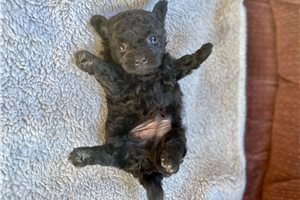
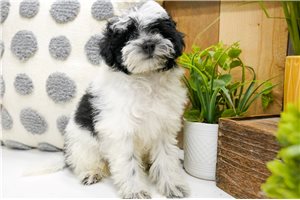
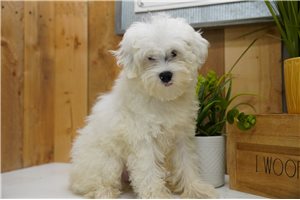
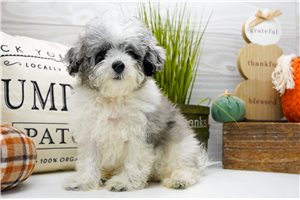
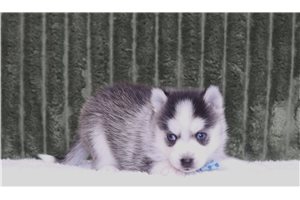
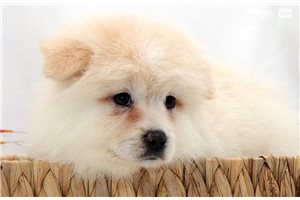
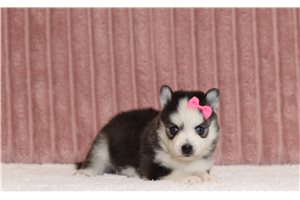
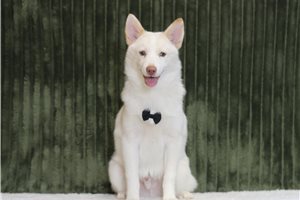
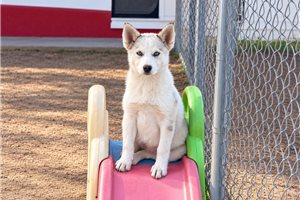
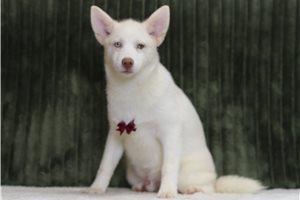
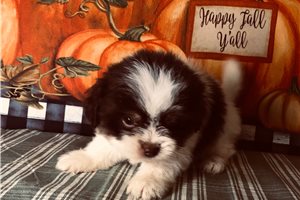
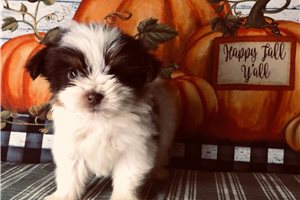
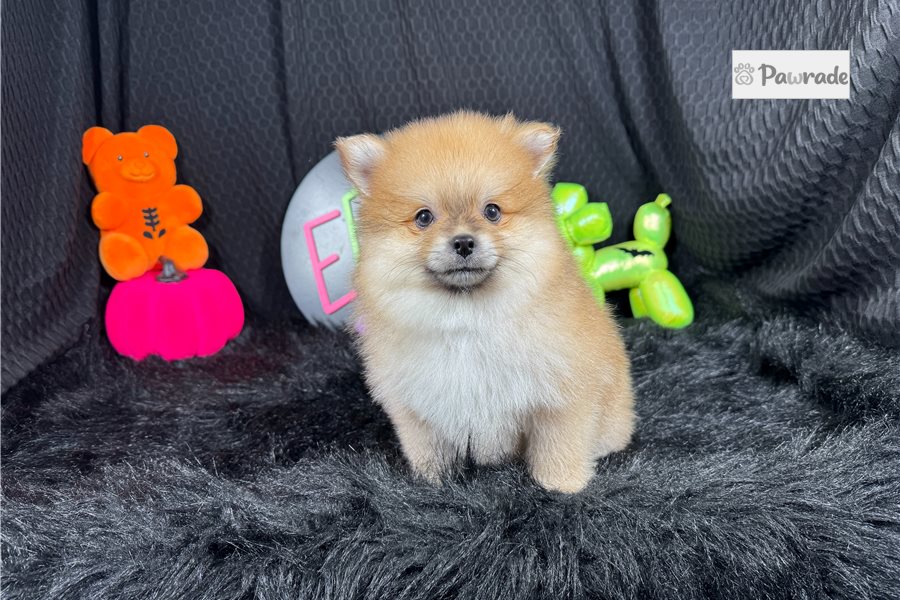
A Pomeranian is a cloud of fluff with a fox's face and a plumed tail fanned flat over its back. Inside all that coat is a bright, curious little dog that sticks close to its person and announces every visitor.
A Pomeranian is a cloud of fluff with a fox's face and a plumed tail fanned flat over its back. Inside all that coat is a bright, curious little dog that sticks...A Pomeranian is a cloud of fluff with a fox's face and a plumed tail fanned flat over its back. Inside all that coat is a bright, curious little dog that sticks close to its person and announces every visitor.
Only with Pawrade, you receive a pet insurance policy with no waiting period included for immediate accident or illness coverage. *NH, NY, RI, SC and TN residents excluded
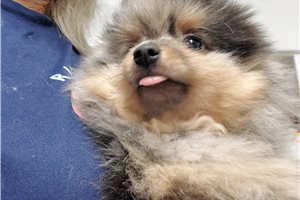
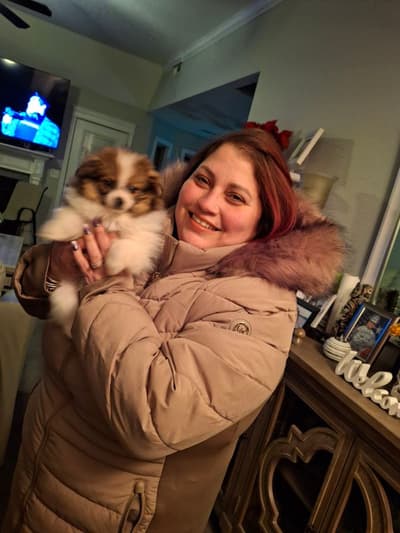
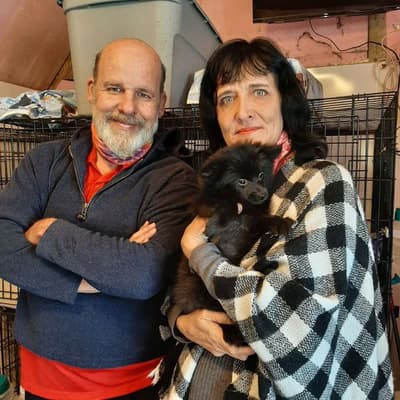
“My second pup from you all and all went very well”
Kelsey · Pomeranian
Dec 11, 2025
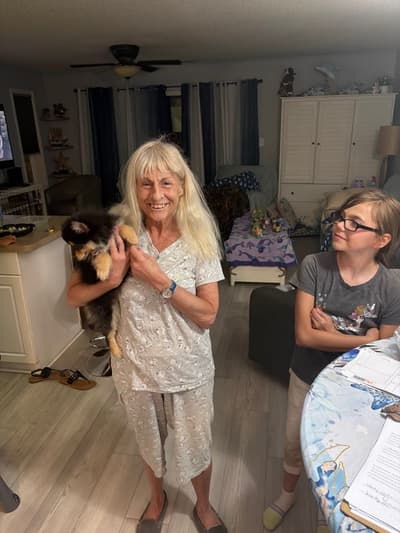
“Everything was very easy going and the personal is amazing and very helpful.”
Opal · Pomeranian
Sep 25, 2024
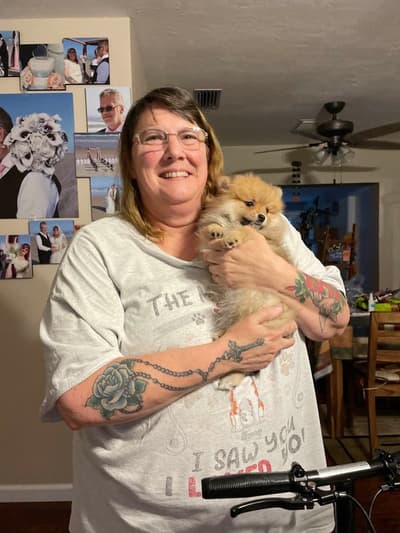
“It was a great experience working with pawrade to find my new puppy!! Highly recommend!!”
Elvis · Pomeranian
Jan 19, 2021
“Very pleased with your service! Elvis certainly shows his breeding and is a perfect puppy! Smart. friendly. Oddly his best friend is a 70# American Bulldog, Elvis weighs 10#. We are very pleased so thank you! Your driver is excellent!”
Puppy scams cost U.S. families millions every year. Here's how you know Pawrade isn't one: we're a named, audited business with a public track record you can check anywhere.
Pawrade data: parents of puppies placed through Pawrade (breeder-reported)
Height
6–7 in
Lifespan
12–16 years
Energy
Low
Shedding
Low
Group
Toy
AKC
Pomeranian Characteristics
Full-Grown Size
1 of 7SmallLarge
Grooming Needs
3 of 7SeldomRegularly
Good with Dogs
1 of 7Not ReallyYes!
Watchdog Ability
5 of 7LowHigh
Exercise Needs
1 of 7Couch PotatoHigh Needs
Your new best friend.
Pomeranian temperament
Personality and daily life
At home
The Pomeranian is the smallest of the spitz dogs, bred down from much larger dogs that herded and kept watch. The watchdog is still in there. A Pom notices every visitor and makes sure you hear about it. It is lively, curious and deeply attached to its owner.
Kids and other pets
Poms do best with older, gentle children, because a dog this small is easily hurt by a fall or rough play. Most get on well with other dogs. But a Pom can be bold toward much bigger dogs and start a quarrel it cannot win, so watch mixed-size play.
Poms tend to bark, so teach quiet habits from an early age. Meeting many new people, dogs and places early on (socialization) helps prevent nervous reactions, too much barking and wariness of strangers.
Pawrade data: parents of puppies placed through Pawrade (breeder-reported). Placements and reviews come from Pawrade's records.
A healthier start for a happier tomorrow.
Pomeranian care & grooming
Care and training
The routine
Exercise needs
Low
Poms are playful, but they are a low-energy breed: short daily walks and indoor play are enough.
Coat and shedding
Low
The double coat has a soft, dense undercoat and a long, harsh outer coat that stands off the body. Shedding is low for most of the year and heavier in spring and fall.
Daily
Teeth and gums
Brush the teeth every day, because a small mouth collects tartar quickly.
Weekly
Coat and grooming care
Brush two or three times a week, and every day while the coat is shedding. Tidy the hair under the tail.
Monthly / as needed
Ear checks
Tidy the hair on the ears.
Around the eyes
Keep the hair near the eyes trimmed.
Paws and pads
Tidy the hair on the feet.
Keeping them safe
Heat safety
Never leave a Pom in a closed car in warm weather.
Cold weather
The thick coat helps in cold weather, but a dog this small still feels the cold.
Stairs and jumping
Use ramps or steps instead of letting your Pom jump off the sofa or bed.
Leash and fencing
Walk your Pom on a body harness rather than a neck collar. Keep yours on a leash or in a secure yard, and stay close outdoors, where birds of prey are a risk for a dog this size.
Mention any thinning coat or skin change to your vet, since coat loss (alopecia X) runs in the breed.
Breathing and airwayKeep them lean and cool
Keep your Pom lean and away from smoke to protect its airway, since a weak windpipe (tracheal collapse) runs in the breed.
Joints and movementRoutine vet checks
Your vet checks the knees at every puppy visit, because a slipping kneecap (patellar luxation) can show up young.
Teeth and gumsRoutine vet checks
Ask your vet to look at the teeth at every visit, and plan professional cleanings when they are due.
Body weightKeep them lean and cool
Use your hands to check that your Pom stays lean, because the thick coat can hide extra pounds.
Heart checksRoutine vet checks
In the senior years, ask your vet to listen for a heart murmur at each exam.
Every milestone, together.
Pomeranian puppy milestones
Growing up: your Pom's first years
Before 8 weeks
Before your puppy comes home
Your puppy is still with its breeder, and most Pom litters on Pawrade meet small dogs and children and hear everyday household sounds before they leave. Breeders start socializing toy puppies with other dogs at about 4–6 weeks and with people from about 6 weeks.
Check fences and gates for gaps, because a Pom is quick to slip away.
Buy a small body harness for walks, so no collar ever presses on the windpipe.
Put the crate in a room where the family spends time, or in your bedroom at night.
Stock a puppy food made for toy breeds, and ask what your puppy is eating now.
Why it matters
A puppy's first 3 months are its most important window for learning that new people, places, animals and things are safe.
Pomeranian note
A fall can hurt a dog this small, so teach children to sit on the floor to hold the puppy.
8–10 weeks
Week 1 at home
Everything is new, and the move itself can bring on low blood sugar (hypoglycemia) in a puppy this small. A puppy can hold its bladder for about as many hours as it is months old, so a young Pom needs to go out often.
Keep your puppy warm and offer small, frequent meals on a steady schedule.
If your puppy turns weak, trembly or wobbly, rub a little syrup or honey on its gums and call your vet.
Take your puppy out first thing in the morning, after every nap and last thing at night.
At the first vet visit, bring the Veterinary Health Report and ask your vet to feel the knees.
Why it matters
Frequent small meals keep a tiny puppy fueled, and frequent trips outside give it plenty of chances to get house-training right.
Pomeranian note
Poms often take longer than other dogs to house-train, so patience now pays off later.
10–12 weeks
Weeks 2 to 4 at home
Your puppy is settling in and soaking up the world, and calm, happy meetings now help shape the adult it becomes.
Introduce a couple of new things a day, such as a visitor, a car ride or a new floor, and pair each one with a treat.
Sign up for a puppy class, since classes can start as early as 7–8 weeks as long as your puppy avoids sick dogs.
Start short brushing sessions and gentle all-over handling while your puppy is young.
Why it matters
Early socialization helps prevent the nervous reactions, extra barking and wariness of strangers that can follow a missed start.
Pomeranian note
Poms like to bark, so reward quiet moments now, before barking at every sound becomes a habit.
3–4 months
3 to 4 months
Most puppies finish their vaccine series at about 16 weeks, as your vet advises. By the bladder rule, a 3-month-old can usually wait about 3 hours between trips outside. Poms outgrow the risk of low blood sugar as they mature.
Keep every vaccine appointment, since your own vet completes the series your puppy began with its breeder.
Once your vet says the vaccines are done, widen your puppy's world with new places, surfaces and sounds.
Keep feeding 3 or 4 small meals a day until your puppy is about 5 months old.
Why it matters
Your own vet sets the timing of the final shots, so follow their schedule rather than a fixed date.
Pomeranian note
Teach a quiet cue with treats while your Pom is young and keen to please.
4–6 months
4 to 6 months
Teething is in full swing. Baby teeth start falling out from about 12 weeks, and by about 6 months the adult teeth are in.
Put out a few safe chew toys at a time and rotate them, so the allowed ones stay interesting.
Make tooth brushing a daily habit now, because a Pom's small mouth collects tartar.
Keep brushing the coat 2 or 3 times a week, and every day while it is shedding.
Why it matters
Chewing is strongest while the teeth change, so a safe outlet protects your things and your puppy.
Pomeranian note
Expect the fluffy puppy coat to give way to the adult double coat, a phase owners call the 'ugly stage'.
6–12 months
6 to 12 months
Adolescence usually starts between about 6 and 8 months, and your Pom may test the rules or seem to forget its training. Toy breeds finish growing at about 9–12 months, and the growth plates in the legs stay soft until growth is done.
Keep training short and upbeat, and reward good choices rather than scolding the stubborn moments.
Spaying or neutering is a decision to make with your vet, who can weigh your own dog's sex and size.
Agree an exercise plan with your vet while your Pom is still growing.
Call your vet about any limp on a back leg, since a hip problem of small breeds, Legg-Calvé-Perthes disease, can appear in the first year.
Why it matters
This teenage phase is normal and passes, and calm, steady training carries you both through it.
Pomeranian note
Some Poms have an independent streak that shows more now, so stay patient and keep lessons fun.
1–2 years
1 to 2 years
Your Pom is settling into the lively, curious companion it will be for life. Most dogs are fully grown and settled into adulthood at around 2 years.
Book a wellness exam at least once a year, and ask your vet to check the knees, teeth and weight.
Keep up daily tooth brushing, and plan professional cleanings when your vet advises.
Try a dog sport now that your Pom is grown: AKC Scent Work is gentle on the joints, and Poms also do rally and agility.
Why it matters
Regular checks catch changes in the knees, teeth and coat early, when they are easier to manage.
Pomeranian note
Keep an eye on the adult coat as it fills in, and mention any thinning to your vet, since coat loss (alopecia X) runs in the breed.
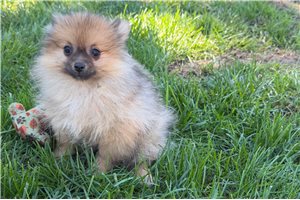
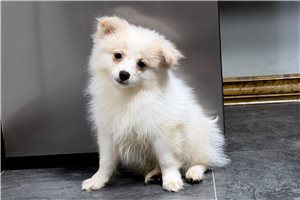
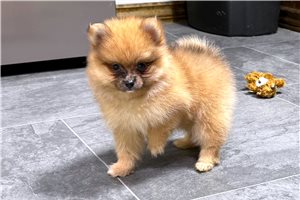
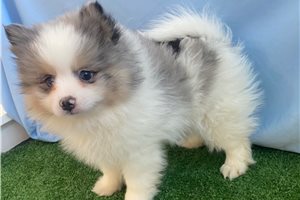
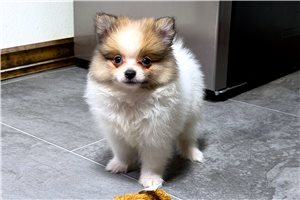
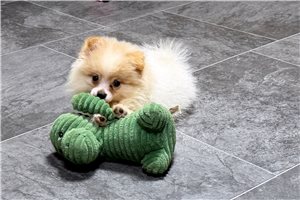
The Pomeranian is compact, short-backed and square, with sturdy bones, small high-set pricked ears and a fox-like expression. Its heavily plumed tail is set high and lies flat on the back. The coat stands off the body, with a ruff around the neck and feathering on the legs.
Colors and coat
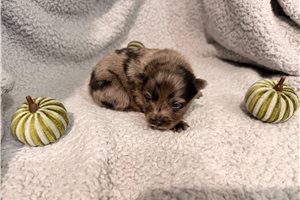
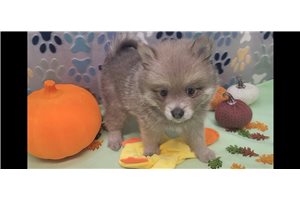
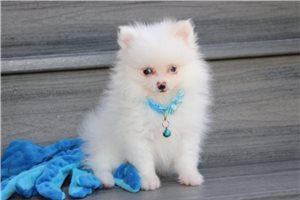
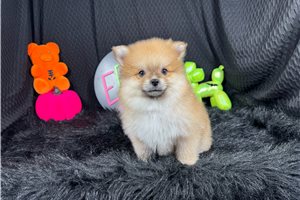
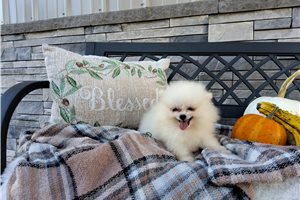
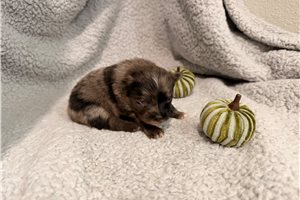
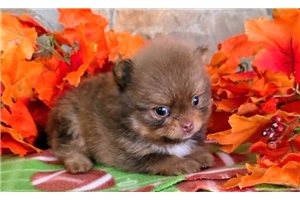
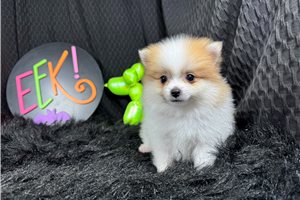
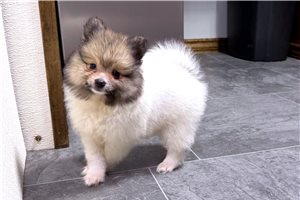
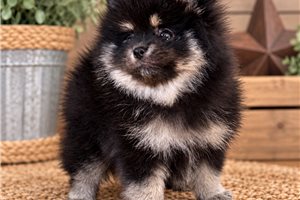
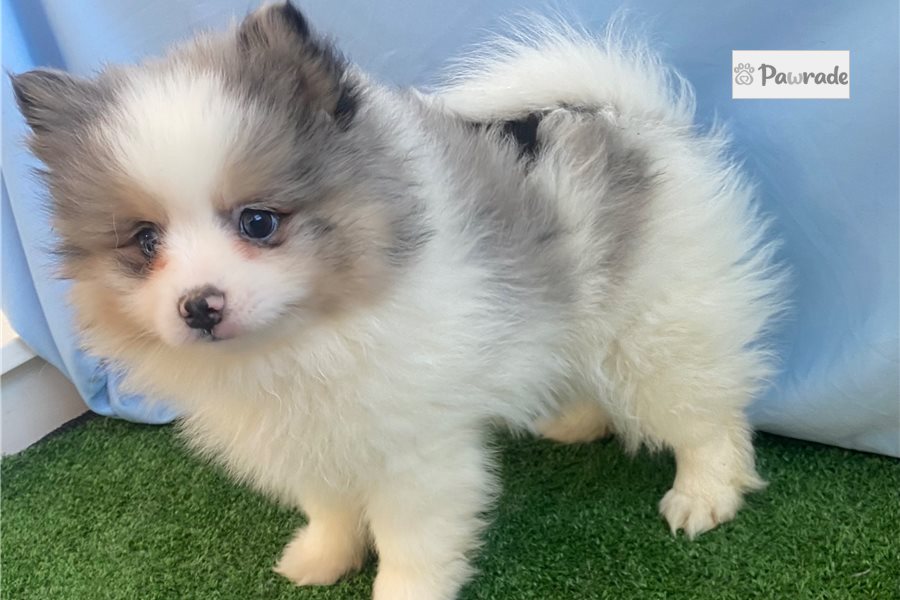
The AKC standard allows all colors, patterns and variations and judges them equally. It describes brindle, parti-color and tan-point patterns. Orange and orange sable are the most common colors. Almost two dozen colors are recognized, and merle Poms are shown in the AKC's 'any other allowed color' class. Light blue, blue-marbled or blue-flecked eyes are outside the AKC breed standard. The nose, lips and eye rims are black, except in chocolate, beaver and blue dogs, whose pigment matches the coat.
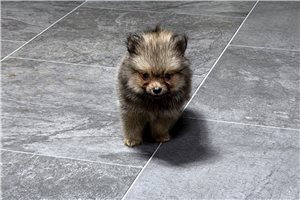
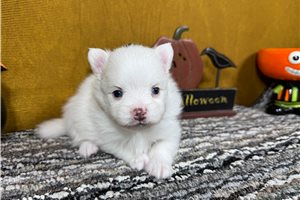
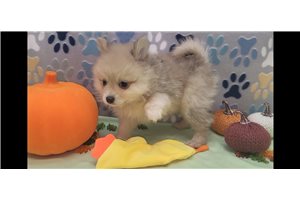
Puppies have a shorter, denser coat that may lack the long guard hairs, and the adult double coat replaces it.
Colors listed by Pawrade breeders
Albino
Beaver
Black
Blue
Blue Merle
Brindle
Brown
Chocolate
Cream
Gold
Gray
Lavender
Merle
Orange
Red
Sable
Sable Merle
Silver
Tan
White
Wolf Sable
Keeping your Pom healthy
Pomeranians are known to be prone to a few conditions: slipping kneecaps (patellar luxation), a weak windpipe (tracheal collapse) and coat loss (alopecia X). Everyday care and regular vet checks help with all of them.
A little history, a lot of heart.
Pomeranian history
History and fun facts
The Pomeranian is named for Pomerania, a Baltic coastal region now in northern Germany and Poland, and it comes from the spitz family.
Its ancestors were much larger, around 30 lb, and worked as herding and watch dogs.
The international kennel federation (FCI) still treats the Pom as the toy size of the German Spitz.
The AKC, UKC and The Kennel Club register it as a breed of its own.
British royalty made the breed fashionable.
18th century
Queen Charlotte brought Pomeranians to England in the 18th century.
1888
Queen Victoria's Marco, a 12-lb Pom from Florence, arrived in 1888, and her enthusiasm helped drive the trend toward smaller Poms.
1900
The American Pomeranian Club, founded in 1900, is still the breed's parent club, the AKC's official club for the breed.
1912
Two Pomeranians survived the sinking of the Titanic in 1912 with their first-class owners.
1988
In 1988 a Pom won Best in Show at Westminster, the only Pomeranian to do so.
2019
In 2019 a Pom named Bella became the first Toy-breed dog to earn the AKC Scent Work Master title.
Checked with care before travel.
Pomeranian Veterinary Health Report
Your puppy's Veterinary Health Report
Before your Pomeranian puppy comes home, the breeder's licensed vet gives it a full hands-on exam to PetPay's exam standards, and the results go into its Veterinary Health Report.
The exam, a health certificate and a stool test for parasites all happen 3 to 5 days before your puppy leaves.
1It is a check of your own puppy, not paperwork about its family, so you start with a clear record of how your puppy is doing.
2If the vet finds something that could put your puppy at risk during travel, your puppy stays with the breeder until it's resolved.
3Problems that can be treated before travel are treated by the breeder's licensed vet first.
4Anything else the vet notes is shared with you.
5A hard copy of the report travels with your puppy for your records, and a digital copy is in your PetPay account.
PetPay Veterinary Health Report form
16 areas checked on the exam
Closer look for PomeraniansOn every puppy's report
Puppies travel only once they are at least 8 weeks old and weigh at least 2 lb. Every puppy also comes with a health guarantee administered by PetPay, independent of the seller. The terms are on the health guarantee page.
Frequently asked questions about Pomeranian puppies
Frequently asked questions
Adult Pomeranians weigh 3–7 lb and stand 6–7 in tall. Toy breeds usually finish growing at about 9–12 months. The breed standard favors quality over size.
Teacup, toy and miniature are not recognized sizes, because no registry recognizes a teacup Pom and the AKC and UKC standards describe one size of Pomeranian. Breeding for an ever-smaller dog is linked to health problems.
Parents of Pawrade Pomeranians typically weigh 4–10 lb (fathers) and 5–10 lb (mothers). Toy breeds usually finish growing at about 9–12 months.
The AKC standard allows all colors, patterns and variations and judges them equally. Orange and orange sable are the most common, and the standard also describes brindle, parti-color and tan-point patterns. Merle Poms are shown in the AKC's 'any other allowed color' class.
Blue eyes are outside the AKC breed standard, which rules out light blue, blue-marbled and blue-flecked eyes.
The puppy coat is shorter and denser and may lack the long guard hairs, and the adult double coat replaces it. Owners call the in-between phase the 'ugly stage'.
The two are closely related, and the international kennel federation (FCI) treats the Pomeranian as the toy size of the German Spitz. The AKC, UKC and The Kennel Club register the Pomeranian as a breed of its own. The Keeshond and the American Eskimo Dog come from the same German spitz family.
Both make good pets, and Pawrade places males and females in close to equal numbers. Among the parents of Pawrade Pomeranians, fathers typically weigh about 6 lb and mothers about 7 lb.
A Pom is lively, curious and outgoing, and it bonds closely with its owner. It is alert too, so expect it to announce visitors.
Poms like to bark, and they make alert little watchdogs that announce visitors. Teach quiet habits from an early age, and socialize your puppy widely.
Many Poms work as therapy dogs, and their strong bond with their owners makes them close companions. Reward-based training and early socialization lay the groundwork.
Most Poms are sociable with other dogs, and nearly half of Pawrade Pomeranian buyers already have one at home. Introduce a much larger dog carefully and supervise play, because a Pom can be bold toward bigger dogs and start a quarrel it cannot win. Pawrade breeders socialize most Pom litters with other small dogs before the puppies go home.
Poms do best with older, gentle children. A fall or rough play can hurt a dog this small, so supervise young children and have them sit on the floor to hold the puppy. Pawrade breeders socialize most Pom litters with children before the puppies go home.
Early socialization is the best start for a Pom that will share a home with a cat, because it helps prevent nervous reactions and lasting fearfulness. Some breeders on Pawrade socialize their litters with cats before the puppies go home.
Poms are well suited to apartments and small homes. Short walks and indoor play cover their exercise, and teaching quiet habits early helps when neighbors are close.
About 30 minutes a day of short walks and indoor play is enough for most Poms, a low-energy breed. Walk on a harness rather than a collar to protect the windpipe.
Much about a Pom suits an owner who can't walk far: it weighs 3–7 lb, fits apartment life and needs only short walks and indoor play. Plan for brushing a few times a week, a house-training stretch that takes patience, and a quick little dog that can slip away. Poms typically live 12–16 years, so plan for many years together.
Most Pom litters on Pawrade ride in a car or truck before the puppies go home. On trips, use a harness rather than a collar, and never leave a Pom in a closed car in warm weather.
The thick coat helps in the cold, but a dog this small still feels low temperatures. In warm weather, never leave a Pom in a closed car.
Toy breeds finish growing at about 9–12 months, and the growth plates in a puppy's legs stay soft until then. Agree an exercise plan with your vet, and use ramps or steps instead of letting your puppy jump off furniture.
Poms are quick, slip away easily and do not understand traffic, so keep yours on a leash or in a secure yard. Check fences and gates for gaps, and stay close outdoors, because birds of prey are a risk for a dog this size.
Pomeranians are low-shedding for most of the year, with heavier shedding in spring and fall. The Pom does shed, and no dog is truly hypoallergenic. Brushing 2 or 3 times a week, and every day while the coat sheds, keeps loose hair under control.
Brush 2 or 3 times a week, and every day while the coat is shedding. The coat is otherwise left natural, with light trimming of the feet, ears and the area under the tail for neatness and hygiene. Brush the teeth every day too, because a small mouth collects tartar quickly.
House-training a Pom usually takes longer than with other dogs, so plan on consistency and patience. Take your puppy out first thing in the morning, after naps and last thing at night, and praise every success. An indoor potty system is an option. Breeders on Pawrade report whether they have started crate training, so ask how far your puppy has got.
A puppy can usually hold its bladder for about as many hours as it is months old, so a 3-month-old Pom can wait about 3 hours. The rule holds up to about 9 months to 1 year of age. Young puppies still need trips out first thing in the morning, last thing at night and after naps.
Poms are smart and quick to learn tricks. Most are eager to please, but some have a stubborn streak, so keep training reward-based, patient and consistent.
Your Pom is most likely in adolescence, a normal phase that usually begins between about 6 and 8 months. Dogs this age test boundaries and may seem to forget their training. Consistent, reward-based training, patience and plenty of play carry you both through it.
Poms take part in agility, rally and obedience, and AKC Scent Work is a low-impact sport that suits a toy dog. In 2019 a Pom became the first Toy-breed dog to earn the AKC Scent Work Master title.
Pawrade puppies travel only once they are at least 8 weeks old and weigh at least 2 lb, and the breeder's licensed vet examines each one first. Most Pomeranian puppies go home at about 12 weeks, usually between 9 and 18 weeks.
Across 500 Pomeranian litters on Pawrade, the typical litter has 3 puppies, and most have between 2 and 5.
Get a small body harness, a puppy food made for toy breeds, and ramps or steps for the sofa and bed. Check fences and gates for gaps, because Poms are quick to slip away. Put the crate in a room where the family spends time, or in your bedroom at night.
Most Pom litters on Pawrade meet small dogs and children and hear everyday household sounds before the puppies go home, as reported by their breeders. Breeders report that 94% of 500 litters met small dogs and 75% met older children. Most litters also got used to the vacuum cleaner (67%), loud music or TV (64%), car rides (61%) and pots and pans (57%). Keep going once your puppy is home, with new people, dogs and places a little at a time.
Start the day your puppy comes home, because the first 3 months are the most important time for socialization. Breeders begin even earlier, with other dogs from about 4–6 weeks and people from about 6 weeks. Puppy classes can start as early as 7–8 weeks, as long as your puppy stays away from sick dogs.
Most puppies have their adult teeth by about 6 months, and baby teeth start to fall out from about 12 weeks. Rotate a few safe chew toys and supervise chewing while the teeth change.
Most puppies finish their core vaccine series at about 16 weeks, as your vet advises. Puppy classes can start before then, as long as your puppy stays away from sick dogs. Your puppy's vaccination and deworming records are separate documents that travel with your puppy. Bring them, with the Veterinary Health Report, to your first visit so your vet starts from the same record.
Feed a growth food made for toy breeds through the first year. Offer 3 or 4 small meals a day until about 5 months, then 2 or 3 meals a day as an adult. You can ask what your puppy is eating now before it comes home.
Very small puppies can get low blood sugar (hypoglycemia), especially under about 3 months and during the move to a new home. Small, frequent meals and warmth help prevent it, and puppies outgrow the risk as they mature. If your puppy turns weak, trembly or wobbly, rub a little syrup or honey on its gums, offer food and call your vet if it does not recover.
The Veterinary Health Report is the written record of your Pomeranian puppy's health exam before it goes home. The breeder's licensed veterinarian examines the puppy to PetPay's exam standards and records the results in the report. It is a full hands-on exam of your puppy itself, not a record of the parents' health.
The breeder's licensed veterinarian examines every Pomeranian puppy before it goes home, to PetPay's exam standards. The results are recorded in the puppy's Veterinary Health Report, and a copy travels with your puppy for your records.
The breeder's licensed vet gives each Pomeranian puppy a full hands-on exam before it goes home, to PetPay's exam standards. The vet feels both knees for a kneecap that slips out of place and listens to the heart for a murmur. The vet also checks body condition, the skin and coat and, in a male, that both testicles have come down.
Before travel, every puppy follows PetPay's vaccination and deworming schedule as far as its age allows: deworming at 2, 4, 6, 8, 10 and 12 weeks, and the distemper, parvo, adenovirus and parainfluenza combination shot at 6–8, 9–11 and 12–14 weeks. Bordetella and corona are given at the vet's discretion, and no vaccine is given within 3 days of travel. Rabies is given by a licensed vet on the schedule your state requires. Your own vet completes the series. Your puppy's vaccination and deworming records are separate documents that travel with your puppy. Bring them, with the Veterinary Health Report, to your first visit so your vet starts from the same record.
If the vet finds something that could put your puppy at risk during travel, your puppy stays with the breeder until it's resolved. Problems that can be treated before travel are treated by the breeder's licensed vet first. Anything else the vet notes is shared with you.
Puppies grow and change quickly, and their immune systems are still developing, so no exam can find everything. Coat loss from alopecia X, for example, cannot be predicted in a young puppy. The report is a strong early look at your puppy, and your own vet builds on it at every checkup.
Pomeranian buyers rate their Pawrade experience 4.8 out of 5 on average, from 382 reviews. About 88% of their reviews give the full 5 stars.
Right now, most Pomeranian puppies on Pawrade are listed within the typical range shown on Pawrade's Pomeranian listings. Each breeder on Pawrade sets their own price, and each puppy's listing shows it. A Pomeranian puppy's price reflects what goes into it: its pedigree and registration, its coat and color, and the breeder's program. Every Pawrade puppy's price also includes the pre-travel exam by the breeder's licensed vet, the Veterinary Health Report and a health guarantee administered by PetPay.




 Pomeranian note