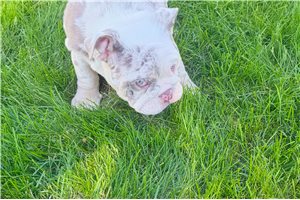
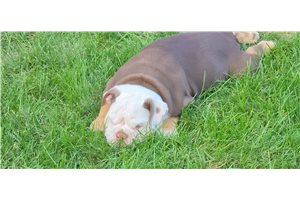
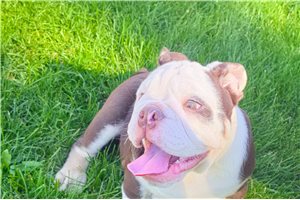
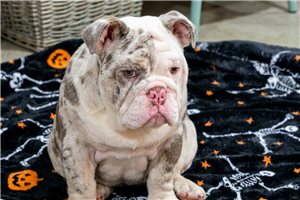
People fall for the Boxer's bounce: a playful, clownish dog that wants a part in everything its family does. Behind the fun is a watchful, fearless guardian that is patient with children and deeply attached to its people.
People fall for the Boxer's bounce: a playful, clownish dog that wants a part in everything its family does. Behind the fun is a watchful, fearless guardian...People fall for the Boxer's bounce: a playful, clownish dog that wants a part in everything its family does. Behind the fun is a watchful, fearless guardian that is patient with children and deeply attached to its people.
Only with Pawrade, you receive a pet insurance policy with no waiting period included for immediate accident or illness coverage. *NH, NY, RI, SC and TN residents excluded
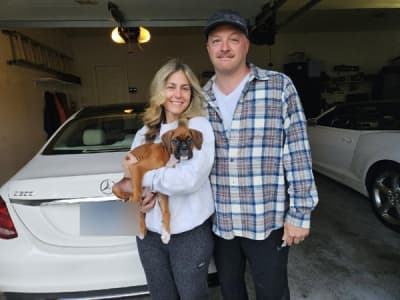
“We had a great experience with the delivery of Jaiden our new boxer! The management team that took us through the whole process did a great job and delivered Jaiden before scheduled! Thank you for everything and Merry Christmas to everyone from Jay , Ya ya and Jaiden!”
Melina · Boxer
May 19, 2025
“Communication was excellent. Someone was around 24/7 for any questions. The check off packet was a great help too. Everything was planned in a timely manner & the Andrew & Garett were the best!! Thank you for Melina now “Izabella”, Izzy for short. She’s the best!!”
Luke · Boxer
Mar 25, 2026
“Outstanding service from start to finish, great communication and made me feel very comfortable and confident about my puppy”
Puppy scams cost U.S. families millions every year. Here's how you know Pawrade isn't one: we're a named, audited business with a public track record you can check anywhere.
Pawrade data: parents of puppies placed through Pawrade (breeder-reported)
Height
21–25 in
Lifespan
10–12 years
Energy
High
Shedding
Moderate
Group
Working
AKC
Boxer Characteristics
Full-Grown Size
4 of 7SmallLarge
Grooming Needs
1 of 7SeldomRegularly
Good with Dogs
3 of 7Not ReallyYes!
Watchdog Ability
3 of 7LowHigh
Exercise Needs
3 of 7Couch PotatoHigh Needs
Your new best friend.
Boxer temperament
Personality and daily life
At home
A Boxer wants to be in the middle of family life. Its wish for human affection is the breed's defining trait, and a Boxer is happiest living as part of the family. At home it is playful and full of fun, yet alert, dignified and self-assured, and fearless if threatened.
Kids and other pets
Boxers are good with children, patient and protective. Their bouncy play can knock over a small child or a frail adult, so supervise play. With strangers they are watchful and wary at first. Yet they respond to friendly approaches and can tell a friend from an intruder, which makes them natural watchdogs.
Boxers are high-energy dogs, and puppies are the busiest of all. Plan on more than 2 hours of exercise and play every day.
Training and play
Boxers are smart and quick to learn, but they are independent-minded and get bored with repetition. Short, varied sessions with tasty food rewards work best, while a hard hand or endless drilling backfires. Make a reliable Stay and Come the first priority. Boxers compete in obedience, rally and agility, and some also work as therapy dogs.
Squinting or tearing needs a prompt vet visit, because Boxers can get a slow-healing sore on the eye called the Boxer ulcer.
Skin changesMention skin changes
Check the skin every month, and mention any new lump to your vet so it can be sampled.
Joints and movementGo easy while growing
Keep a growing puppy lean, with no forced exercise until its bones finish growing, to protect the hips.
Heart checksKnow when to call
Fainting or tiring quickly can point to ARVC (arrhythmogenic right ventricular cardiomyopathy), a heart-rhythm problem, and needs a vet visit.
Heart checksRoutine vet checks
Book a yearly heart check that includes a heart-rhythm recording (Holter) once your Boxer is grown.
Every milestone, together.
Boxer puppy milestones
Growing up: your Boxer's first two years
Before 8 weeks
Before your puppy comes home
Your puppy is still with its breeder, so use the time to get your home ready for a busy, curious young Boxer.
Choose a crate big enough for your puppy to stand, turn and stretch, with no wire mesh its head can slip through.
Put the crate in a warm room where the family spends time, or in your bedroom at night.
Walk the fence line and check every screen door, since a Boxer should never get loose.
Book a first vet visit for the week your puppy arrives, and plan to ask the vet to listen to the heart.
Why it matters
Boxers can be escape artists even from fenced yards, so a secure home from day one keeps your puppy safe.
Boxer note
Most Boxer puppies on Pawrade go home at about 11 weeks, so start this stage whenever yours arrives.
8–10 weeks
The first week home
Everything is new, and a crate set up as a safe den gives your puppy somewhere calm to rest. Boxers are clean dogs that usually take to potty training quickly.
Take your puppy out first thing in the morning, last thing at night and after every nap.
Go out again 5 to 15 minutes after it eats, drinks or plays, and praise it when it goes.
Handle the muzzle and feet every day, and start brushing the teeth while your puppy is small.
At the first vet visit, ask the vet to listen to the heart, and ask about a hearing check for a white or mostly white puppy.
Why it matters
A steady routine teaches your puppy where to go and makes later vet visits and grooming easier.
Boxer note
White Boxers are more likely to be deaf in one or both ears, so an early hearing check is worth asking for.
10–12 weeks
Weeks 2 to 4
The first 3 months are the most important time for a puppy to learn that new people, places, animals and things are safe. For a Boxer, good early experiences also help channel its energy and protective streak.
Introduce your puppy to many kinds of people and friendly animals, and keep each meeting short and happy.
Sign up for a puppy class, which can start as early as 7–8 weeks, and keep away from sick dogs.
Teach sit and come with tiny food rewards, in sessions of just a few minutes.
Why it matters
Boxers are watchful with strangers, and good early experiences help a young Boxer tell a friend from a real threat.
Boxer note
Boxers get bored with repetition, so change the game often and stop while your puppy still wants more.
3–4 months
3 to 4 months
The vaccine series usually finishes at about 16 weeks, as your vet advises. Bladder control is growing too: a puppy can usually hold it about an hour for each month of age, so a 3-month-old can wait about 3 hours.
Keep every vaccine appointment your vet sets, because your own vet completes the series that began before your puppy came home.
Stretch the time between potty trips slowly, and still go straight out after meals, naps and play.
Practice Stay and Come in the house and yard every day, with a treat each time your puppy gets it right.
Why it matters
A reliable Stay and Come comes first for a Boxer, because some are escape artists even from fenced yards.
Boxer note
Most Boxers are fully house-trained by about 1 year old, so the odd accident now is normal.
4–6 months
4 to 6 months
Teething is in full swing: baby teeth start to fall out from about 12 weeks, and by about 6 months the adult teeth are in. Chewing is strongest while the teeth change.
Keep only a few chew toys out at a time and rotate them, and hand one over whenever your puppy starts on a hand or chair leg.
Keep brushing the teeth daily, and ask your vet to check for any baby tooth that has not fallen out.
Keep your puppy lean, skip forced exercise, and have any limping checked by your vet.
Why it matters
A lean puppy that is not pushed too hard puts less strain on hips and elbows that are still forming.
Boxer note
In Boxers, hip and elbow trouble usually first shows as limping between 4 months and a year.
6–12 months
6 to 12 months
Adolescence usually starts at about 6–8 months. Your Boxer may test boundaries and seem to forget its training, which is a normal phase.
Keep the house rules the same and training sessions short and varied, with high-value food rewards and plenty of exercise.
Talk with your vet about if and when to spay or neuter, and about anesthesia for your own dog.
Save hard running and jumping for later, because the growth plates do not close until about 18 months.
Call your vet about bloody diarrhea with mucus, which in young Boxers can be a bowel inflammation called granulomatous colitis.
Why it matters
Boxers do not tolerate a hard hand, so patience and rewards get far better results than force at this age.
1–2 years
1 to 2 years
Adolescence winds down, and most dogs are fully grown by about 2 years. From 12 months, a yearly heart-rhythm recording, called a Holter, helps catch rhythm problems early.
Once the joints are grown, try a sport such as obedience, rally, agility, tracking or dock diving.
Keep up the daily exercise, weekly brushing and regular tooth brushing that suit the breed for life.
Book a vet exam at least once a year that checks the heart, eyes, thyroid and skin.
Why it matters
Heart and skin problems in Boxers are easier to manage when they are found early.
Boxer note
If a murmur was heard earlier, your vet may suggest a heart scan (echocardiogram) as your Boxer reaches adulthood.
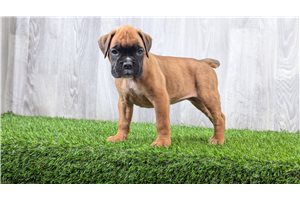
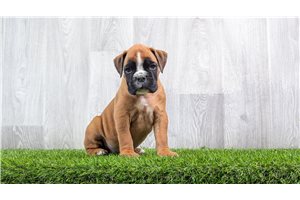
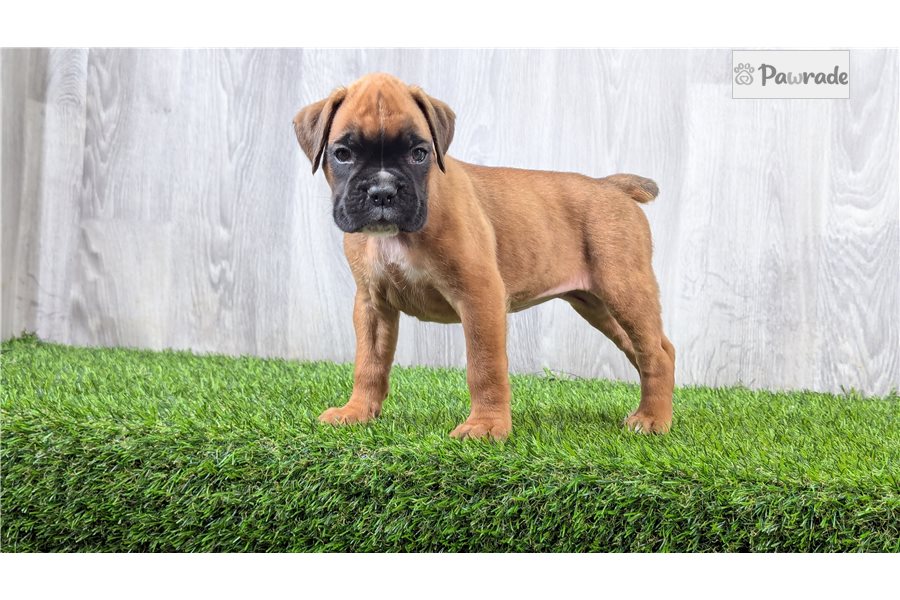
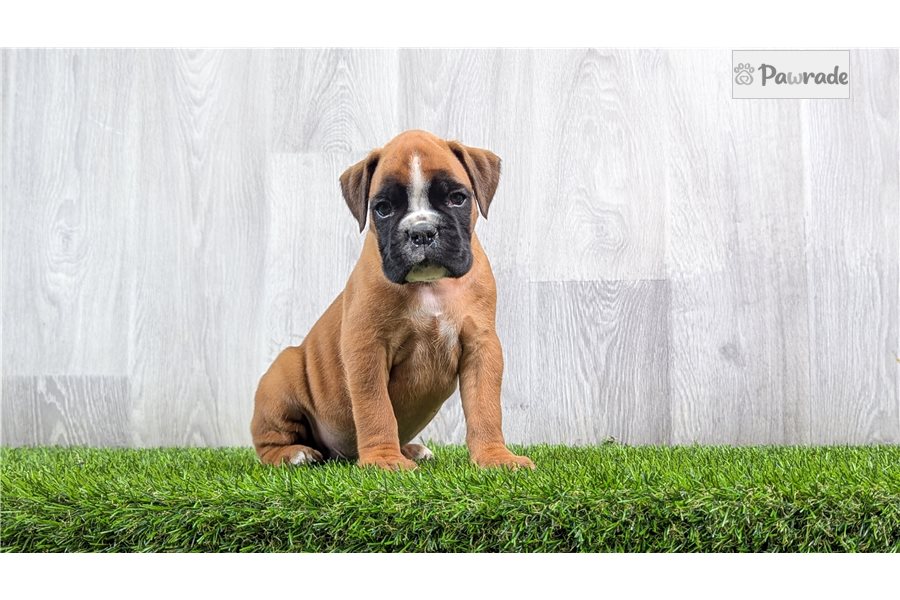
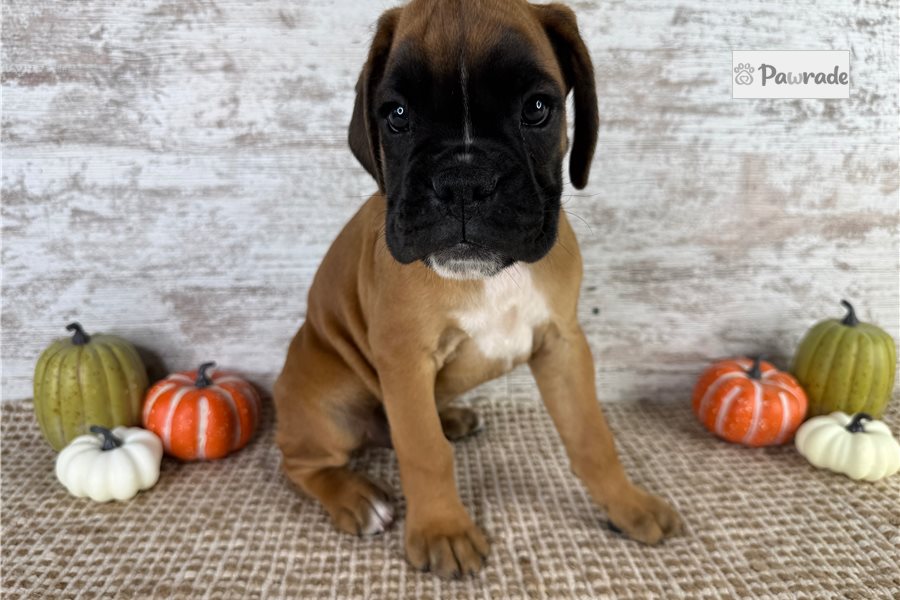
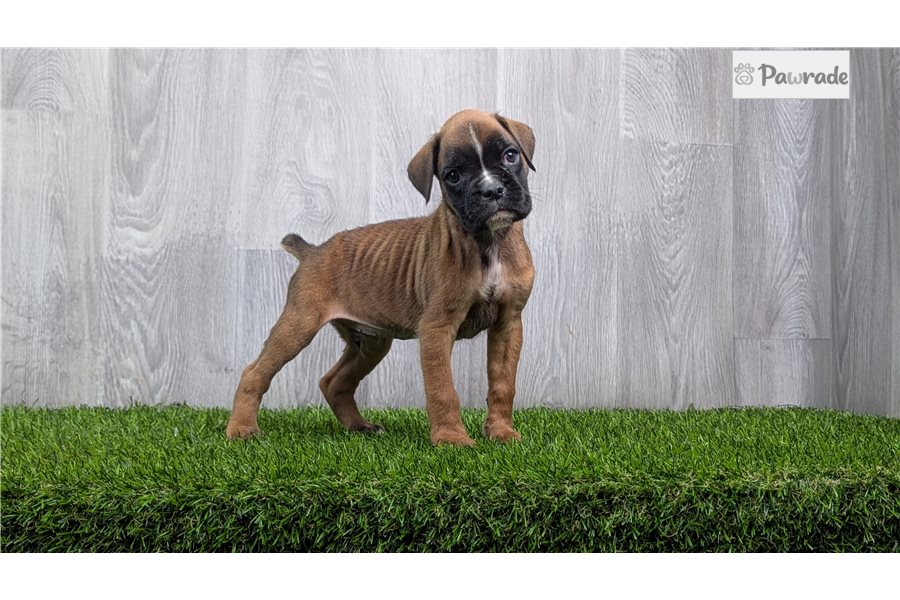
The Boxer is square-built, with a short back, strong legs and a deep chest. Its broad, blunt muzzle is the breed's hallmark. The bite is undershot, with the lower jaw reaching past the upper. Ears are often cropped in the US, but natural ears are allowed. In the US, tails are usually docked, while the UKC and the World Canine Organization (FCI) accept natural ears and tails. There are no miniature or giant Boxers: the standard describes one size.
Colors and coat
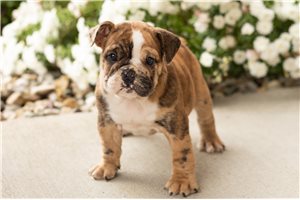
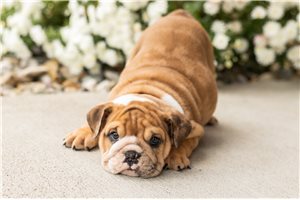
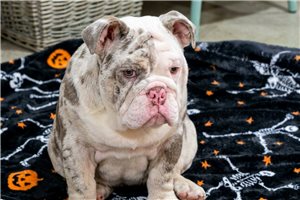
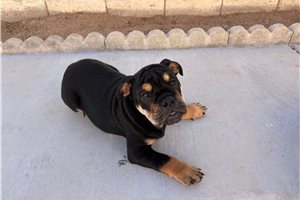
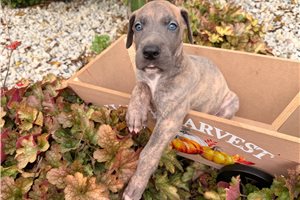
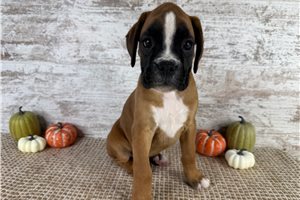
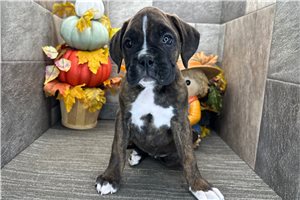
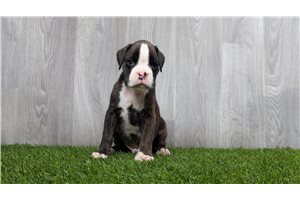
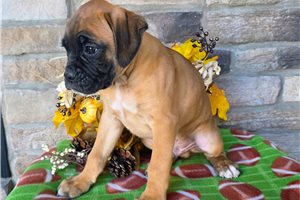
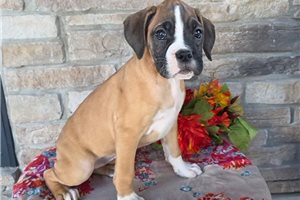
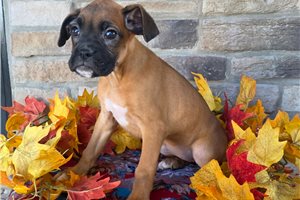
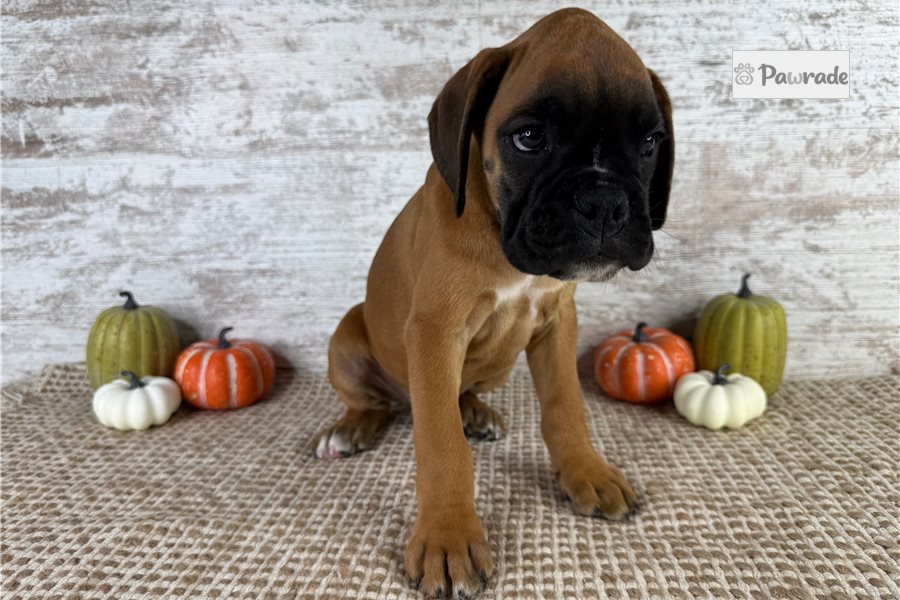
The AKC standard colors are fawn, from light tan to mahogany, and brindle, which is black striping on fawn. Both come with a black mask, with or without white markings covering up to a third of the coat. A heavily striped brindle can look almost black, a look often called reverse brindle. White or mostly white ("check") Boxers are outside the AKC breed standard; they can receive AKC limited registration and compete in performance events.
Colors listed by Pawrade breeders
Brindle
Fawn
Flashy Brindle
Flashy Fawn
Flashy Sealed Brindle
Sealed Brindle
White
Keeping your Boxer healthy
Boxers are known to be prone to a handful of conditions, including two heart problems, and everyday care with regular checkups catches most of them early.
A little history, a lot of heart.
Boxer history
History and fun facts
before the 19th century
The Boxer descends from the Bullenbeisser, a German hunting mastiff that seized and held boar, bear and deer until the hunter arrived.
Later the dogs worked for butchers and cattle dealers and as guards.
1895
Fanciers formed a Boxer club in Munich in 1895, wrote the first standard and held the first Boxer show.
1904
The AKC recognized the breed in 1904.
But Boxers became established in the US only with imports after World War I.
1930s
Their popularity grew in the late 1930s and again after the Second World War.
Four German imports known as the Four Horsemen, led by Sigurd v. Dom, shaped the American lines.
1935
The American Boxer Club, founded in 1935, is the breed's AKC parent club.
World Wars I and II
Boxers served as military dogs, including couriers and guards, in both World Wars.
Their easy trainability once put them in the circus.
1947–1970
Four Boxers have won Best in Show at Westminster, in 1947, 1949, 1951 and 1970.
The name is an English word, commonly said to come from the way Boxers spar with their front paws.
Checked with care before travel.
Boxer Veterinary Health Report
Your puppy's Veterinary Health Report
Before your Boxer puppy comes home, the breeder's licensed vet gives it a full hands-on exam to PetPay's exam standards, and the results go into its Veterinary Health Report.
The exam, a health certificate and a stool test for parasites all happen 3 to 5 days before your puppy leaves.
1It is a check of your own puppy, not paperwork about its family, so you start with a clear record of how your puppy is doing.
2If the vet finds something that could put your puppy at risk during travel, your puppy stays with the breeder until it's resolved.
3Problems that can be treated before travel are treated by the breeder's licensed vet first.
4Anything else the vet notes is shared with you.
5A hard copy of the report travels with your puppy for your records, and a digital copy is in your PetPay account.
Puppies must be at least 8 weeks old and weigh at least 2 lb before they travel. Every Pawrade puppy also comes with a health guarantee administered by PetPay, independent of the seller. The terms are on the health guarantee page.
A Boxer puppy's price reflects what goes into it: its pedigree and registration, its coat and color, and the breeder's program. Every Pawrade puppy's price also includes the pre-travel exam by the breeder's licensed vet, the Veterinary Health Report and a health guarantee administered by PetPay. See today's price range for Boxer puppies on Pawrade's Boxer listings.
Adult Boxers weigh 50–80 lb and stand 21–25 in tall. Parents of Pawrade Boxers typically weigh 60–89 lb (fathers) and 45–70 lb (mothers).
Males are bigger, at about 65–80 lb and 22–25 in tall, against 50–65 lb and 21–23.5 in for females.
There are no miniature or giant Boxers, and the breed standard describes one medium size.
The AKC standard colors are fawn, from light tan to mahogany, and brindle, with a black mask and with or without white markings. A heavily striped brindle can look almost black, and white or mostly white Boxers are outside the AKC breed standard.
Not all, but white Boxers are at increased risk of deafness in one or both ears, so a hearing check is worthwhile. A white coat is outside the AKC breed standard, but a white Boxer can receive AKC limited registration and compete in performance events. Its unpigmented skin also needs protection from strong sun.
In US practice, tails are usually docked within a few days of birth, and front dewclaws may be removed. Boxers have no rear dewclaws. Ear cropping is common in the US but not required: the AKC standard allows natural ears, and the UKC and FCI standards accept natural ears and tails.
Boxers are alert, dignified and self-assured, and playful with their families. They are high-energy dogs, and puppies are especially active, so daily exercise and play are a must.
Boxers are strongly people-oriented, and their wish for human affection is the breed's defining trait.
Boxers are alert watchdogs with a strong instinct to protect their family. They are wary of strangers but can tell a friend from an intruder, and they respond to friendly approaches.
Boxers take part in therapy dog work, including the AKC Therapy Dog program. The breed also has a long working record, including courier and guard duty in both World Wars.
Boxers are good with children, patient and protective. Their bouncy play can knock over small children, so supervise play with toddlers. Boxer breeders on Pawrade report socializing 76% of their litters with older children and 73% with younger children.
Early socialization is the key, so introduce a Boxer puppy to many people and animals and join a puppy class early. Breeders on Pawrade report socializing 83% of Boxer litters with large-breed dogs before the puppies go home. Nearly half of Boxer buyers on Pawrade already have another dog at home.
A Boxer needs exercise every day, more than 2 hours of activity and play in all. Mix walks with play and short training games, because a bored Boxer finds its own entertainment.
They handle neither well, because the short muzzle makes Boxers sensitive to heat and the very short coat gives little warmth. Avoid long spells in heat and sun, keep exercise for the cooler hours, and use a dog coat in cold weather.
Not for long stretches, because Boxers are people-oriented and happiest with their family. A crate makes a safe den, but keep crate time to about 4 hours at a stretch, and remember that boredom can turn destructive.
It can work, but it is not the easiest fit, because Boxers need plenty of daily exercise and room to move. Almost all Boxer buyers on Pawrade have a yard.
A Boxer should never run loose, so it needs a securely fenced yard or a leash. Some are escape artists even from fenced yards, so check the fence and screen doors and train a reliable recall.
Hard running and jumping should wait until the growth plates close, at about 18 months. Growth plates in a puppy's legs stay soft while it grows, and strenuous exercise can hurt them. Until then, keep your puppy lean and stick to free play and easy walks rather than forced exercise.
Boxers shed moderately all year, and no dog is truly hypoallergenic. A short coat does not make a dog allergy-friendly: Boxers shed and drool.
A Boxer needs little grooming, just a weekly brush, a bath now and then and regular nail trims. Boxers tend to keep themselves clean, and their teeth need brushing often.
Boxers are intelligent and quick to learn, but independent-minded, so the right approach matters. Use high-value food rewards in short, varied sessions, because harsh handling and endless repetition backfire.
Boxers are clean dogs that usually take to potty training quickly, and a crate helps. Take the puppy out 5 to 15 minutes after meals, drinks, naps and play. Most are fully house-trained by about 1 year old. Breeders on Pawrade report whether they have started crate training, so ask how far your puppy has got.
A Boxer puppy can usually hold its bladder for about an hour for each month of age, so a 3-month-old can wait about 3 hours. Take young puppies out first thing in the morning, last thing at night and after naps. Boxers also need to go out 5 to 15 minutes after eating, drinking or play.
Adolescence usually starts at about 6–8 months, and many dogs test boundaries and seem to forget their training for a while. It is a normal phase, and consistent training, patience and plenty of exercise help. Boxers do not tolerate a hard hand, so stick to short sessions with high-value food rewards.
Boxers compete in AKC obedience, rally, agility, tracking and herding events, and in lure coursing. They also take part in dock diving, barn hunt, nose work and carting.
Puppies travel only once they are at least 8 weeks old and weigh at least 2 lb. Most Boxer puppies go home at about 11 weeks, usually between 9 and 18 weeks.
Boxer breeders on Pawrade report a typical litter of 6 puppies, usually between 3 and 8.
Set up a crate the puppy can stand, turn and stretch in, check fences and screen doors, and plan to keep the puppy warm. Book a first vet visit and ask the vet to listen to the heart.
Start the day your puppy comes home, because the first 3 months are the most important time for learning that new people, places and animals are safe. Puppy classes can start as early as 7–8 weeks, as long as your puppy stays away from sick dogs. For a Boxer, early socialization also helps channel the breed's energy and protective streak.
Most Boxer litters on Pawrade meet other dogs and children before the puppies go home. Breeders report socializing 83% of litters with large-breed dogs, 76% with older children and 73% with younger children. These figures come from what breeders reported for 267 litters. Keep introducing new people and animals once your puppy is home, because early socialization helps channel the breed's energy.
Spaying or neutering is a decision to talk through with your vet, because the right timing depends on things like sex and expected adult size. Ask about anesthesia for your own dog at the same visit.
The puppy vaccine series usually finishes at about 16 weeks, as your vet advises. Your puppy's vaccination and deworming records are separate documents that travel with your puppy. Bring them, with the Veterinary Health Report, to your first visit so your vet starts from the same record. Puppy classes can still start before then, as long as your puppy stays away from sick dogs.
The Veterinary Health Report is the record of your Boxer puppy's exam before it goes home. The breeder's licensed vet gives the puppy itself a full hands-on exam to PetPay's standards and writes down what they find. It gives you and your own vet a clear starting point for your puppy's care.
The breeder's licensed veterinarian examines every puppy before it goes home, to PetPay's exam standards. The results are recorded in the puppy's Veterinary Health Report, and a copy travels with your puppy for your records.
The breeder's vet examines the whole puppy and pays close attention to a few things that matter in Boxers. The vet listens to the heart for a murmur, checks the bite and teeth, and checks how a white or mostly white puppy responds to sound.
Before travel, every puppy follows PetPay's vaccination and deworming schedule as far as its age allows: deworming at 2, 4, 6, 8, 10 and 12 weeks, and the distemper, parvo, adenovirus and parainfluenza combination shot at 6–8, 9–11 and 12–14 weeks. Bordetella and corona are given at the vet's discretion, and no vaccine is given within 3 days of travel. Rabies is given by a licensed vet on the schedule your state requires. Your own vet completes the series. Your puppy's vaccination and deworming records are separate documents that travel with your puppy. Bring them, with the Veterinary Health Report, to your first visit so your vet starts from the same record.
If the vet finds something that could put your puppy at risk during travel, your puppy stays with the breeder until it's resolved. Problems that can be treated before travel are treated by the breeder's licensed vet first. Anything else the vet notes is shared with you.
Puppies grow and change quickly, and their immune systems are still developing, so no single exam can find everything. In Boxers, the heart-rhythm problem ARVC and degenerative myelopathy start in adulthood, and some murmurs are heard only as a puppy grows. The report is a strong early look at your puppy, and your own vet builds on it at every checkup.
Boxer buyers rate their Pawrade experience 4.7 out of 5 on average, from 234 reviews, and about 80% of those reviews give 5 stars.
Right now, most Boxer puppies on Pawrade are listed within the typical range shown on Pawrade's Boxer listings. Each breeder on Pawrade sets their own price, and each puppy's listing shows it. A Boxer puppy's price reflects what goes into it: its pedigree and registration, its coat and color, and the breeder's program. Every Pawrade puppy's price also includes the pre-travel exam by the breeder's licensed vet, the Veterinary Health Report and a health guarantee administered by PetPay.









 Boxer note