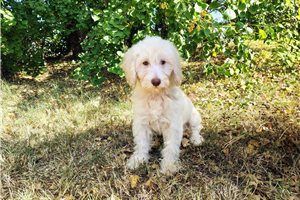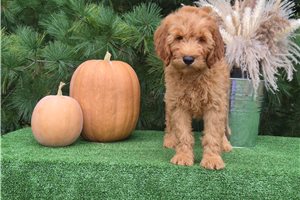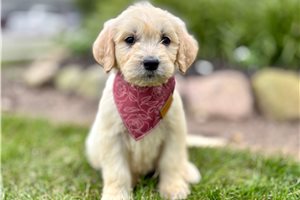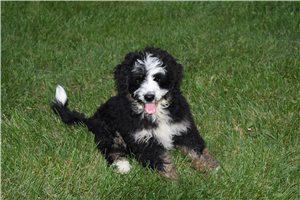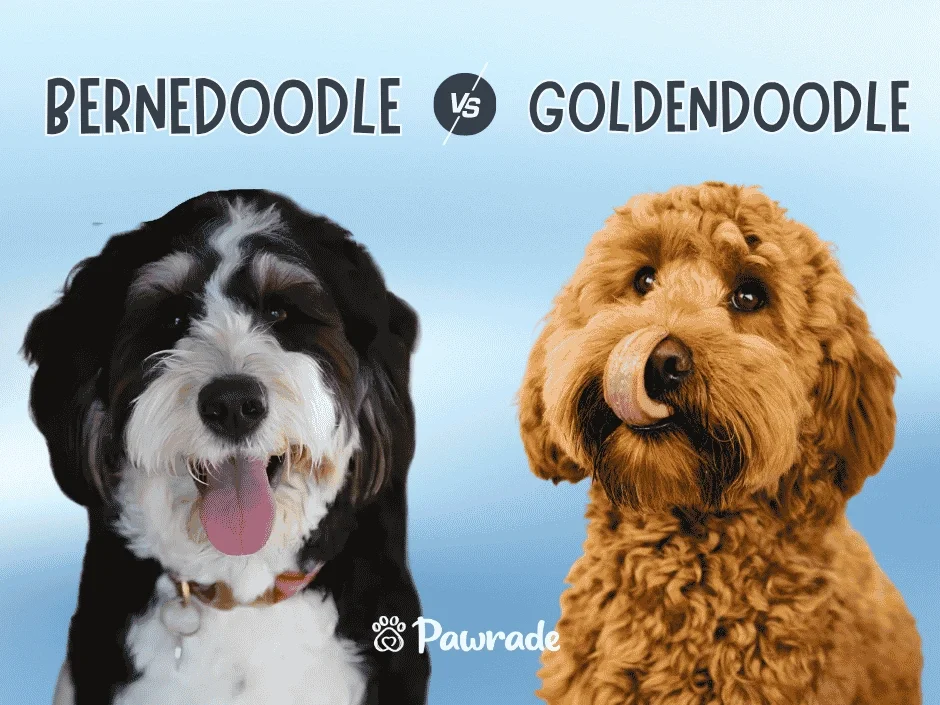
The Goldendoodle vs. Bernedoodle comparison trips people up because both breeds look so similar on the surface, but temperament, energy levels, health concerns, and size differences affect the kind of daily life each breed genuinely thrives in. Pawrade has matched thousands of families with puppies from screened breeders for both breeds, so here is a reliable answer: the right choice almost always comes down to which household the dog fits, not which one looks better in a comparison chart.
Differences Between a Bernedoodle and a Goldendoodle
A Bernedoodle is a cross between a Bernese Mountain Dog and a Poodle. A Goldendoodle is a cross between a Golden Retriever and a Poodle. The difference in the non-Poodle parent explains most differences between these doodles, and understanding what each parent breed was bred to do makes the rest of the comparison much easier to follow.
The Goldendoodle emerged in the early 1990s when breeders began crossing Golden Retrievers, one of the most recognized and popular breeds in the country, with Poodles to create a social, loving family dog with a lower-shedding coat. The Golden Retriever's people-first personality helped create a breed that greets nearly everyone like a long-lost friend and is genuinely eager to please. The Bernedoodle came later, developed in 2003 by Sherry Rupke, who wanted to combine the Bernese Mountain Dog's loyal, gentle nature with the Poodle's intelligence and reduced-shedding coat. If the Goldendoodle was designed to be broadly social, the Bernedoodle was built to bond deeply with its main family unit.
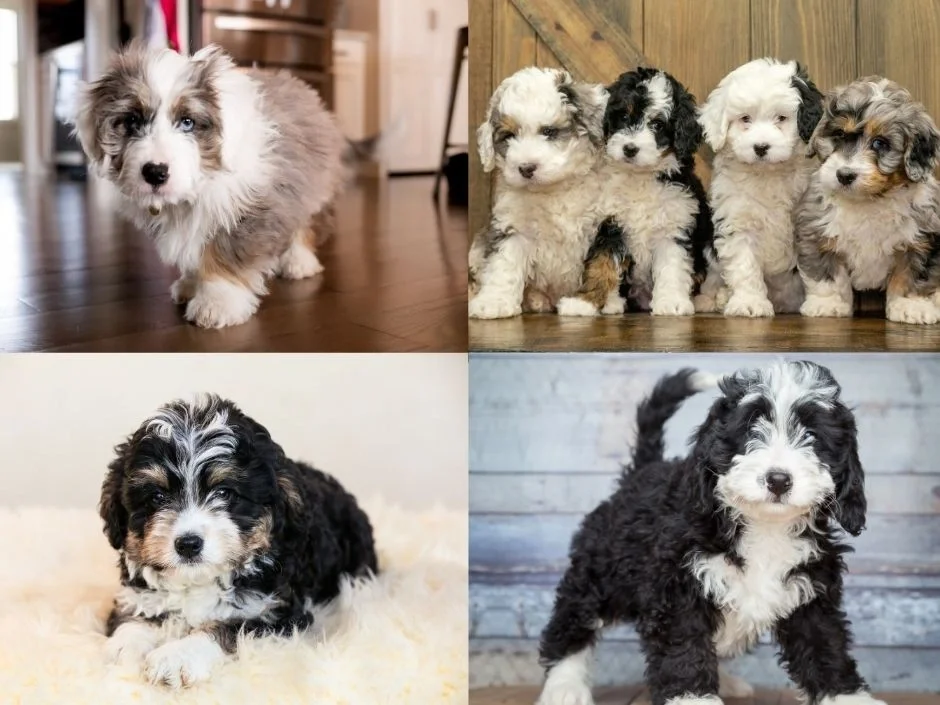
Both breeds have moved well past novelty status. The world of doodle dogs has grown immensely in popularity with no signs of slowing down, as Poodles are now mixed with many breeds to achieve a more hypoallergenic coat. Doodles are now the topic of national breeder conferences, specialized training programs, and discussions between first time dog owners that span every region of the country. Rover's 2025 breed popularity report confirms that Bernedoodles have graduated from trending breed to household staple, while Goldendoodles remain among the most sought-after dogs in the US.
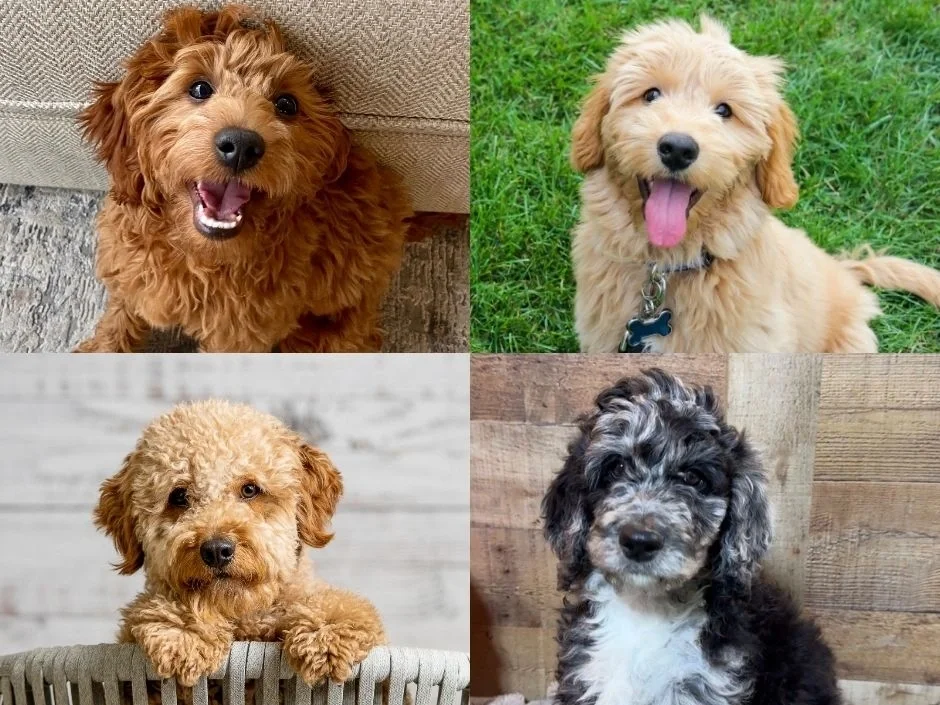
Here is how the two breeds compare at a glance:
|
Feature |
Bernedoodle |
Goldendoodle |
|
Parent breeds |
Bernese Mountain Dog and Poodle |
Golden Retriever and Poodle |
|
Introduced |
2003 |
Early 1990s |
|
Typical build |
Generally larger; standard, medium, and mini variants |
More compact on average; standard, medium, mini, and toy variants |
|
Common coat colors |
Tricolor (black, white, and brown); also solid or bicolor |
Golden, cream, apricot, or red; occasionally darker shades |
|
Energy level |
Moderate, more relaxed |
Higher energy and more social |
|
Starting price from reputable breeders |
Higher range, depending on colors, lineage, and health |
More affordable entry price, due to popularity and fewer coat variations |
|
Temperament tendency |
Loyal and calm; deeply bonded with family |
Outgoing and social; warm with nearly everyone |
The size and coat differences in that table are workable for most households. The temperament and price range are often where the real decision is made.
Are Bernedoodles Calmer Than Goldendoodles?
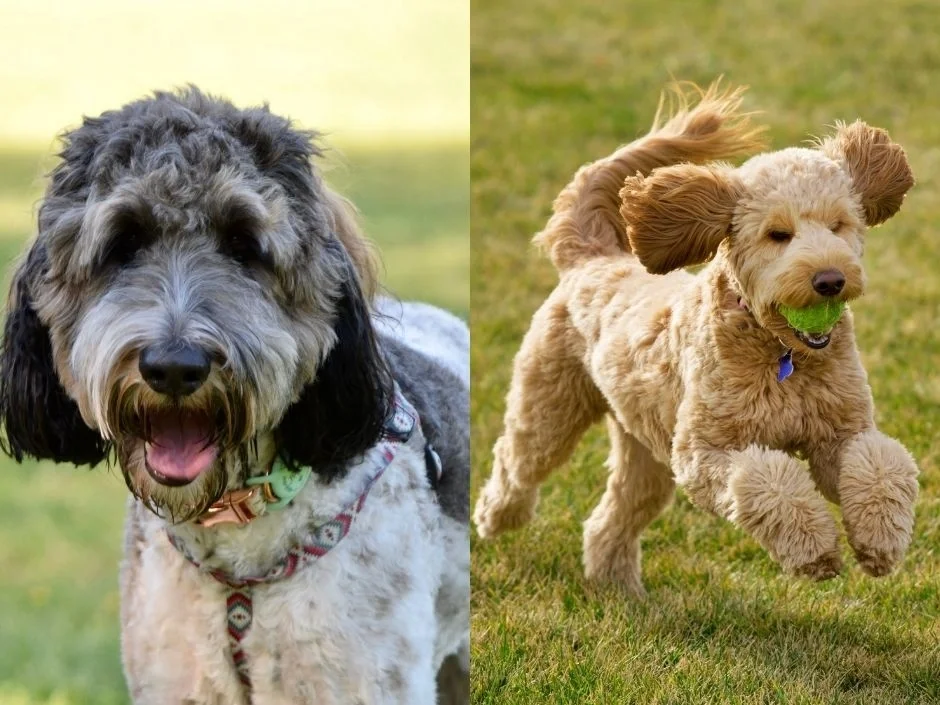
Yes, in general, Bernedoodles tend to have a calmer baseline energy level than Goldendoodles. Equally as important is how each breed relates to the people around them, and that distinction shapes daily life more than energy level alone.
The Goldendoodle inherits the Golden Retriever's foundational characteristics: friendly, reliable, and trustworthy. Pair that with the Poodle's social confidence and intelligence, and you get a dog that treats its human encounters as a fun social experiment. Goldendoodles tend to warm up to new visitors within minutes. They thrive in busy households, dog parks, and any environment that brings fresh faces into their orbit.
The Bernedoodle's social style is different. The Bernese Mountain Dog forms deep attachments to its family while remaining naturally reserved with strangers, and that trait carries through in the Bernedoodle. The bond a Bernedoodle forms is strong and devoted. But it extends more selectively to outsiders, especially early on. A well-socialized Bernedoodle is not unfriendly. It simply takes a few minutes to decide you are worth knowing.
Trainability is where the temperament difference matters most for new owners. Golden Retrievers are easy to train because of their kind temperament and eagerness to please, and that is expressed by Goldendoodle behavior. Bernedoodles are just as intelligent, but the Bernese Mountain Dog's working-dog independence can surface as a stubborn streak during adolescence. Positive reinforcement works well for both breeds. With a Bernedoodle, consistency matters more. The Bernese Mountain Dog is an active, intelligent, and loving working breed and those working-dog instincts do not disappear in the crossbreed.
Both breeds are known to be patient with children, tolerant of other animals, and well-suited to family life. The differences are in energy and social orientation, not in character or warmth.
Comparing Size, Coat, and Grooming: What You Are Signing Up For
When browsing doodle puppies for sale, three characteristics should be deeply understood: how different the size ranges between these breeds can be, how shedding changes between “doodle generations”, and how important grooming is throughout your dog’s life.
Standard vs. Mini Doodles
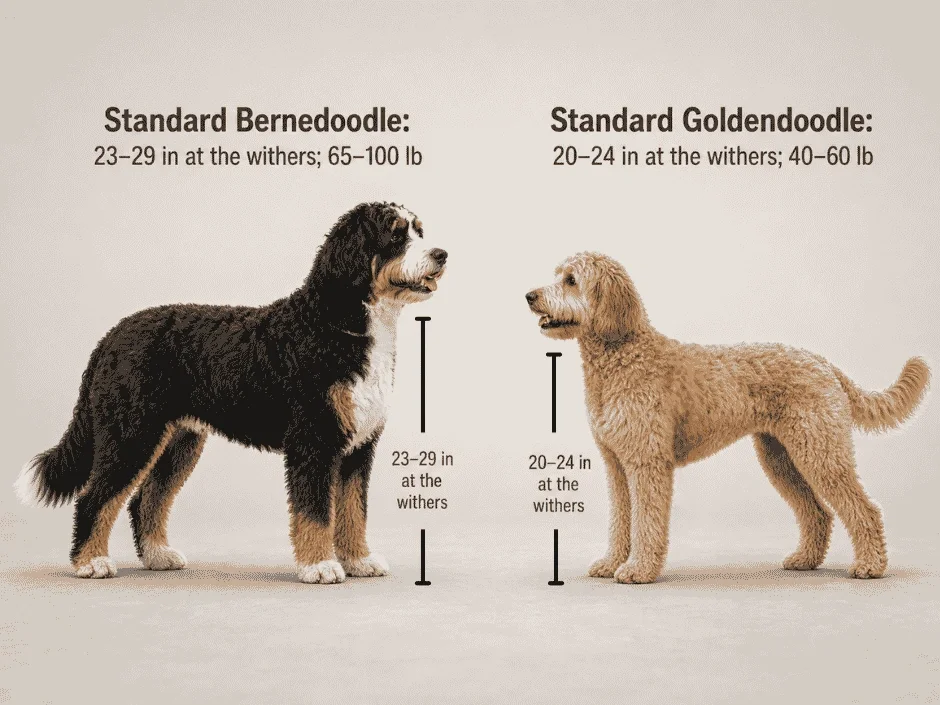
The AKC Bernese Mountain Dog breed standard lists Bernese Mountain Dog dogs between 23 to 27.5 inches tall at the withers and 70-115 pounds based on gender, while AKC Golden Retrievers top out at 23 to 24 inches and 65 to 75 pounds. Those parent breed differences impact the mature, adult weight of the mixed puppies. Standard Bernedoodles commonly reach 23 to 29 inches and 65 to 100 pounds, while standard Goldendoodles typically reach 20 to 24 inches and 40 to 60 pounds.
Both breeds are bred in mini versions that bring the weight down considerably and make smaller living spaces more viable. The more popular of these offspring generations are called F1 and F1B. Breeders breed a miniature poodle or toy poodle sire (father) with a Golden Retriever or Goldendoodle dam (mother) to scale down the size of the puppies in the litter. If size is a real factor in your decision, be specific about which size variant you are comparing before drawing conclusions from a general "Bernedoodle vs Goldendoodle" comparison.
What to expect before owning a Mini Bernedoodle
What to expect before owning a Mini Goldendoodle
Does a Bernedoodle Shed Less Than a Goldendoodle?
Bernedoodles are not guaranteed to be lower-shedding than Goldendoodles, and the honest answer depends more on coat genetics and generation. F1B, F1BB, and F2BB generations of both Bernedoodles and Goldendoodles are the least likely to shed or trigger allergies because those generations carry a higher percentage of Poodle DNA compared to the F1 cross, which is closer to a 50/50 ratio. An F1B at 75% Poodle is expected to be more hypoallergenic, for example, and may behave differently from an F1 at 50%.
Bernese Mountain Dogs are heavier shedders than Golden Retrievers, which means the starting point for a Bernedoodle’s shedding has slightly higher shedding potential. A well-bred Bernedoodle from Poodle-heavy lines, however, is no more likely to shed than a comparable Goldendoodle of the same generation. Ask your breeder about the specific generation and request information about both parent dogs' coat types before making assumptions.
The Grooming Commitment Most Owners Underestimate
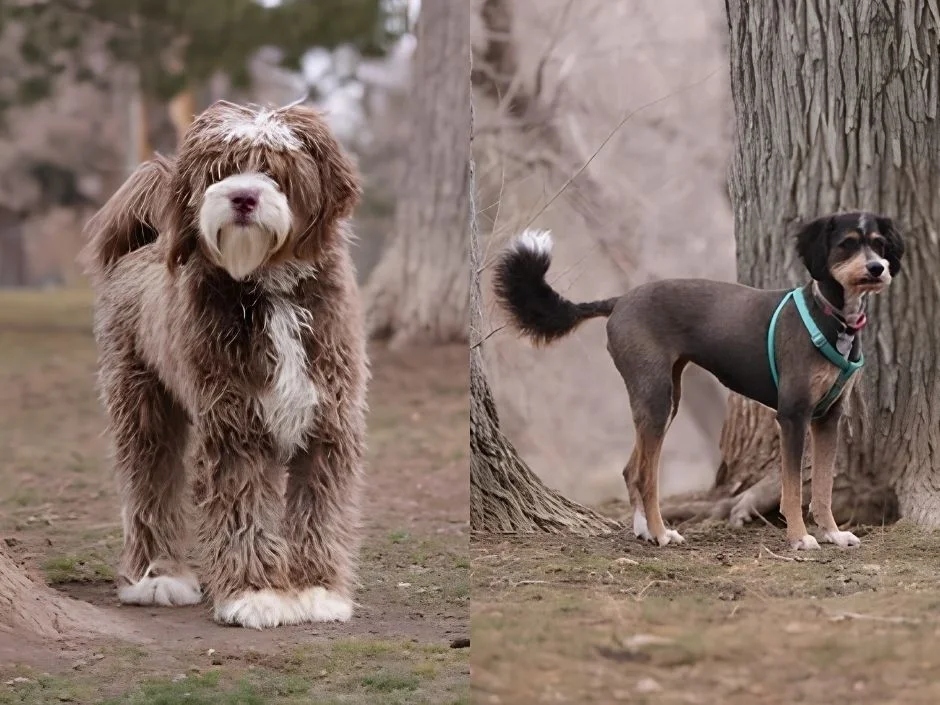
Professional grooming every six to eight weeks is strongly recommended for either breed. Doodle coats are among the most labor-intensive coat types in professional grooming because the curly texture traps shedding hair and mats quickly when brushing lapses. The annual grooming bill for large doodle breeds typically runs between $1,080 and $1,800, and that is even with daily brushing at home.
A doodle's grooming commitment is not a minor add-on. It is a recurring bill that should be part of your budget conversation from day one.
Energy, Exercise, and What Daily Life Looks Like
The energy difference between these two breeds is real and has direct consequences for how well each one fits a given household. It is also the difference most often softened in content that does not want to commit to a clear recommendation.
The Goldendoodle's Need for Active Engagement
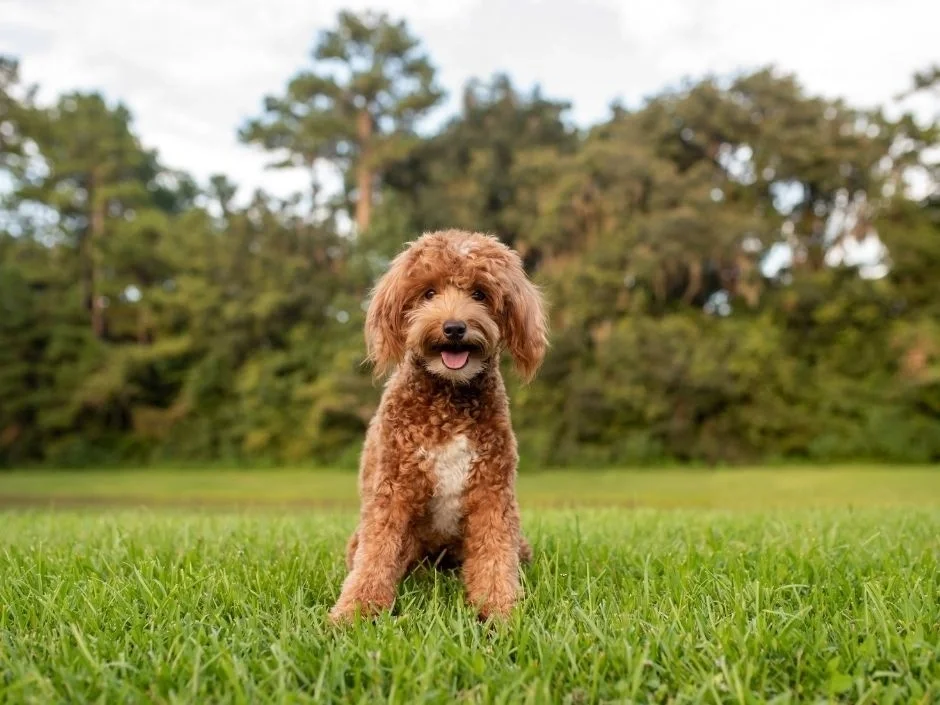
Goldendoodles typically need 60 to 90 minutes of daily exercise to stay physically and behaviorally content. That appetite for movement comes directly from the Golden Retriever side, a breed developed for long days of field work that has never fully lost its need for physical output. A Goldendoodle that gets sufficient exercise is one of the most agreeable dogs you can live with. One that does not tends to redirect that energy toward furniture, shoes, or anything else available.
The Bernedoodle's Flexible Energy Level
Bernedoodles are considerably more adaptable to lower-activity households. Their exercise needs are genuine but more dynamic. A solid daily walk and some active play time will satisfy a Bernedoodle, particularly during the calmer years of their temperament. They also handle cold weather better than most breeds, inheriting the Bernese Mountain Dog's deep tolerance for the kind of conditions that prompt a Goldendoodle to head back inside.
Mini Bernedoodles are particularly well-suited to apartment living. Their calmer indoor presence and less intensive exercise needs make them a reasonable breed in smaller spaces, provided they still get regular outdoor time. A Bernedoodle left without sufficient mental and physical engagement will show it, but the threshold for "enough" tends to be lower than it is for a Goldendoodle in an equivalent situation.
The Right Expectations About Health and Lifespan
This is the section most comparison articles skip, and it is the one that matters most to a buyer making a ten to fifteen year commitment. Neither breed is universally healthier than the other. What separates a well-bred Bernedoodle or Goldendoodle from a poorly-bred one is the health testing the breeder performs on both parent animals before producing the litter.
Do Bernedoodles Have a Higher Cancer Risk?
Golden Retrievers and Bernedoodles both carry an intrinsically high risk of cancer, with studies that suggest 50-60% of both breeds receive a cancer diagnosis in their lifetimes. Peer-reviewed research published through the National Institutes of Health documents that Bernese Mountain Dogs carry an overall cancer incidence of approximately 50%, with about half of those cases attributed to histiocytic sarcoma, an aggressive tumor that is rare in virtually every other breed but strikingly common in Berners. Large-scale epidemiological studies consistently place the Bernese Mountain Dog among the five breeds with the highest proportional mortality from cancer in data spanning multiple countries.
However, the Poodle cross introduces hybrid vigor, also known as heterosis, which is when two animals of the same breed combine their different genetic backgrounds to produce offspring with higher fitness. Responsibly-bred Bernedoodles may outlive purebred Bernese Mountain Dogs by several years. Bernedoodles typically live 12 to 15 years and Goldendoodles 10 to 15 years, and the smaller versions often reach the top of those ranges. The underlying genetic risk from the Bernese side does not disappear with crossbreeding, however. Pet insurance is worth serious consideration for any Bernedoodle, and asking a breeder directly about cancer history in their Bernese Mountain Dog lines is a fair, reasonable question that a trustworthy breeder will welcome.
What Goldendoodle Buyers Should Ask About

Goldendoodles carry their own inherited risk profile. The Golden Retriever side introduces susceptibility to hip dysplasia, certain eye conditions, and cardiac issues, along with a documented cancer predisposition. Neither breed comes with a clean bill of genetic health by default, which is why health testing records on both parent animals are the most important thing a buyer can request before committing.
Cornell University College of Veterinary Medicine explains that OFA hip evaluations require radiographs taken after the dog reaches two years of age, accompanied by a physical examination, because subtle changes in joint conformation cannot be reliably detected from imaging alone. This means any breeder claiming comprehensive hip clearances must have actual OFA records to show, not just a verbal description of the testing they did.
Reading a Breeder's Health Testing Record
Canine hip dysplasia is a polygenic condition with no single genetic test available. The OFA physical evaluation remains the primary screening method, which means you should be looking for documented clearance records, not a generic claim that "parents were health-tested." For Bernedoodle litters, responsible breeding on the Bernese Mountain Dog parent side requires OFA hip evaluation, OFA elbow evaluation, a cardiac clearance, an eye exam by a board-certified ophthalmologist, and degenerative myelopathy DNA testing for the SOD1-A and SOD1-B mutations. The Bernese Mountain Dog Club of America supports these standards through the CHIC health certification program. Ask to see the documentation for both parents. A breeder worth working with will produce it without hesitation.
Comparing Prices of Bernedoodle Puppies and Bernedoodle Puppies
The price gap between Bernedoodles and Goldendoodles ranges per breeder and per region. Bernedoodles from reputable breeders typically cost $2,000 to $5,000, with an average around $3,500. The Bernedoodle's higher starting price reflects the relative scarcity of quality Bernese Mountain Dog lines and the more extensive health testing requirements on the Bernese Mountain Dog parent side, both of which add real breeder cost before a puppy is ever born. Goldendoodles are more accessible, with reputable breeders starting around $1,000 and prices ranging to $3,000 depending on lineage and coat. Golden Retrievers are more widely bred, and that supply dynamic keeps Goldendoodle prices lower without necessarily indicating lower quality.
The purchase price, however, is the smallest part of the total cost picture. The ASPCA estimates annual recurring expenses for large dogs at approximately $1,040 in routine costs, not counting grooming. Rover's 2025 report places annual dog care costs between $1,390 and $5,295 depending on size, care level, and geographic region. For a standard Bernedoodle, lifetime ownership costs can reach $35,000 to $65,000 when food, grooming, veterinary care, and incidentals are tallied across a 12 to 15-year life. Goldendoodle lifetime costs land in a comparable range but generally come in lower due to smaller average size and a more accessible initial price.
Which Doodle Fits Your Life? A Practical Matching Guide
Neither the Goldendoodle nor the Bernedoodle is objectively better. Reframe the question from which is better to which is better for me? The right answer depends entirely on your household, your lifestyle, and what you are prepared to provide day to day. Bernedoodles are better suited for individuals or families seeking a calmer, deeply bonded companion. Goldendoodles are better suited for households that want an outgoing, socially energetic dog who is enthusiastic about everything. Here is how that breaks down across the buyer types we see most often.
If Your Household Is Active and Social
A Goldendoodle is the stronger fit. The combination of high energy, sociability, and warmth towards strangers makes Goldendoodles ideal for families that host guests often, have active older children who want a true playmate, or maintain an outdoor-active lifestyle. Their responsiveness to training also makes them a practical choice for households that want a dog that learns quickly and adjusts to a busy routine.
If Your Household Is Calmer or More Reserved
A Bernedoodle fits more naturally. If your home runs at a lower energy level, perhaps due to the ages of people in the family or simple preferences, if you prefer a dog that chooses its moments rather than operating at full volume all day, or if you want a companion that settles beautifully into quiet evenings, the Bernedoodle will feel like the right match almost immediately.

If You Have Young Children or Seniors at Home
Both breeds are patient and gentle with children and are well-suited to multigenerational households. For households with toddlers or for seniors and less mobile owners, the Bernedoodle's calmer tendencies reduce the risk of accidental knockdowns from an overexcited large dog. For families with older, active children who want a dog that matches their energy and enthusiasm, the Goldendoodle is the better pairing. Supervision remains appropriate with any large-standard dog of either breed simply because of size and enthusiasm.
If You Are a First-Time Dog Owner
The Goldendoodle's trainability and social ease make it the lower-friction choice for someone new to dog ownership. Yet the Bernedoodle’s readiness to bond deeply with its humans are an endearing trait as well. If you are willing to invest in training from the start and enjoy working through the occasional challenge, a Bernedoodle is a fully manageable first dog. If you want an easier early experience, start with a Goldendoodle.

If You Live in a Smaller Space
Mini versions of both breeds can adapt well to apartment living. Mini Bernedoodles carry a slight advantage because of their calmer indoor temperament and more modest daily exercise needs. Either breed in a mini size still needs regular outdoor time, but neither requires a large yard to be satisfied.
How to Find a Reputable Breeder for Goldendoodles and Bernedoodles
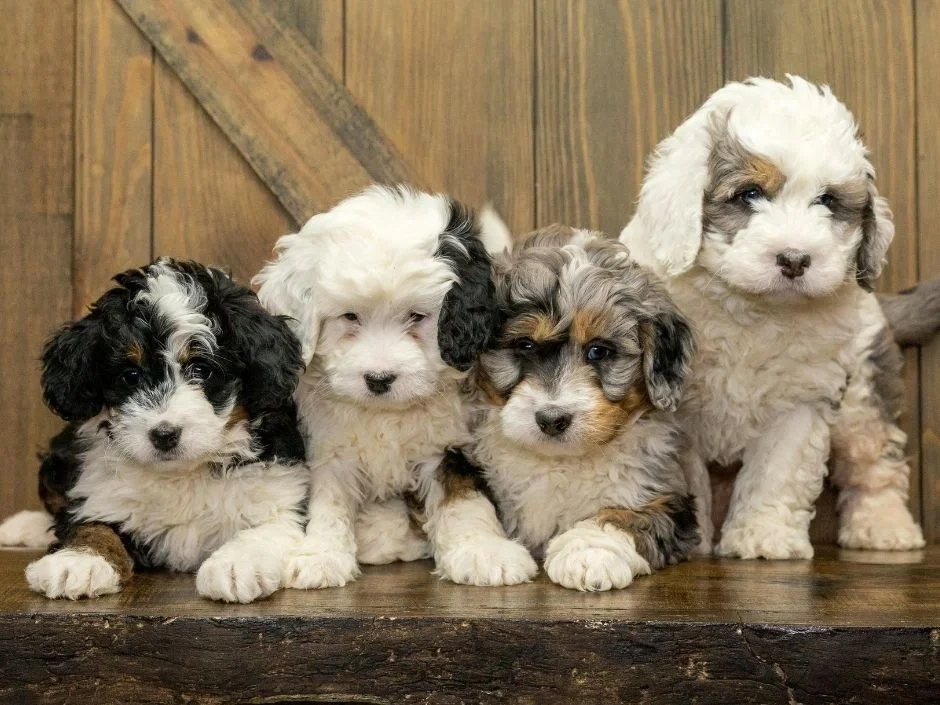
Knowing which breed fits your life is the first decision. Finding a breeder who meets the standard is the harder one, and it is where most buyers go wrong.
Pawrade removes this uncertainty entirely. Every breeder on the platform has been vetted through a comprehensive review process, every puppy comes with a three-year health guarantee, and full concierge support covers the match, the logistics, and the period after your puppy arrives home. The hard work of finding a trustworthy breeder has already been done.
Browse Bernedoodle puppies from screened breeders
Browse Goldendoodle puppies from vetted breeders
Frequently Asked Questions
What is the biggest difference between a Bernedoodle and a Goldendoodle?
The most defining difference is in social orientation. Goldendoodles extend their warmth broadly, greeting nearly everyone, including strangers, with the same open enthusiasm they show their family. Bernedoodles are deeply devoted to their own household but more reserved with people they do not know, taking time to warm up before that bond extends outward. This is not a better-or-worse distinction. It is a temperament style that fits different households differently, and it is the single variable that matters most when deciding which breed belongs in your home.
Are Bernedoodles or Goldendoodles better for families with young children?
Both breeds are gentle with children and patient under pressure, making either a workable choice for family households. For toddlers specifically, the Bernedoodle's calmer energy baseline reduces the chance of an enthusiastic large dog accidentally knocking over a small child during play. For families with older, active kids who want a dog that matches their energy, the Goldendoodle's enthusiasm and high exercise tolerance are assets rather than liabilities. For any large-standard dog of either breed, adult supervision during interactions with very young children is always the right approach, regardless of how gentle the breed tends to be.
Do Bernedoodles shed more than Goldendoodles?
Not categorically, but there is a nuance worth understanding before you buy. Bernese Mountain Dogs are heavier shedders than Golden Retrievers, which means a Bernedoodle with a straighter coat and higher BMD influence can shed more than expected. Asking a breeder specifically about furnishing genes, the genetic markers that produce the low-shedding doodle coat, is the most reliable way to predict what a specific puppy will do. Buyers with genuine allergy concerns should prioritize generation over breed name and seek an F1B or multigenerational puppy from either breed rather than assuming the breed label is a sufficient guarantee.
Is a Bernedoodle easier to train than a Goldendoodle?
Goldendoodles are typically easier for most owners to train because the Golden Retriever's eagerness to please reduces resistance and accelerates learning. Bernedoodles are equally intelligent but the adolescent phase, roughly 8 to 18 months, is when BMD-influenced independence tends to surface most clearly. Short, consistent sessions with clear positive reinforcement work well for both breeds. With a Bernedoodle, avoiding confrontational approaches and building a strong reward relationship early makes a significant difference in how quickly that adolescent independence passes.
Do Bernedoodles cost more than Goldendoodles, and why?
The purchase price gap between a Bernedoodle and a Goldendoodle from reputable breeders typically runs $1,000 to $2,500, though both breeds can exceed $5,000 from specialty or high-demand breeders. The gap is primarily a supply-side phenomenon. Bernese Mountain Dogs are significantly rarer than Golden Retrievers, produce smaller litters on average, and require more comprehensive health testing on the parent side before a responsible breeder will produce a litter. That investment in testing and sourcing quality parent animals flows directly into the puppy price. It is not a branding premium. It reflects what an ethical breeder actually spent.
You have what you need to make a confident choice. If your household runs at a higher energy level, prioritizes social engagement, or is new to dog ownership, the Goldendoodle will likely feel like a natural fit from the first week. If your household is calmer, values deep loyalty over broad sociability, or wants a companion that settles in alongside a quieter routine, the Bernedoodle is worth the higher investment. Both are excellent dogs in the right home.
Pawrade's screened breeder network covers both breeds in standard and mini sizes, with concierge support from the moment you match through the first months of life together.